Egyptian mythology · Gods & goddesses
Min, god of fertility and of the eastern desert roads
In brief
Min is the ithyphallic god of Coptos and Akhmim, master of generative power and patron of the roads running from the Nile to the Red Sea. His festival, the Going Forth of Min, opens the harvest, and his epithet Kamutef, 'bull of his mother', makes him a god who fathers himself.
- generative power and fertility
- harvest and the ripening of the fields
- eastern desert roads and mining expeditions
- renewed kingship
- +4
Who is Min?
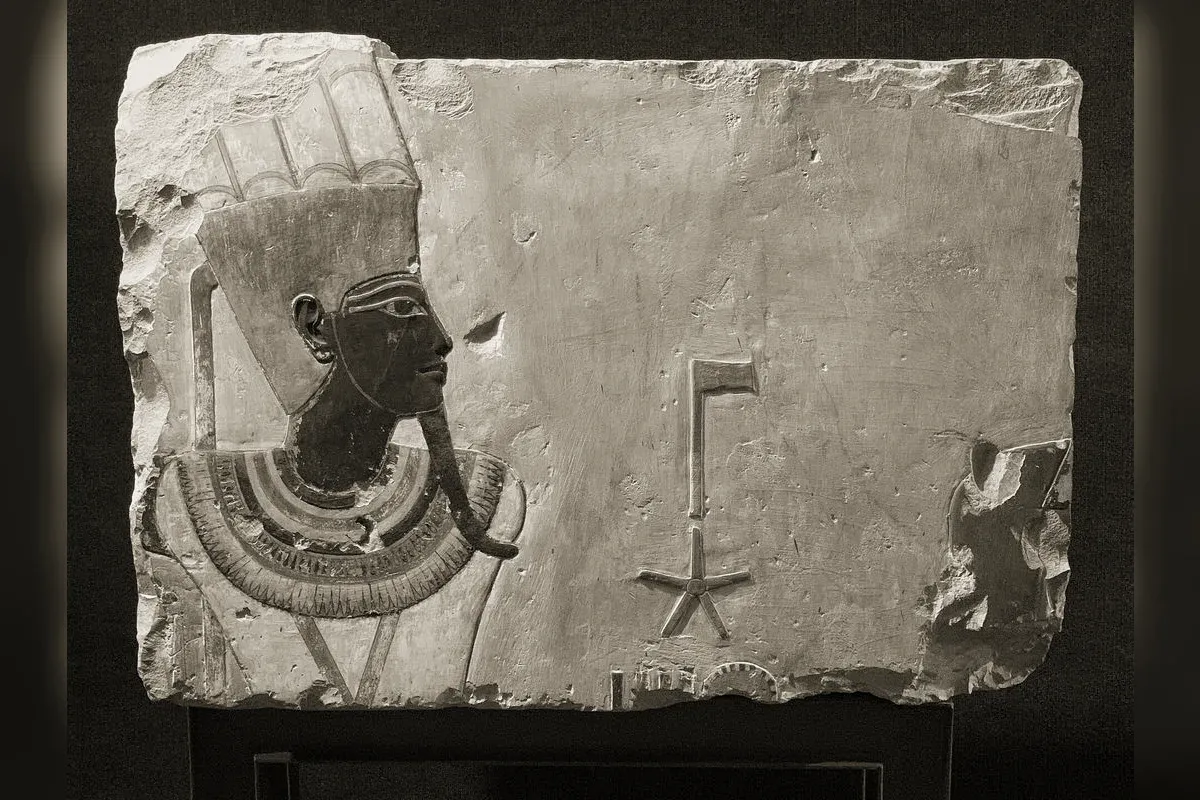
Min is the ithyphallic god of fertility, master of the towns of Coptos (Gebtu) and Akhmim in Upper Egypt. He is shown standing, his body sheathed like a mummy, one arm raised behind his head holding a flail, wearing a tall double-plumed crown, with an erect phallus.
His competence goes well beyond reproduction. From Coptos run the tracks that cross the eastern desert towards the quarries of the Wadi Hammamat and the Red Sea: Min is also the god who protects expeditions and guarantees their return. Fertility of bodies, fertility of fields, profit of caravans — he covers everything that produces a surplus.
A god older than writing
Min is among the very earliest attested Egyptian deities. Excavations at Coptos at the end of the nineteenth century uncovered three heavily eroded colossal limestone statues of the god in his canonical pose. They date to the Predynastic period or the very beginning of the dynasties, and rank among the oldest known monumental sculptures from Egypt.
Min’s iconography, in other words, was fixed before Egyptian theology had organised itself into a system. The great narratives — the cosmogony of Atum, the Osiris myth — took shape around a god who was already there, which explains how hard they later found it to give him a place in any genealogy.
His emblem raises the same problem. The sign that writes his name, an elongated form with a double barb, has never been identified with confidence: a fossil, an arrow, a thunderbolt, a shrine door have all been proposed. Nobody knows what the earliest Egyptians drew there.
Patron of the desert roads
Coptos sits at a strategic point: from it runs the shortest route between the Nile and the Red Sea, following the Wadi Hammamat, whose quarries supplied the greywacke of royal statuary and through which the gold of the eastern desert travelled.
The walls of that wadi are covered in expedition graffiti and stelae: a mission leader, a date, a headcount, a prayer. The god invoked is regularly Min, “master of the eastern foreign lands”. The patronage is not vague: sending several thousand men into a waterless desert was a high-risk operation, and the god of fertility is summoned as the guarantor of their return.
That role makes Min one of the few Egyptian gods explicitly tied to the economy. He protects what pays.
The Going Forth of Min
The god’s great festival, the Going Forth of Min, falls at the beginning of Shemu, the harvest season. The reliefs of the Ramesseum and of Medinet Habu preserve the full sequence, making it one of the best-documented Egyptian ceremonies.
The god’s statue leaves the sanctuary carried on a palanquin by priests, escorted by standard-bearers and by a white bull. The king walks behind. At the climax of the rite, the pharaoh himself cuts a sheaf of emmer with a sickle and presents it to the god: the ruler harvests, publicly, like a farmer.
The gesture is political as much as agricultural. It puts the fertility of the country under the king’s personal responsibility and turns the harvest into an affair of state. Birds are also released towards the four cardinal points to announce the ruler’s renewed vigour — the festival of Min is a festival of regenerated kingship too.
Kamutef, or the god who fathers himself
Min’s most striking epithet is Kamutef, “the bull of his mother”. It means exactly what it says: the god begets upon his own mother the child who is himself. He is therefore his own father, and his cycle needs no outside partner.
The formula solves a real theological problem. How could a god of fertility depend on somebody else in order to exist? Declaring him Kamutef grants him total autonomy. The epithet later passes to Amun when he becomes king of the gods at Thebes: Amun-Min Kamutef is one of the major forms of the Theban god, and it is through Min that the great state god inherits generative power.
It also explains why Min resists genealogy. Local traditions attach him now to Isis as consort at Coptos, now as mother when he is assimilated to Horus under the name Min-Horus, now to the goddess Repyt at Akhmim. These versions are mutually incompatible, and that is precisely the mark of a god who never needed ancestry: every town manufactured one for him.
What the ancient sources say
Min appears as early as the Pyramid Texts and runs through the whole of religious literature without ever receiving a story of his own. Like many very old gods, he is invoked everywhere and narrated nowhere.
The Greeks identified him with Pan and renamed Akhmim Panopolis, “the city of Pan”, a name that held throughout the Graeco-Roman period. Strabo, in book XVII of his Geography, describes the town and its workshops of weavers and stonecutters.
Herodotus stops at Chemmis — the other name of Akhmim — for an unexpected reason: he reports (II, 91) that its inhabitants honour Perseus with Greek-style games, which he presents as an exception in an Egypt otherwise hostile to Hellenic custom. The passage tells us less about the god than about his city, which was already perceived in the fifth century BCE as a point of contact between two worlds.
Further reading
For the Theban god who inherits his epithet and his power, read the page on Amun. For the goddess the Coptos traditions attach to him, see Isis, and for the god he is sometimes merged with, Horus. For another great god of the fertility of soil and water, see Hapi, and for the shaper of living bodies, Khnum.
Ancient sources
- Pyramid Texts
- Coffin Texts
- Expedition graffiti and stelae of the Wadi Hammamat
- Reliefs of the festival of Min, Ramesseum and Medinet Habu
- Herodotus, Histories, II, 91 (Chemmis)
- Strabo, Geography, XVII, 1 (Panopolis)
Frequently asked questions
What is Min the god of?
Min is the god of generative power, of the fertility of fields and herds, and the patron of the roads that link the Nile valley to the Red Sea from Coptos. In Egyptian logic these are one domain rather than two: Min underwrites whatever yields a surplus, the harvest as much as the caravan that comes back loaded.
Why is lettuce offered to Min?
Because the lettuce grown in Egypt is tall and upright, and releases a white latex when cut. The analogy with semen was obvious to Egyptians, who made it the plant of the fertility god. Reliefs show lettuce beds laid out in front of his sanctuaries: the offering was not a figure of speech, it was cultivated on the spot.
Why do Greek sources call Akhmim 'Panopolis'?
Because the Greeks identified Min with Pan, on the strength of his generative character and his links with the wild margins. Akhmim accordingly became Panopolis, the city of Pan, and kept that name throughout the Graeco-Roman period. Strabo describes the town and its weavers and stonecutters in book XVII of his Geography.