Egyptian mythology · Gods & goddesses
Hapi, god of the Nile flood and of abundance
In brief
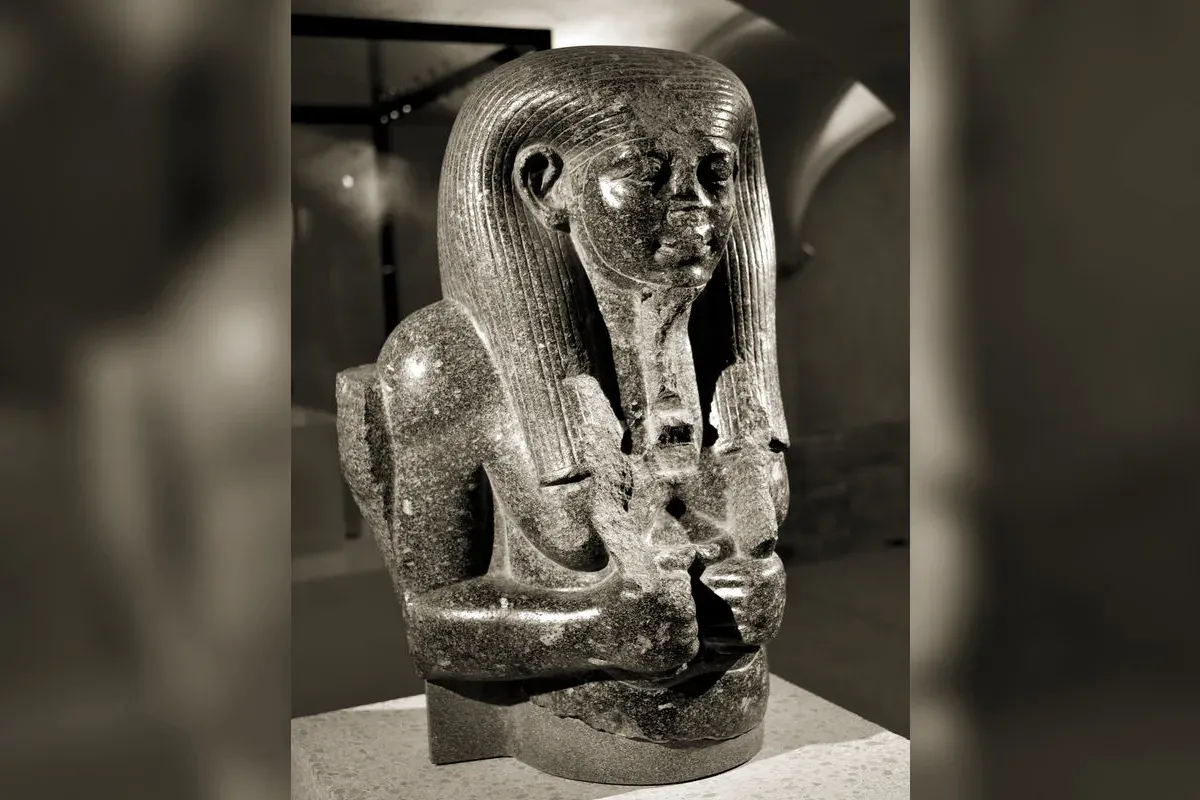
Hapi is the Egyptian god of the Nile flood, not of the river itself. He is shown as a man with a heavy belly and pendulous breasts, blue or green skin, laden with offerings: a body built to state abundance. Rising from the caverns of the First Cataract, he brings the silt on which every Egyptian harvest depended.
- annual Nile inundation
- fertility of the fields and silt
- abundance of food
- symbolic union of the Two Lands
- +5
Who is Hapi?
Hapi is the Egyptian god of the Nile flood. The precision matters: he is not the river, he is the annual inundation. Egyptian had two distinct words — itru for the watercourse, ḥʿpy for the rising water — and it is the second that gave the god his name.
He is unmistakable: a man with a heavy belly, pendulous breasts, blue or green skin, a clump of papyrus or lotus on his head, carrying an offering table piled with fish, birds and flowers. The body is not a portrait but a declaration: it states abundance before it states a person.
The flood was the only event that mattered
To understand Hapi you have to understand what the inundation meant in a valley where it practically never rains.
Each year from mid-July, monsoon rains on the Ethiopian highlands swelled the Blue Nile; the flood wave reached Egypt, covered the cultivable land for several weeks and withdrew leaving a layer of intensely fertile black silt. That deposit gave the country its own name: Kemet, “the Black Land”.
The whole economy hung on the height of that flood. Too low, and the higher fields stayed dry and famine set in; too high, and it carried away dykes, canals and villages. Nilometers — graduated stairways built at Elephantine, at Kom Ombo and later on Roda Island — measured the rise as soon as it arrived in the south, which allowed the harvest to be forecast and the tax assessed. Hapi is no contemplative deity: he is the god whose behaviour decided the state budget.
The Egyptian year itself is set by him. Its first season, akhet, means “inundation”.
The god of the southern caverns
Where does the god live? Tradition houses him in caverns — the qerty — at the First Cataract, around Elephantine and the island of Bigeh, or further north at Gebel el-Silsila, where the valley narrows between two sandstone cliffs.
These caverns were held to be the reservoir from which the water burst each summer, and their keeping was entrusted to Khnum, the ram god of Elephantine, who controlled the flow. It was at Gebel el-Silsila that New Kingdom kings had chapels cut and texts carved in honour of the flood, and its arrival was celebrated there with offerings cast into the river.
That southern siting matches an accurate observation: the flood comes from the south, and its progress northward was tracked stage by stage. The Egyptians did not know the sources of the Nile, but they knew exactly which way the water reached them.
Two Hapis to bind the Two Lands
The god’s most reproduced image is not religious but political. On the sides of royal thrones, at Karnak and Luxor and on the colossi of Ramesses II, two identical figures of Hapi — one for Upper Egypt, one for Lower Egypt — knot a lotus stem and a papyrus stem around the sema-tawy sign, a windpipe flanked by two lungs, the hieroglyph of union.
The message is plain. What joins the two halves of the country is not only conquest or the person of the king: it is the river, the same from south to north, and the flood that reaches everywhere. The god of abundance is summoned to legitimise territorial unity, exactly as Wadjet and Nekhbet do for the royal titulary. Late divine lists in fact pair those two goddesses with Hapi as regional consorts, one for each half of the country.
A god without a temple, but with a hymn
Hapi left no great temple and no priesthood comparable to those of Amun or Ptah. He did leave a remarkable text: the Hymn to Hapi, a Middle Kingdom composition copied and recopied on New Kingdom school papyri — among them Papyrus Sallier II and Papyrus Anastasi VII — and on dozens of ostraca.
The poem opens with a salutation that has become famous: “Hail to you, Hapi, sprung from this earth, come to nourish Egypt.” It then lists what happens when the god comes, and what happens when he is late — the empty table, granaries opening on nothing, people in rags. One passage insists that he cannot be carved, cannot be housed in a shrine, that his place cannot be known: Hapi is a power with no official image and no address.
That is probably the reason for his singular status. The Egyptians built him no house because he lived nowhere in particular: he arrived.
What the ancient sources say
The Famine Stela, carved in the Ptolemaic period on Sehel Island but put in the mouth of King Djoser, tells of seven years of insufficient flood and want. The text credits the resolution to Khnum, who appears to the king in a dream and restores the flow in exchange for an endowment for his temple. The document is a piece of priestly special pleading as much as a story — and it shows that control of the flood could be claimed by competing deities.
Herodotus supplies the two most useful Greek testimonies. He writes that Egypt is “a gift of the river” (Histories, II, 5), a phrase that became proverbial, and reports later (II, 19) that he asked priests why the Nile rose in summer and fell in winter, unlike every river he knew, and got no explanation at all. That silence is valuable: it indicates that the Egyptians lived by the flood without knowing its cause, which explains why they treated it as a deity rather than a phenomenon.
Pliny the Elder (Natural History, V, 58) gives the administrative scale of the flood as read on the nilometer: twelve cubits mean famine, thirteen hunger, fourteen cheerfulness, fifteen security, sixteen delight. The religion of Hapi had ended up converted into a table for assessing tax.
Do not confuse: two Hapys
A homonym keeps a common confusion alive. Hapy, one of the four Sons of Horus, is a funerary god with a baboon’s head who watches over the lungs of the dead and is placed under the protection of Nephthys. He has nothing to do with the flood.
The two names are transcribed almost identically in English and are hard to tell apart out of context. The practical rule is simple: in an offering scene or on a royal throne, it is the god of the flood; on a canopic jar or in an embalming hall, it is the Son of Horus.
Further reading
For the ram god who keeps the caverns the flood pours from and who shapes beings on his wheel, read the page on Khnum. For the Delta cobra goddess paired with his northern form, see Wadjet. For the other great deity of returning fertility, see Osiris, whose mythical cycle follows the agrarian rhythm, and the Osiris myth. For the goddess who guards the lungs his namesake attends, read Nephthys.
Ancient sources
- Hymn to Hapi (Papyrus Sallier II, Papyrus Anastasi VII)
- Famine Stela, Sehel Island
- Reliefs of the Gebel el-Silsila shrine
- Herodotus, Histories, II, 5; 19
- Pliny the Elder, Natural History, V, 58
See also
Frequently asked questions
Is Hapi the god of the Nile or of the flood?
Of the flood. The Egyptians distinguished the river, *itru*, from the annual inundation, *ḥʿpy*, which gives the god his name. Hapi is therefore not the spirit of a permanent watercourse but the power behind a dated event: the rising of the waters from mid-July to September, on which the country's survival depended. A weak flood meant famine, an excessive one meant broken dykes.
Why is Hapi shown with breasts and a swollen belly?
Because his body is a statement about abundance, not a portrait. The heavy belly figures the swollen waters, the pendulous breasts the capacity to feed. Hapi is neither man nor woman: he is the fertility of the silt made visible. His skin, blue or green, takes the colours of the water and of the vegetation he brings.
Who are the two Hapi figures tying plants on royal thrones?
They are the god's two regional forms, one for Upper Egypt and one for Lower Egypt, carved on the sides of pharaonic thrones. They knot lotus and papyrus around the *sema-tawy* sign — a windpipe with lungs, the emblem of union. The image is as political as it is religious: it is the flood, the same from south to north, that makes the country one.