Egyptian mythology · Gods & goddesses
Serqet, scorpion goddess and keeper of the breath
In brief
Serqet is the Egyptian goddess crowned with a scorpion. Her full name, Serqet-hetyt, means 'she who causes the throat to breathe': she is the power that gives breath back to a stung man. Protector against venom and patron of a corps of healers, she is also one of the four goddesses who guard the viscera of the dead.
- venom, stings and bites
- magical medicine and incantation
- protection of the viscera of the dead
- binding of the powers of chaos
- +3
Who is Serqet?
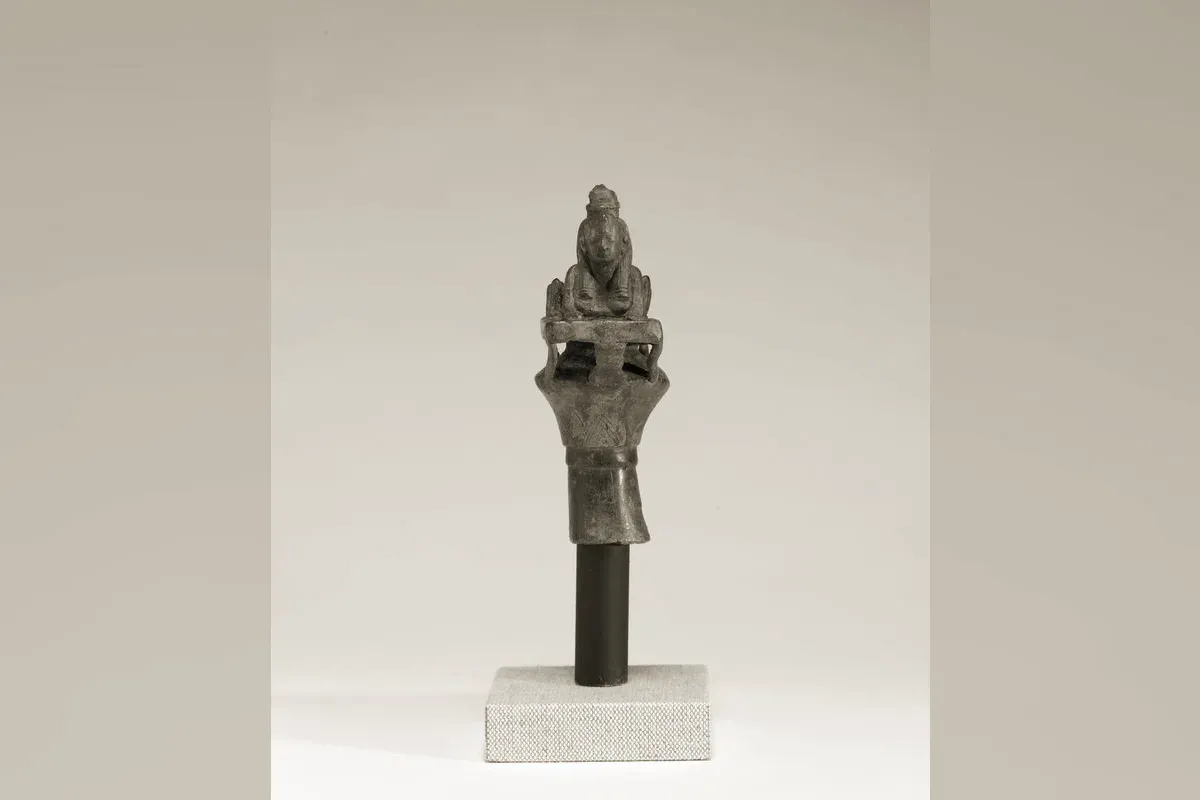
Serqet is the Egyptian goddess recognisable by the scorpion set on her head. Contrary to what the image suggests, she is not the goddess of poison but the one who releases you from it: her full name, Serqet-hetyt, means “she who causes the throat to breathe” — the one who gives breath back to a stung man.
She holds three distinct positions in Egyptian religion: a medical power invoked against venom, a funerary guardian beside Isis, Nephthys and Neith, and a gaoler of the powers of chaos in the books of the afterlife.
A goddess named after the cure
The decisive point is linguistic. The Egyptian verb srq means “to let breathe, to open the breath”; ḥtyt is the throat. The goddess’s name therefore states a healing in progress, not a threat.
The clinical observation behind it is precise. The sting of a dangerous scorpion — Egypt hosts several such species — produces respiratory symptoms: constriction, difficulty swallowing, a sense of suffocation. To name the goddess “she who causes the throat to breathe” is to name exactly the sign a healer watches to know whether the patient will pull through.
The iconography points the same way. The scorpion on her headdress often lacks a sting, and its zoological identification remains debated: several specialists read it as a nepa, the “water scorpion”, a harmless aquatic insect whose silhouette imitates a scorpion’s. The goddess wears the image of the danger, disarmed.
The physicians of Serqet
Serqet is one of the few Egyptian deities whose cult produced an actual profession.
Administrative and funerary sources mention, from the Old Kingdom onward, holders of the office of kherep Serqet, “controller of Serqet”. These practitioners combine what we separate: they apply remedies, recite spells and handle amulets. Some hold parallel titles as physicians or lector priests; the post appears in the royal entourage as much as on work sites, where the risk of a sting was a daily matter.
The surviving magical corpus shows how they worked. The venom is identified as a being and ordered out; a mythical precedent is recited in which a deity was saved; and that success is transferred to the patient. Egyptian venom medicine is medicine by narrative analogy: the sick man recovers because a god has already recovered.
Isis and the seven scorpions
The story that serves as the template for these spells survives on the Metternich Stela, a monument of healing magic carved under Nectanebo II in the fourth century BC.
Isis, fleeing Seth with the infant Horus, crosses the Delta escorted by seven scorpions, each named in the text. Reaching the door of a wealthy woman, she asks for shelter; the woman shuts the door in her face. A poor girl takes her in. The scorpions, insulted on their mistress’s behalf, pool their venom into the sting of one of them, who stings the rich woman’s child.
The reversal is the heart of the text. Isis hears the mother’s cries and heals the child — the child of the woman who turned her away. The goddess then pronounces the formulas that draw the poison out, and it is those formulas the practitioner repeats at the patient’s bedside.
Serqet is the tutelary power behind the whole dossier: the goddess who commands scorpions is also the one who disarms them. The Metternich Stela stood beside a basin; water was poured over it, took on the words carved there, and was given to the stung to drink.
The fourth guardian of the dead
From the New Kingdom onward, four goddesses watch over the canopic jars containing the viscera of the dead, each paired with one of the four Sons of Horus: Isis with Imsety, Nephthys with Hapy, Neith with Duamutef, and Serqet with Qebehsenuef, the falcon who guards the intestines.
The most famous witness is the canopic chest of Tutankhamun: an alabaster shrine surrounded by four goddess statues with outstretched arms and heads slightly turned, Serqet among them. They do not look at the dead man; they watch the approaches.
Her place in that quartet is not arbitrary. The dead traveller through the Duat meets serpents, scorpions and venomous creatures at every gate, and the Book of the Dead carries a whole series of spells “for not being bitten in the realm of the dead”. The venom specialist belongs in a funerary kit.
The one who binds Apophis
Serqet’s third employment is the most spectacular. The books of the afterlife carved in New Kingdom royal tombs recount the sun’s night crossing and the attack the barque of Ra suffers each night.
In the Amduat, at the seventh hour, the fight against Apophis is won not by force but by binding: the serpent of chaos is tied, his coils cut, his advance stopped by powers who know how to handle what crawls. Serqet stands among them, alongside Isis and the Elder Magician.
The consistency of the character is striking. Serqet never attacks; she neutralises. She immobilises venom in the body, the serpent in the night, danger in the tomb. She is a goddess of the bolt, not of the blade — which sets her clearly apart from Sekhmet, the pantheon’s other great protector, who settles problems by slaughter.
What the ancient sources say
The Pyramid Texts, the oldest Egyptian religious corpus, already give her offspring: Nehebkau, the many-coiled serpent, is called her son there. The descent is logical within the Egyptian system — a venom deity begets a serpent deity — and Nehebkau would follow a path parallel to his mother’s, moving from danger to protector of the dead.
The Coffin Texts and then the Book of the Dead keep her in her guardian role. In the Late Period she is often absorbed by Isis, whose magical competence gradually covers her own: the Greco-Roman healing stelae invoke Isis where Old Kingdom practitioners invoked Serqet.
Greek authors, who described the Egyptian pantheon with care, found no counterpart for her and match her to none of their own deities. Serqet remains a goddess without a translation: her speciality, the throat that opens again, had no office-holder on Olympus.
Further reading
For the three other guardians of the canopic jars, read the pages on Isis, Nephthys and Neith. For the serpent she helps bind each night, see Apophis. For the underworld she helps the dead cross, see the Duat and the judgment of the dead. For the flight of Isis that models her incantations, read the Osiris myth.
Ancient sources
- Pyramid Texts (Serqet and Nehebkau)
- Coffin Texts
- Amduat, seventh hour (binding of Apophis)
- Metternich Stela (Isis and the seven scorpions)
- Canopic chest of Tutankhamun
See also
Stories featuring this entity
Frequently asked questions
What is Serqet the goddess of?
Of venom and its cure. Her full name, *Serqet-hetyt*, translates as 'she who causes the throat to breathe': it names the aim of the treatment, not the harm. The Egyptians placed under her patronage the practitioners who specialised in scorpion stings and snakebite, men who bore the title *kherep Serqet*, 'controller of Serqet'.
Why does Serqet wear a scorpion on her head?
Because the animal figures the danger she masters. The scorpion on her headdress is in fact often shown without a visible sting, and its exact identification is debated: several Egyptologists recognise a nepa, the harmless 'water scorpion'. The goddess therefore displays herself not as the sting but as its neutralisation.
What is Serqet's role in the canopic jars?
She is the fourth of the tutelary goddesses of the dead, with Isis, Nephthys and Neith. Each watches over one of the four Sons of Horus and the organ he guards: Serqet is paired with Qebehsenuef, keeper of the intestines. The canopic chest of Tutankhamun shows her with arms outstretched, facing outward, on sentry duty.