Egyptian mythology · Gods & goddesses
Seshat, Egyptian goddess of writing and measurement
In brief
Seshat is the Egyptian goddess of writing, reckoning and surveying. Her name means 'the female scribe'. She is the one who stretches the cord with the king to lay out a temple, and the one who writes regnal years on the leaves of the ished tree. Female counterpart of Thoth, she nonetheless never had a temple of her own.
- writing and archives
- surveying and temple foundation
- accounting and inventories
- length of reigns and royal annals
- +4
Who is Seshat?
Seshat is the Egyptian goddess of writing, reckoning and surveying. Her name, sšȝt, means literally “the female scribe”. She turns up wherever Egypt pins something down: the ground plan of a temple, the years of a reign, the count of a haul of booty, the catalogue of a library.
She is a deity of precision, and one of the few in the pantheon whose function can be summed up in a single gesture: she holds a reed pen and she writes it down. She never had a temple of her own, nor a priesthood — and that anomaly says a great deal about what she is.
The seven-pointed emblem
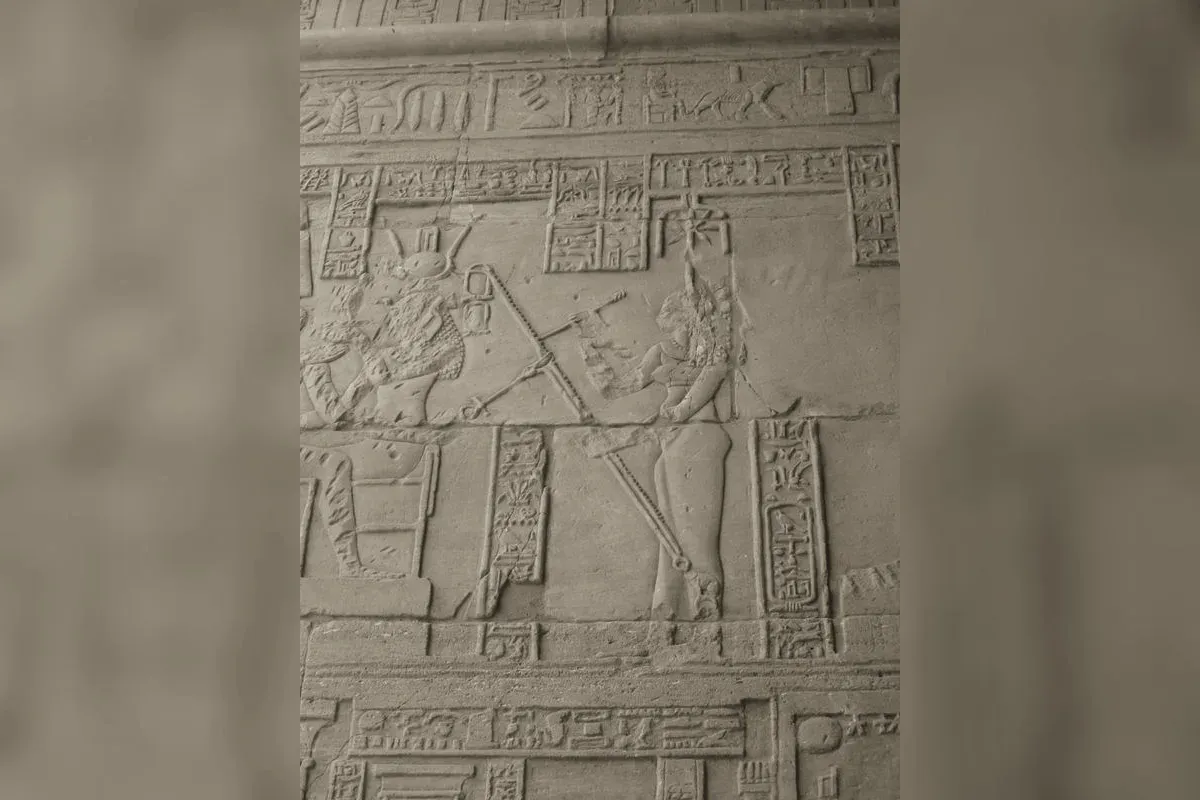
Seshat is recognisable at once by her headdress. Above her head, on a tall stem, stands a seven-branched sign shaped like a star or rosette, surmounted by what is usually described as an inverted crescent or a pair of downturned horns.
The sign has never received a settled explanation. It nonetheless gives the goddess her second name from the New Kingdom onward: Sefkhet-Abwy, “she of the seven horns” or “seven points”. It is a rare case of a deity renamed after her own attribute, as though the emblem mattered more than the person.
Her second distinguishing feature is her clothing: over her close-fitting dress Seshat wears a spotted panther skin. That is the costume of the sem priest, the officiant of funerary rites and foundation ceremonies. The goddess is dressed as a celebrant: her garment says she is on duty.
Stretching the cord: the goddess who lays out temples
Seshat’s most frequent appearance on Egyptian walls is a foundation scene. The ritual is called pedj shes, “stretching the cord”.
The sequence is always the same. King and goddess face one another, each holding a mallet and a stake. Between the stakes runs a line that materialises the axis of the temple to come. The orientation is taken from the sky — texts speak of sighting on the stars, notably on the constellation of the Great Bear. Once the cord is stretched, the position is fixed and building can begin.
The longevity of that scene is remarkable. It is attested from the earliest dynasties and still carved, almost unchanged, on the walls of the Ptolemaic temples of Edfu and Dendera nearly three thousand years later. No Egyptian temple counted as properly founded unless Seshat had held the other end of the cord.
She bears, fittingly, the title lady of builders. Where Ptah is the craftsman who fashions and Khnum the potter who models, Seshat is the one who measures first: the plan precedes the work.
Recorder of reigns
Seshat’s second great employment is the registration of royal time.
On reliefs at the Ramesseum, at Abydos and at Karnak, she is shown before the ished tree — the sacred persea of Heliopolis — inscribing on its leaves the pharaoh’s name and the number of his regnal years. Thoth performs the same act in other versions of the scene, or stands beside her. The image means that the length of a reign is not decided by the king but recorded by the gods: it is already written somewhere.
Seshat also carries the notched palm rib, the tally-stick that writes years in Egyptian script, often combined with the tadpole and the shen sign to mean “millions of years”.
The same expertise applies to concrete matters. The Annals of Thutmose III at Karnak, itemising the king’s Asiatic campaigns, belong to an accountancy placed under her patronage: horses, prisoners, metals, tribute. The goddess who records centuries also records inventories.
Seshat and Thoth: a pairing of functions
The sources hesitate over the nature of the link between Seshat and Thoth. Depending on the text she is his wife, his sister or his daughter. The indecision is not a documentary gap: it indicates that the relationship is professional before it is familial.
The two share a domain — writing, counting, memory — but not a position. Thoth is the master of divine speech, inventor of hieroglyphs, the scribe who pleads and who judges: he stands at the scales in the judgment of the dead, in a position of authority. Seshat executes. She measures, she traces, she registers. The pair sets the author against the clerk.
It is worth noting that Thoth has, at Hermopolis, an official consort of his own, Nehemetawy, which confirms that Seshat is not his wife in the cultic sense. Their association is a matter of trade, not of marriage.
A goddess without a temple
Seshat’s most interesting anomaly is archaeological: no temple of her own is known, no established priesthood, no festival in her name.
Yet she is everywhere — on the walls of other gods’ sanctuaries, in foundation scenes, in annals, in the temple libraries called “houses of life”. Her commonest title is precisely Mistress of the House of Books.
That ubiquity without a place of her own fits her nature. Seshat is not a power one prays to for something: she is an operation. You cannot found a temple without her because you cannot found a temple without measuring. Her place is not in a sanctuary but in the technical act itself — which sets her radically apart from a city goddess like Neith at Sais or Bastet at Bubastis.
Further reading
For the god with whom she shares writing and memory, read the page on Thoth, and for the scene in which he keeps the record, the judgment of the dead. For the two great craftsman gods whose work she prepares, see Ptah and Khnum. For the order of the world her measurements translate into stone, see Maat.
Ancient sources
- Pyramid Texts
- Stretching-of-the-cord scenes, temples of Edfu and Dendera
- Annals of Thutmose III, Karnak
- Ished-tree scenes, Ramesseum and Abydos
See also
Related entries
Frequently asked questions
Who is Seshat in Egyptian mythology?
Seshat is the goddess of writing, reckoning and surveying. Her name means 'the female scribe'. She appears wherever something has to be fixed in writing or by measurement: the ground plan of a temple, the length of a reign, the inventory of a haul of booty. She is the female counterpart of Thoth, with whom she shares the domain of the written word.
What is the stretching of the cord?
It is the foundation ceremony of an Egyptian temple, called *pedj shes*, 'stretching the cord'. King and goddess face each other, drive in stakes and pull a measuring line between them to trace the building's axis, oriented by sighting on the stars. Scenes of it are carved down to the Ptolemaic temples of Edfu and Dendera, more than two thousand years after its earliest attestations.
Is Seshat the wife of Thoth?
Depending on the text she is called his wife, his sister or his daughter — the sources do not settle it, and the uncertainty is telling: it suggests the two form a pairing of functions rather than a family. At Hermopolis, in any case, Thoth's official consort is a different goddess, Nehemetawy.