Egyptian mythology · Mythical places
The Field of Reeds: the farmland paradise of the Egyptian dead
In brief
The Field of Reeds, Egyptian Sekhet-Iaru, is the paradise granted to the dead whose heart passes the weighing: an idealised Egypt with canals, outsized harvests and real farm work — which the deceased delegates to figurines, the shabtis.
- eternal home of the justified dead
- agricultural abundance and offerings
- idealised continuation of Egypt
- reward following the weighing of the heart
What is the Field of Reeds?
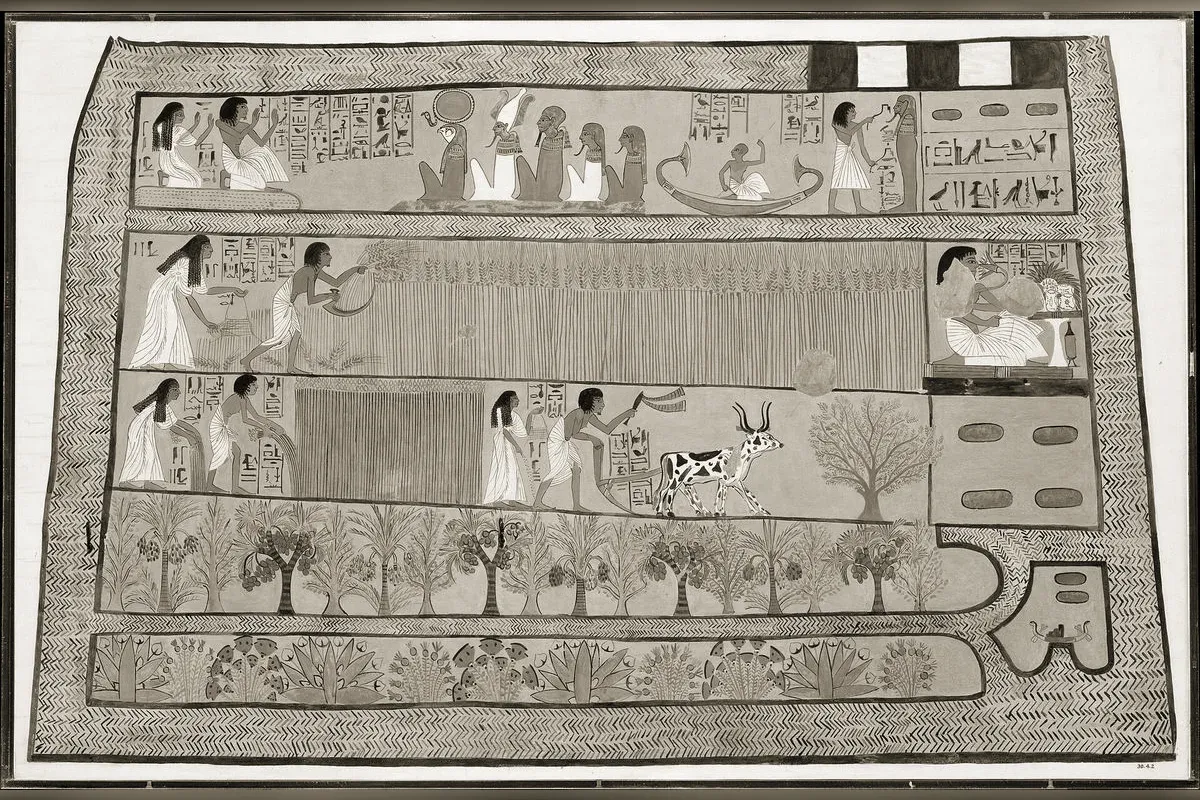
The Field of Reeds — Egyptian Sekhet-Iaru, “the field of rushes” — is one of the blessed landscapes of the Egyptian afterlife. In the Book of the Dead, it is closely associated with the justified dead, whose heart is weighed before Osiris. It is neither a luminous heaven nor a state of contemplation: it is farmland, with canals, dykes, grain fields and boats. Egyptians did not hope to leave the world; they hoped to get it back, improved.
Egypt copied out, only better
The description given by the funerary texts is startlingly agricultural in its precision. The Field of Reeds is cut by canals crossed by boat, planted with trees, lined with dykes, and above all covered in outsized crops.
Spell 109 of the Book of the Dead puts numbers on the abundance: barley there stands five cubits high, two of them ear, and emmer seven — figures that vary a little between manuscripts but always say the same thing, cereals two or three times a man’s height. That exaggeration is the only “marvellous” device this paradise allows itself. Everything else is recognisable: the same tools, the same gestures, the same river.
This is where the Egyptian afterlife differs most sharply from other traditions. Where the Greek Elysium offers heroes a dwelling outside time, the Field of Reeds promises the continuation of an ordinary existence. For an inhabitant of the Nile valley, the height of happiness was a good flood and a harvest that never failed.
How one gets in
Admission is not automatic, and that is the whole subject of the judgment of the dead. In the Hall of the Two Truths the heart is set on one pan of the scale and the feather of Maat on the other. Anubis tends the instrument, Thoth records the verdict, and Ammit waits, ready to devour a heart that weighs too much.
The deceased found maa-kheru, “true of voice”, may join Osiris and continue a transfigured existence. The sources do not, however, set out one systematic itinerary to the Field of Reeds: they combine several blessed destinies, with Osiris or with Ra. Nor do they describe a symmetrical realm of eternal punishment; in the judgment scene Ammit instead threatens a “second death”, the loss of continued existence in the afterlife.
A geography to be learned by heart
Entering the Field of Reeds is not enough; one also has to know how to move around it. Spells 110 and 149-150 of the Book of the Dead map the region, with its mounds, gates and gatekeepers, each bearing a name the traveller must be able to pronounce.
Spell 99 adds a famous ordeal: the ferryman. To cross the canal, the deceased must satisfy a boatman whose face is turned backwards and who demands that every part of his ferry be named — hull, oars, mast, ropes — before he will make the crossing. The test is purely verbal, and that is the whole logic of Egyptian funerary magic: to know the name is to obtain passage. The papyrus placed in the tomb is not a prayer book but a travel manual with its passwords.
This geography connects to that of the Duat, the underworld crossed each night by the barque of Ra. Some compositions connect the Field of Reeds with the eastern horizon and solar renewal; elsewhere its location remains celestial or undefined. It is therefore better understood as a blessed destination than as a fixed district of the Duat.
The paradise where you work
An awkward consequence follows from all this: if the afterlife is a field, it has to be farmed. The texts say so plainly — the dead may be called up to plough, to irrigate, to shift sand from one bank to the other.
The Egyptian solution has a remarkable administrative frankness. Spell 6 of the Book of the Dead is the formula of the shabtis (or ushabtis, “answerers”): small mummiform figurines placed in the tomb and ordered to stand up and say “here I am” whenever the dead man is summoned to corvée labour. They are equipped with miniature hoes and baskets.
Their numbers climbed over the centuries. From one or two in the Middle Kingdom, sets grew large: by the Late Period the ideal count reaches 401 figures — 365 workers, one for every day of the year, and 36 overseers, one per ten-day week. No text states more clearly what eternity meant to a well-off Egyptian: the same life, with the same workforce.
The images: Sennedjem and the Papyrus of Ani
Two documents fixed the picture we have of the Field of Reeds.
The first is the tomb of Sennedjem (TT1) at Deir el-Medina, belonging to a craftsman of the royal tombs who died under the Nineteenth Dynasty. Its vaulted ceiling carries the most complete painting of the Egyptian paradise: Sennedjem and his wife Iyneferti, in spotless white linen, ploughing behind a pair of oxen, reaping barley with sickles, pulling flax, and standing before date palms lined along the canals. They work, but in festival dress — the painting states the promise exactly: labour without hardship.
The second is the Papyrus of Ani (British Museum EA 10470), the most famous copy of the Book of the Dead, where the vignette of spell 110 spreads the same scene across a horizontal register, divided by the blue bands of the canals, with the boat, the offerings and the herons that mark living water.
What the ancient sources say
The field of rushes is old. The Pyramid Texts, in the Old Kingdom, already have the dead king purify himself there before joining the sun: at that stage it is a space of celestial purification reserved for the sovereign.
The Coffin Texts, in the Middle Kingdom, widen access and add maps — the Book of Two Ways, painted on coffin floors, draws the land and water routes leading there. With the Book of the Dead in the New Kingdom, the description reaches its classic form: spell 110 for the image, 109 for the harvests, 99 for the ferryman, 149-150 for the list of mounds, and 6 for the corvée.
The trajectory is telling. In a thousand years a royal privilege became an asset available to anyone who could pay a scribe — one of the deepest transformations in Egyptian religion, and the reason so many funerary papyri have come down to us.
Further reading
For the underworld of which the Field of Reeds is the happy portion, read the Duat. For the ceremony that decides admission, see the judgment of the dead and the page on Maat. For the sovereign who rules there, consult Osiris and the Osiris myth. For the devourer waiting on those who fail, read Ammit. To compare with the blessed abode of the Greeks, see Elysium.
Ancient sources
- Pyramid Texts
- Coffin Texts (Book of Two Ways)
- Book of the Dead, spells 6, 99, 109, 110, 149-150
- Papyrus of Ani (British Museum EA 10470)
- Tomb of Sennedjem at Deir el-Medina (TT1)
See also
Frequently asked questions
What is the Field of Reeds?
It is one of the blessed landscapes of the Egyptian afterlife and is associated, in the Book of the Dead, with the dead person declared consistent with Maat. Texts and paintings describe it as a perfect Egypt — canals, fields of barley and emmer, date palms, a boat, the family reunited. Nothing about it is immaterial: the Egyptian afterlife is fertile farmland where life continues as before, but without lack and without end.
Where is the Field of Reeds located?
Texts give it no single address: depending on period and composition, this blessed landscape belongs to the sky or the realm of the dead and is reached by water. Its association with the justified dead and Osiris's tribunal becomes especially clear in the Book of the Dead. Such flexibility is normal: the Egyptian afterlife is first a set of journeys and modes of existence, not an address.
Why were shabtis placed in tombs?
Because the Egyptian paradise is farmland, and farmland has to be worked. The dead could be conscripted there to irrigate, plough or shift sand. Spell 6 of the Book of the Dead hands that duty to statuettes, the shabtis, whose task is to answer 'here I am' in his place. In the Late Period a full set numbers 401: 365 workers, one for each day of the year, and 36 overseers.