Greek mythology · Creatures
Pegasus, the winged horse of Greek mythology
In brief
Pegasus, born from Medusa's blood: the winged horse who carried Bellerophon against the Chimera, created the spring of the Muses, and became a constellation.
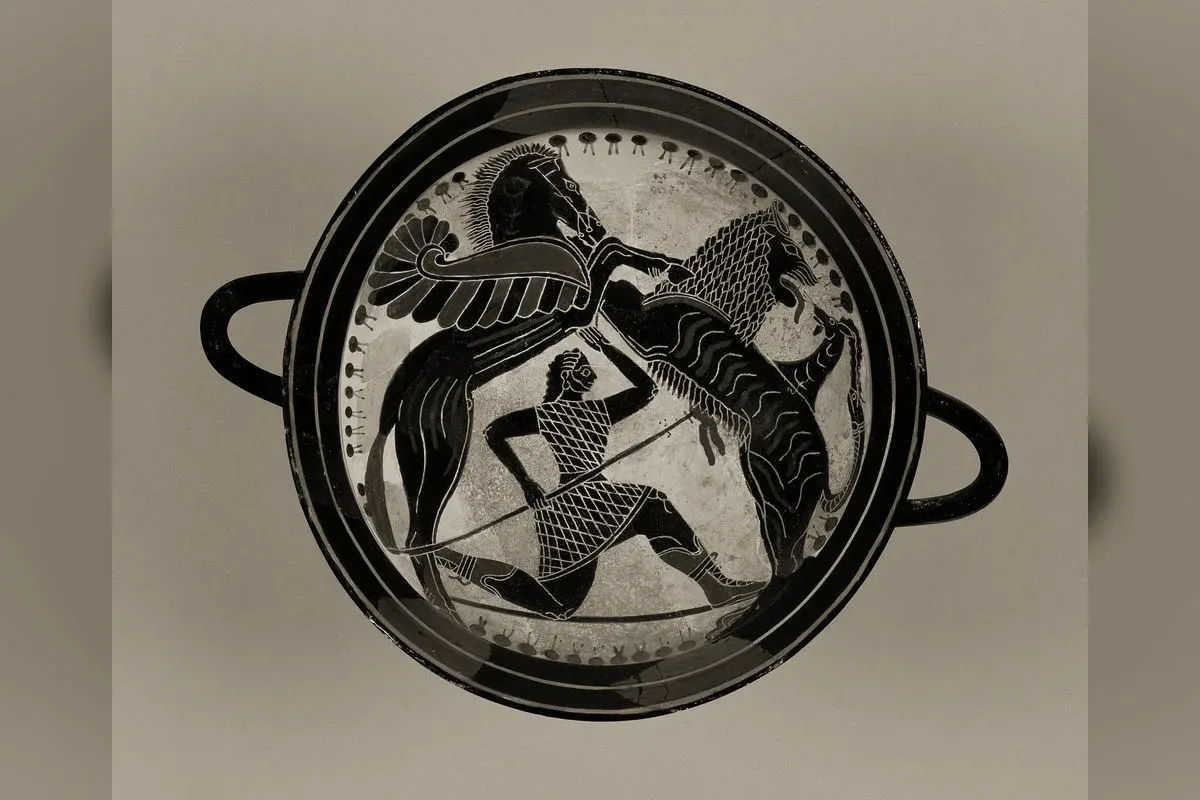
Pegasus is the most beautiful creature in Greek mythology — a white horse with vast wings, born from violence and blood, who becomes a symbol of poetic inspiration, divine power, and the dangerous vertigo of ambition. He springs from the severed neck of a Gorgon, strikes the earth to release the spring that feeds the Muses, carries a mortal hero against monsters at the edge of the world, and ends his existence as a constellation above Olympus. His story touches nearly every register of the mythological imagination: the monstrous, the beautiful, the heroic, and the divine.
Birth from Medusa’s blood
The birth of Pegasus is one of the most extraordinary moments in Greek mythology: a creature of pure beauty and freedom erupting from an act of violence. When Perseus cuts off the head of Medusa — using the mirrored shield given by Athena to avoid her petrifying gaze — the blood that spills from the Gorgon’s neck generates two beings simultaneously.
The first is Chrysaor, a giant warrior bearing a golden sword, whose descendants will later populate the far edges of the mythological world. The second is Pegasus himself: a white horse with great feathered wings, who springs upward immediately upon birth, toward the sky.
His father is Poseidon, who had lain with Medusa before her transformation — or, in the Ovidian version, after Athena’s punishment had already made her monstrous, the god drawn to her despite, or perhaps because of, her cursed beauty. The lineage is paradoxical: the child of the god of the sea and a creature of the earth’s darkest edges becomes the freest being in the mythology, the one creature capable of moving between every level of the cosmos.
The name Pegasos the Greeks connected to pege — spring, source — both for his birth near the springs of Ocean at the world’s western edge, and for the springs he would later produce with the strike of his hoof. He is, from his first breath, associated with origins and with the mysterious sources from which things flow.
The spring of the Muses
Before Bellerophon, before the Chimera, before Olympus, Pegasus performs the act for which poets would remember him most: on Mount Helicon in Boeotia, the sacred mountain of the Muses, the divine horse strikes the earth with his hoof and produces the Hippocrene — “the horse’s spring,” hippos (horse) + krene (spring). This spring becomes the sacred source of poetic inspiration in the Greek tradition. The Muses bathe in it. Poets drink from it. To be inspired is, in the classical tradition, to have drunk from the Hippocrene.
This detail establishes Pegasus as something more than a heroic mount or a divine creature: he is the embodiment of the connection between the divine and artistic inspiration. Where his hoof strikes the earth, a source appears. The same force that carries him through the sky can open the ground and release the waters that feed human creativity.
Hesiod, in the opening of the Theogony, describes the Muses dancing on Helicon near the Hippocrene. The spring is thus present at the very beginning of Greek literary tradition — and Pegasus, who made it, is its invisible founding patron.
Bellerophon and the golden bridle
The hero Bellerophon is a prince of Corinth — a young man of extraordinary courage and beauty who finds himself in the position of needing to kill the Chimera, a fire-breathing composite monster sent against him by the king of Lycia. The Chimera — with the head of a lion, the body of a goat, and the tail of a serpent — cannot be approached on foot, let alone killed in direct combat. It breathes fire. It is, in the natural course of things, unkillable by mortal means.
A seer advises Bellerophon to seek Athena’s help. He sleeps in her temple, and in sleep — or in waking vision, depending on the source — Athena appears and gives him a golden bridle. Some versions attribute the bridle to Poseidon himself, Pegasus’s father, who provides the means of taming his own son. The divine instrument appears to Bellerophon as a gift of permission: the gods have decided he may use this creature for his purpose.
Bellerophon finds Pegasus drinking at the Pirene spring in Corinth — a spring that later tradition associates with Pegasus’s own hoof-strike. The horse allows himself to be bridled. This is the key: Pegasus is not broken; he is offered a bond. The golden bridle is not a constraint by force but a divine mediation that makes the partnership possible. Pegasus lowers his head willingly. Bellerophon mounts, and they take to the air.
The quest against the Chimera
Riding Pegasus, Bellerophon approaches the Chimera from above — an angle from which the creature’s fire cannot reach him and from which he can attack without being struck. He kills it, in some versions by driving a lump of lead into its mouth on the tip of a spear, the lead melting in the creature’s fire-breath and suffocating it.
The partnership continues for several more exploits. Bellerophon rides Pegasus against the Solymi (a warlike people of Asia Minor), against the Amazons, and against the Lycian champions sent to kill him. In each case, aerial mobility makes him effectively invincible. The combination of Bellerophon’s intelligence and courage and Pegasus’s divine flight is, for a time, unstoppable.
The two are bound together in the way that the greatest hero-companion pairs in mythology are bound: the human provides direction and will; the divine creature provides the power that makes the human’s will effective. But unlike Odysseus and Athena, or Heracles and the raw force of his own divine parentage, the partnership of Bellerophon and Pegasus is fragile — conditional on Bellerophon remaining within the limits of mortal ambition.
The fatal flight and the fall of Bellerophon
After his triumphs, Bellerophon’s pride tips into hubris — the transgression of human limits that Greek mythology always punishes. Flush with victory, having defeated monsters and armies and survived every danger, he attempts the one thing that is definitively forbidden: he mounts Pegasus and flies toward Olympus itself, attempting to join the gods as an equal.
Zeus sees him coming. The response is surgical: he sends a gadfly — a tiny, invisible insect — that stings Pegasus. The horse rears in pain and Bellerophon is thrown, falling from the height of heaven to the earth. He survives, but the fall destroys him: blinded, lamed, crazed, he wanders the earth alone for the rest of his life, shunned by gods and men, unable to explain what has happened to him. He dies in solitude and ruin.
Pegasus, by contrast, completes the flight. Without his rider, he reaches Olympus and is received there.
The myth is precise in its distinction: Bellerophon’s ambition was disordered; Pegasus’s flight to Olympus was not. The horse was always divine; his place there was always his destination. The gadfly removes the mortal who had confused his own status with the horse’s. Pegasus could always reach the summit. The man could not.
Pegasus on Olympus
On Olympus, Pegasus is received into Zeus’s divine stables. He becomes the carrier of the thunderbolts — the thunderbolt of Zeus, the supreme symbol of divine authority and power, is borne through the sky on the wings of the creature born from Medusa’s blood. The circularity has the quality of myth at its most complete: the daughter of Poseidon cursed by Athena gives birth, at her death at Perseus’s hand, to the horse who will carry Zeus’s weapons across the sky.
The divine stables of Olympus are not described in any surviving source with particular detail, but the image of Pegasus as a permanent resident of the divine realm — the thundercloud incarnate, the visible form of celestial power — became one of the most durable of ancient iconography.
The constellation
Zeus eventually immortalises Pegasus permanently by transforming him into a constellation. The constellation Pegasus is one of the largest and most ancient recognised star groupings in the northern sky: a great square of four stars forming the body, with lines of stars extending outward for wings and neck. It is visible throughout autumn and winter in the northern hemisphere and has been identified in astronomical traditions as far back as Mesopotamia, where it appeared under a different name.
The Greek tradition’s identification of these stars with Pegasus connects the horse’s story to the permanent sky: the spring-maker, the muse-helper, the thunder-carrier is now the sky itself, visible every night above the world he once flew through.
Pegasus in art and culture
Pegasus was one of the most widely depicted creatures in ancient Greek art. His image appears on coins from Corinth — where his connection to the Pirene spring made him a civic emblem — on vase paintings, on reliefs, and on architectural sculpture. The Corinthian coin with the winged horse became one of the most recognised monetary images in the ancient Mediterranean world.
In heraldry, Pegasus became a symbol of fame, eloquence, and the power of the poetic imagination — carried into Renaissance emblems, royal coats of arms, and the insignia of military units. The connection to poetic inspiration made him a natural symbol for literary academies: the Accademia dell’Arcadia, the publishers Elsevier and Gallimard, and many others have used his image.
In modern culture, Pegasus has shed most of his specific mythological context and become a generalised symbol of freedom, transcendence, and the winged imagination. He appears in the Macy’s Thanksgiving parade, on the logo of Mobile/Mobil, in animation (Disney’s Hercules), and in fantasy literature. The word “Pegasus” has become a common noun for any winged horse figure, and a metaphor for any vehicle of creative or spiritual elevation.
What endures beneath all of this is the original paradox: a creature of beauty born from horror, a divine being produced at the meeting point of Poseidon’s power and Medusa’s curse, who makes the earth flower with springs and carries the sky’s lightning — and who belongs, in the end, not to the hero who rode him but to the gods, and to the stars.
Further reading
For Medusa, the mother whose death produces Pegasus, see her dedicated page. For Poseidon, Pegasus’s divine father and god of the sea and horses, see his page. For Perseus, the hero whose sword releases Pegasus into the world, see his page. For Athena, who provides the golden bridle and enables Bellerophon’s partnership with Pegasus, see her page. For Zeus, who receives Pegasus on Olympus and immortalises him as a constellation, see his page. For the thunderbolt of Zeus that Pegasus carries in the divine stables, see its dedicated page. For the hero who rides Pegasus to his greatest victories, read the page on Bellerophon. For the fire-breathing hybrid monster that Bellerophon defeats from the air, see the page on the Chimera.
Ancient sources
- Hesiod, Theogony, lines 280-286
- Homer, Iliad, 6.155-202
- Pindar, Olympian, 13
- Apollodorus, Library, 2.3.2
See also
Frequently asked questions
How was Pegasus born?
Pegasus springs from the neck of Medusa at the moment Perseus beheads her. His father is Poseidon, who had lain with Medusa before her transformation into a Gorgon. When Perseus strikes off her head, two beings are born from the blood: Pegasus, the winged horse, and Chrysaor, the giant with the golden sword. Pegasus leaps upward immediately, toward the sky — his first act is flight.
What is Pegasus's connection to Bellerophon?
Bellerophon is the Corinthian hero tasked with killing the Chimera — a fire-breathing monster combining lion, goat, and serpent. He cannot approach it on foot. On the advice of a seer, he sleeps in Athena's temple and receives in a dream (or directly from the goddess) a golden bridle with which he can tame Pegasus. He finds the horse drinking at the Pirene spring in Corinth, bridles him, and rides him to defeat the Chimera and complete other heroic tasks. Their bond is the central partnership of Bellerophon's mythology.
How did Pegasus become a constellation?
After Bellerophon's fatal attempt to fly to Olympus — punished by Zeus with a gadfly that throws him from the saddle — Pegasus continues the flight alone and reaches Olympus. Zeus receives him, installs him in the divine stables as his thunder-carrier, and eventually immortalises him by transforming him into the constellation Pegasus, one of the largest and most recognisable constellations in the northern sky.