Greek mythology · Gods & goddesses
Boreas, Greek god of the north wind and Athens's son-in-law
In brief
Boreas, god of the north wind: son of Eos, abductor of Oreithyia, father of the Boreads, and the wind Athens thanked for wrecking the Persian fleet.
- north wind
- winter and cold
- storms at sea
- wings
- +2
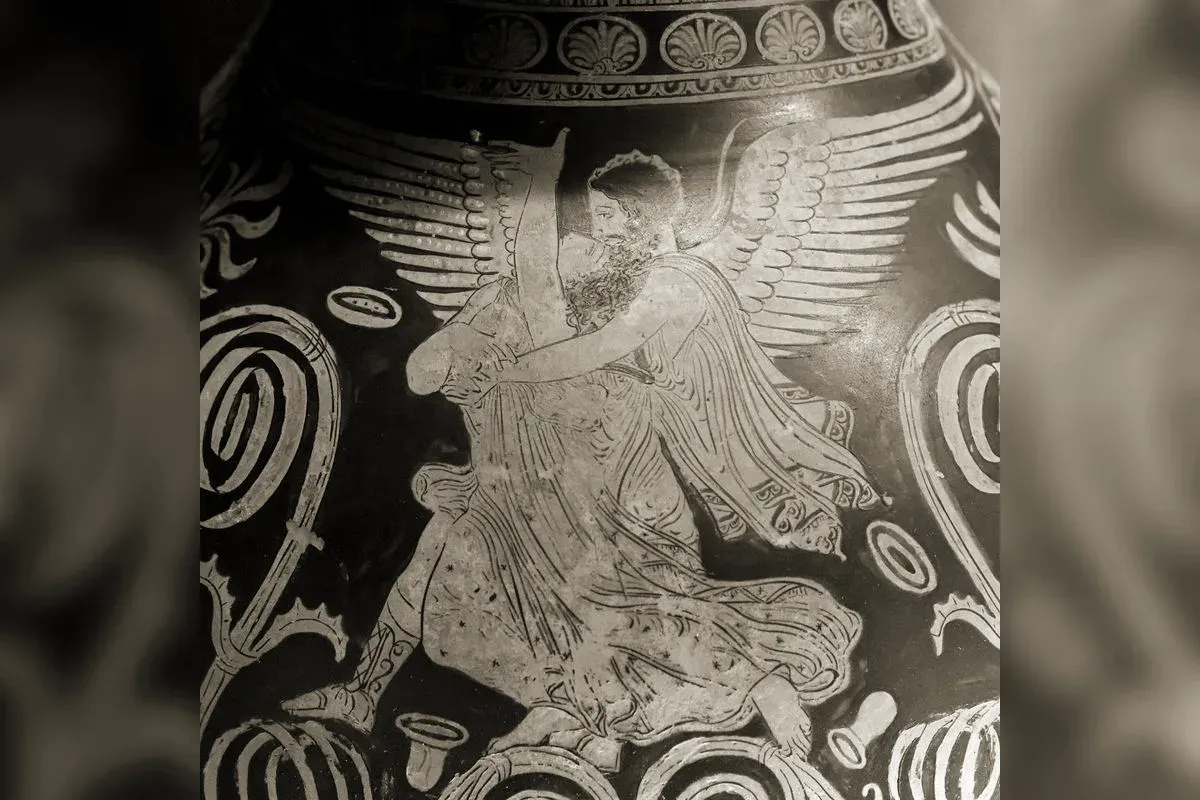
Boreas is the north wind made a god: the one that comes down out of Thrace, freezes the sea and breaks fleets. Son of the Titan Astraeus and Eos the Dawn, brother of Zephyrus, he is the only Greek wind to have been granted a civic cult as payment for a military service — and one of the few gods whose plausibility Plato debates in the middle of a walk.
Sons of the Dawn
Hesiod gives the canonical pedigree of the winds: from Astraeus, Titan of the starry sky, and Eos are born clear Zephyrus, swift-coursing Boreas and Notus (Theogony 378-380). The poet is careful to set them apart from the harmful winds, those descended from Typhoeus, which have neither names nor rules.
The distinction matters. The three sons of Eos are oriented winds: they come from a fixed quarter of the sky, return with the seasons, and a sailor can plan around them. Their father Astraeus has no entry on Mythoblog yet — an acknowledged gap in the Greek cluster — but their mother does: the wind is born at the edge of daybreak.
Boreas lives in Thrace, in a cave on Mount Haemus. Greeks placed the northern limit of the known world there, and beyond it, in a tradition Pindar transmits, the blessed people of the Hyperboreans — literally those living “beyond Boreas,” where Apollo spends the winter. That etymology is the ancients’ own; modern scholars dispute it, but it was enough to make the north wind the boundary marker of the Greek world.
A stallion in the Iliad
Homer gives him one strange adventure in Iliad 20. Erichthonius, king of the Troad, owned three thousand mares; Boreas fell in love with them, took the shape of a dark-maned stallion and covered twelve. The foals of that union ran over standing corn without bending the ears and over the crests of the sea without wetting their hooves.
The image states precisely what a divinised wind is: a speed that weighs nothing. It also sets a pattern Greek myth will repeat for Zephyrus, father of Achilles’s immortal horses — winds beget horses, because nothing else in the Greek world moves so fast.
The pyre of Patroclus
In Iliad 23 the pyre of Patroclus refuses to catch. Achilles promises offerings to Boreas and Zephyrus; Iris, messenger of the gods, carries the prayer to Thrace, where the winds are feasting in Zephyrus’s house. They rise at once, cross the sea driving the swell before them, and blow on the pyre all night until it burns as a single flame.
The scene is one of the rare moments in the Iliad where the winds act as persons: they eat, they receive a messenger, they accept a contract of sacrifice. Homer treats them as minor but fully realised deities, with a house and a table of their own.
The seizing of Oreithyia, and Socrates’s question
Boreas’s most productive myth is Athenian. Oreithyia, daughter of King Erechtheus of Athens, is playing beside the Ilissos — or dancing on the Acropolis, depending on the version — when the north wind seizes her, wraps her in dark cloud and carries her off to Thrace.
Four children come of the union: the winged sons Zetes and Calais, called the Boreads, and two daughters, Cleopatra and Chione.
What makes the myth memorable, though, is the scene Plato builds on it. The Phaedrus opens with Socrates and Phaedrus walking along the Ilissos; Phaedrus asks whether this is not the spot where Boreas is said to have taken Oreithyia, and whether Socrates believes the story. The answer is a model of irony: Socrates grants that the learned explain it as a gust that threw the girl off the rocks, concedes the ingenuity, then declines to spend his time on it — since he would then have to rationalise Centaurs, the Chimera and the Gorgons too, and he has not yet managed to know himself (229b-d).
It is one of the clearest passages in surviving Greek literature on the standing of myth: a fourth-century Athenian knows Boreas can be reduced to meteorology, and chooses not to.
The Boreads and the Harpies
Zetes and Calais inherit their father’s wings and join the Argo. Their exploit fills Argonautica 2 and belongs to the quest for the Golden Fleece.
The blind seer Phineus, punished by Zeus, is tormented by the Harpies: every time food is set before him they drop out of the sky, devour what they can and foul the rest with an unbearable stench. The sons of Boreas, alone able to fly, draw their swords and chase them across the sky to the Strophades islands, where Iris stops the pursuit by swearing that the Harpies will leave Phineus alone from now on.
The service is repaid at once: released, Phineus tells Jason how to pass the Symplegades, the clashing rocks. The voyage to Colchis therefore runs, quite literally, through the sons of the north wind.
Athens’s son-in-law and the fleet of Xerxes
The most surprising episode is a historical one, and Herodotus reports it without hedging.
In 480 BC the fleet of Xerxes was working along the coast of Magnesia. The Athenians, told by an oracle to “call on their son-in-law for help,” understood this to mean Boreas, husband of an Athenian princess. They offered him sacrifice and prayer. A northerly gale rose and blew for three days: by Herodotus’s reckoning at least four hundred Persian ships were lost off Cape Sepias, with supplies and men beyond counting. The Athenians, he says, were convinced Boreas had answered, and on their return built him a shrine on the banks of the Ilissos (7.189).
The historian himself notes that he cannot say whether the wind came for that reason. What matters is the cult: a Greek city founded a sanctuary for a naval service rendered by a wind, on the strength of a mythological marriage alliance. It is probably also why the seizing of Oreithyia becomes one of the commonest subjects in Attic red-figure pottery after 480 — the myth had turned into a matter of state.
Images: the Tower of the Winds
Boreas is shown winged and bearded, in a short cloak filled by his own blast, sometimes with serpent legs on archaic vases. His most complete portrait is architectural: the Tower of the Winds in Athens, the octagonal timepiece built by Andronikos of Kyrrhos in the first century BC, carries one wind in relief on each of its eight faces. Boreas holds the north side, bearded, in heavy boots, blowing a twisted conch — winter personified, facing a Zephyrus loaded with flowers.
Rome translated him as Aquilo, a name that long kept the sense of a freezing blast, and the Greek boreios has given English boreal and the aurora borealis.
Further reading
For the mother of the winds, see the entry on Eos; for his brother, Zephyrus. For his sons’ mission against the Harpies, read Jason and the Golden Fleece. For the messenger who carries Achilles’s prayer to Thrace, see Iris. For the mortal regularly confused with a keeper of the winds, see Aeolus.
Ancient sources
- Hesiod, Theogony, 378-380
- Homer, Iliad, 20.219-229; 23.192-218
- Herodotus, Histories, 7.189
- Plato, Phaedrus, 229b-d
- Apollonius of Rhodes, Argonautica, 1.211-223; 2.234-300
See also
Related entries
Stories featuring this entity
Frequently asked questions
Who is Boreas in Greek mythology?
Boreas is the god of the north wind, son of the Titan Astraeus and Eos the Dawn, brother of Zephyrus and Notus. He lives in Thrace, which Greeks placed at the northern edge of their world, and counts as the most violent of the winds. He carries off Oreithyia, daughter of King Erechtheus of Athens, and through that marriage becomes the Athenians' 'son-in-law.'
Who were the Boreads?
Zetes and Calais, the winged sons of Boreas and Oreithyia. They sail on the Argo and, in *Argonautica* 2, drive off the Harpies who were fouling the food of the seer Phineus — the one service the sons of the north wind render to a heroic quest, and it consists of chasing winged creatures through the air.
Why did Athens build a shrine to Boreas?
According to Herodotus, as Xerxes's fleet approached in 480 BC an oracle told the Athenians to call on their 'son-in-law' for help. They sacrificed to Boreas, husband of the Athenian Oreithyia; a three-day gale then destroyed hundreds of Persian ships off Cape Sepias. On their return the Athenians built him a shrine on the banks of the Ilissos.