Greek mythology · Gods & goddesses
Eos, the Greek goddess of Dawn, and the curse of Tithonus
In brief
Eos, the Greek goddess of Dawn: sister of Sun and Moon, cursed by Aphrodite, the immortality she botched for Tithonus, and the dew wept for Memnon.
- the dawn
- daybreak
- morning dew
- the winds and the morning star through her offspring
- +5
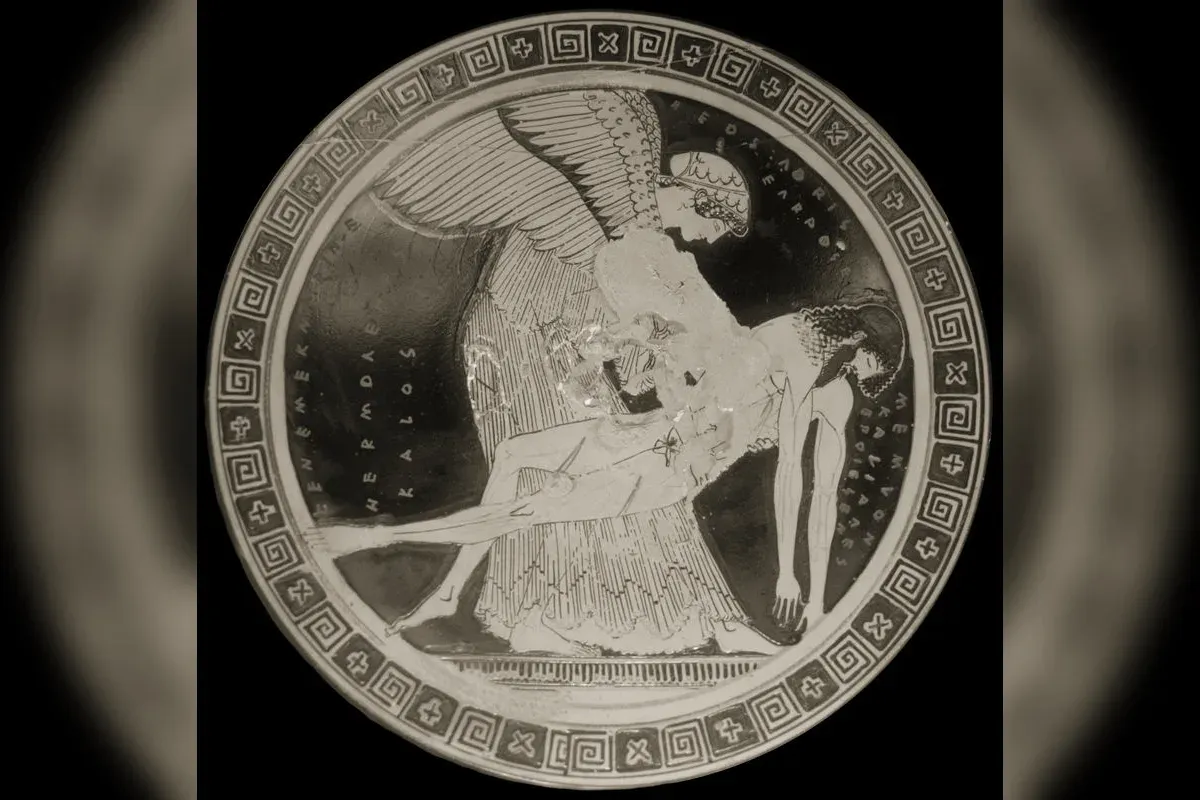
Eos is Dawn itself, personified as a goddess who goes ahead of the Sun’s chariot and opens the day. She belongs to the same astronomical family as Helios and Selene: second-generation Titans who do not govern the heavenly bodies but are them. What sets her apart, in a pantheon where male gods abduct mortal women almost as a rule, is that the direction is reversed. Eos is the Greek deity who carries off men — and every time, it ends badly.
The third light
Hesiod files all three luminaries under one act of genealogy: Theia, joined with Hyperion, bore “great Helios, bright Selene, and Eos, who shines for all mortals on earth.”
The sequence is functional, not ornamental. Hyperion, “he who goes above,” is the principle of celestial motion; Theia, “the divine,” carries brightness. Their three children mark the visible sky: Helios is the Sun, Selene the Moon, and Eos the passage from night into day. Eos is not a vaguely “morning” goddess — she holds a precise slot on the clock, the threshold.
That is why Homer puts her at the head of so many books. The Iliad and the Odyssey use her as a structural device: when “rosy-fingered Dawn, child of morning, appeared,” a new day of story begins. She is, quite literally, the punctuation of epic.
Rosy-fingered, saffron-robed
The two commonest Homeric epithets describe a colour, not a temperament.
Rhododaktylos, “rosy-fingered,” names the pink streaks that stretch up from the horizon like fingers; krokopeplos, “saffron-robed,” names the orange-yellow of the sky just before sunrise. The Greeks did not invent a goddess and then hunt for imagery. They named a phenomenon and inflected it as feminine. Nothing in the formula requires a psychology.
Her offspring follow the same meteorological logic. By Astraeus, a minor Titan, Hesiod gives her the Winds — Zephyrus, Boreas and Notus — then Eosphoros, “dawn-bringer,” the morning star, and the other stars of heaven. The Dawn generates exactly what rises with her.
The curse of Aphrodite
The rest of her mythology follows from a punishment.
Apollodorus reports that Eos had slept with Ares. Aphrodite, enraged, struck her with perpetual desire for young mortals. The whole run of abductions is the sentence being served: she does not fall in love, she is condemned to want.
The victims are many and the pattern repeats. Orion the hunter, whom she takes to Delos and whom Artemis shoots down — Calypso, in the Odyssey, cites that exact case when accusing the gods of refusing goddesses the mortal lovers they allow themselves. Cleitus, whom she settles among the immortals. Cephalus, seized in Attica, whose story branches off into the marital tragedy with Procris. And Tithonus, a Trojan prince and brother of Priam.
The motif is regular enough for art to fix it: on Attic vases Eos appears as a winged woman pursuing a fleeing youth with a lyre or a spear. It is the standard divine pursuit scene, with the genders swapped.
Tithonus, or the wish badly worded
Eos’s central myth is a drafting error.
The Homeric Hymn to Aphrodite tells it as a cautionary tale: Eos asks Zeus to make Tithonus immortal, and Zeus grants it. But the goddess forgets to ask for youth. While his beauty lasts she feeds him ambrosia; then the first grey hairs come and she stops sharing his bed; then “hateful old age” presses on him entirely, and he cannot stir a limb. She shuts him in a chamber with shining doors, from which — the poem says — an endless voice still flows, but no strength at all.
The logic is cruel and thoroughly Greek. Immortality without youth is not a gift but a sentence with no exit, since death, which releases every other old man, is closed to him. A later version, credited to Hellanicus, completes the degradation by turning him into a cicada: an insect that is nothing but a voice.
The contrast with the other great love story in the family is pointed. In a tradition reported by Apollodorus, Selene loves Endymion, whom Zeus allows to choose his fate: he chooses perpetual sleep and remains young. Tithonus, by contrast, receives duration without preservation. The stories thus set two opposite forms of stasis beside one another without giving the goddesses the same wish.
Memnon and the tears of morning
By Tithonus, Eos has a son: Memnon, king of the Ethiopians.
The episode belongs to the Aethiopis, a lost epic of the Trojan Cycle summarised by Proclus and expanded at length by Quintus of Smyrna. After Hector’s death, Memnon arrives with his troops to relieve Troy, wearing — like Achilles — armour forged by Hephaestus. He kills Antilochus, son of Nestor and Achilles’s closest companion after Patroclus. Achilles hunts him down and kills him.
Tradition adds a spectacular scene: the psychostasia, the weighing of souls. Zeus sets the fates of Achilles and Memnon on a balance, and Memnon’s sinks. Aeschylus made a tragedy of it, now lost, titled precisely Psychostasia, in which Eos pleaded her son’s case.
The mourning that follows left two durable aetiologies:
- the morning dew is the tears Eos sheds daily over her son, an image taken up by Ovid and turned into a commonplace of Latin poetry;
- the Memnonides, birds born from the ashes of his pyre, who return every year to fight above the hero’s tomb.
Eos does secure immortality for Memnon from Zeus, if not life. She will thus have asked twice for the same favour and twice received a defective version: a lover who never dies of old age, a son who does not survive the fight. That double failure makes her, within the Trojan War cycle, the divine figure of a grief that starts over every morning.
The colossus that sang at daybreak
An unexpected afterlife ties Eos to real Egypt.
Greeks, and then Romans, identified one of the two colossal statues of Amenhotep III near Thebes as Memnon. Damaged by an earthquake, the northern colossus emitted a ringing note at sunrise — a thermal effect as dew-soaked stone expanded. Visitors heard a son greeting his mother. Pausanias describes the monument and notes, with his usual scepticism, that the local Egyptians insisted it was not Memnon at all but one of their own kings.
Dozens of Greek and Latin inscriptions carved on the statue’s legs record the ancient tourism it attracted, the emperor Hadrian included. Restoration work under Septimius Severus silenced the colossus for good.
Aurora, Uṣás and a distant kinship
Eos is one of very few figures in the Greek pantheon whose name can be reconstructed from well before Greece.
Indo-European comparison groups Ēṓs, Latin Aurora, Vedic Uṣás and Lithuanian Aušrà under a single root, *h₂éwsōs. The epithets answer one another across languages: the Vedic goddess is “daughter of heaven,” yokes horses or ruddy cows, and stays eternally young while ageing the mortals she wakes each morning. That last trait throws the Tithonus myth into sharp relief — the dawn does not age; what she wakes does.
At Rome, Aurora remains largely a poet’s word. The properly Roman deity of first light is Mater Matuta, honoured at the Matralia of 11 June, whose ritual — matrons praying for their sisters’ children rather than their own — has no Greek counterpart. The identification with Eos is, as so often, a literary operation rather than a fact of cult.
What the ancient sources say
No single text gives Eos sustained treatment, and her figure has to be reassembled from cross-references:
- Hesiod supplies the genealogy (371-374), the astral offspring (378-382) and Memnon (984-987);
- Homer installs her as the formula that opens a day and cites Orion through Calypso’s mouth;
- the Homeric Hymn to Aphrodite carries the only developed account of Tithonus, and carries it with an argument in view — dissuading Aphrodite from making Anchises immortal;
- Apollodorus preserves the cause of her curse, which retrospectively gives the whole run of abductions its unity;
- Quintus of Smyrna and Ovid transmit the Memnon cycle, one as epic, the other as an origin story for dew and birds.
The difference of purpose between those texts explains the variants: the Hymn wants a lesson about the limits of divine gifts, Ovid wants an explanation of a natural fact, and Quintus wants a set-piece of valour.
Ancient sources
- Hesiod, Theogony, 371-374; 378-382; 984-987
- Homer, Iliad, 11.1-2; 8.1
- Homer, Odyssey, 5.121-124; 15.250-251
- Homeric Hymn to Aphrodite (no. 5), 218-238
- Apollodorus, Library, 1.4.4; 3.12.4
- Quintus of Smyrna, Posthomerica, books 1-2
- Ovid, Metamorphoses, 13.576-622
- Pausanias, Description of Greece, 1.42.3
See also
Related entries
Stories featuring this entity
Frequently asked questions
Who is Eos in Greek mythology?
Eos is the Dawn personified, a second-generation Titaness, daughter of Hyperion and Theia and sister of Helios the Sun and Selene the Moon. She opens the gates of the sky each morning ahead of her brother's chariot. Homer calls her 'rosy-fingered Dawn', and myth credits her with a run of abductions of young mortal men — the most famous of whom, Tithonus, ends as an immortal reduced to a voice.
Why does Tithonus grow old forever?
Because Eos asked for the wrong thing. In the Homeric Hymn to Aphrodite she obtains immortality for her Trojan lover from Zeus but forgets to ask for eternal youth. Tithonus therefore never dies and never stops ageing: first weakened, then unable to move a limb, he is shut in a chamber from which only an endless voice escapes. A later version finishes the process by turning him into a cicada.
What does 'rosy-fingered dawn' actually mean?
It is a colour word, not a character sketch. The Greek rhododaktylos describes the streaks of pink light that reach up from the horizon like fingers at first light, exactly as krokopeplos, 'saffron-robed', describes the orange-yellow of the sky just before sunrise. Homer uses the phrase as a structural marker: when rosy-fingered Dawn appears, a new day of narrative begins.