Greek mythology · Gods & goddesses
Zephyrus, Greek god of the west wind and the breath of spring
In brief
Zephyrus, god of the west wind: harsh in Homer, gentle in Rome, sire of Achilles's horses, jealous killer of Hyacinthus and husband of Chloris.
- west wind
- spring and flowering
- the breezes of Elysium
- wings
- +1
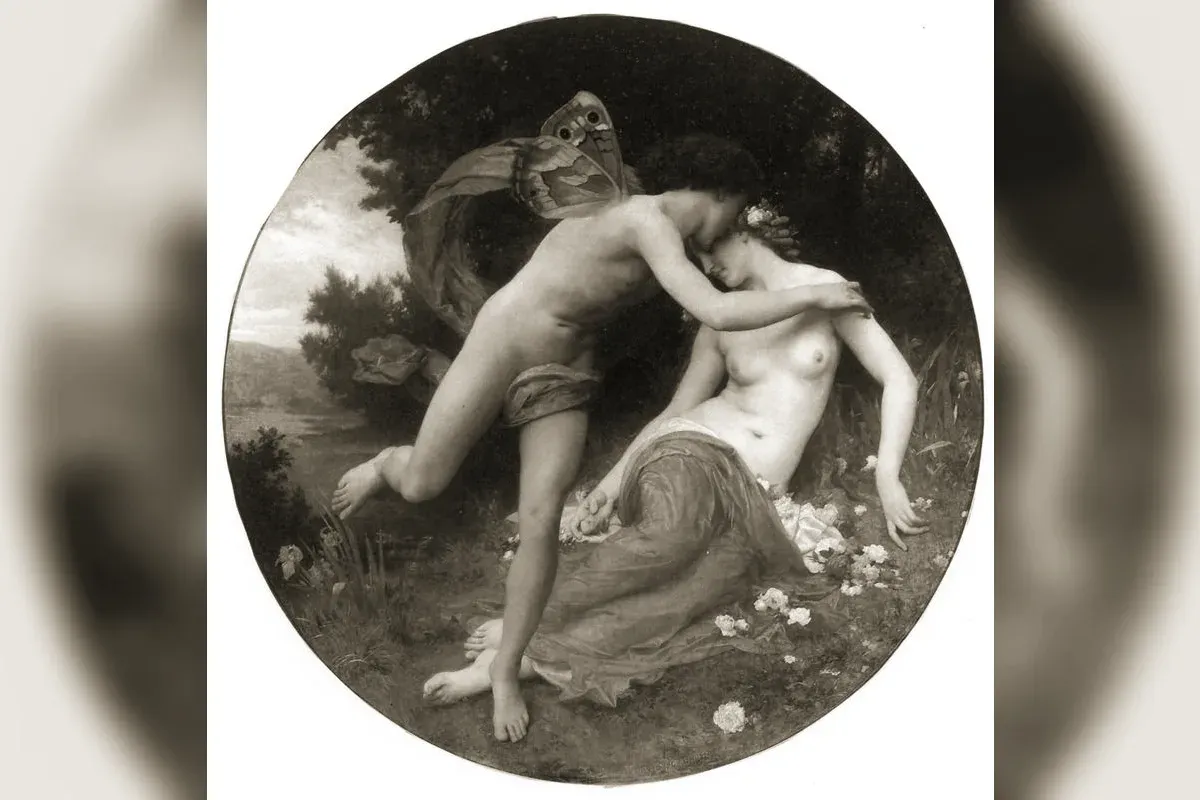
Zephyrus is the west wind personified, and the most misread of the Greek winds. Modern usage has kept only the mild breeze; the Iliad gives a hard wind that piles up the sea. Son of Eos and brother of Boreas, he is the one Greek god whose character reversed itself over the course of antiquity.
An oriented wind, son of the Dawn
Hesiod lists him, with Boreas and Notus, among the children of the Titan Astraeus and the Dawn (Theogony 378-380). These three are the regular winds: they blow from a fixed quarter and return with the seasons. The poet contrasts them explicitly with the squalls descended from Typhoeus, which strike at random and destroy ships.
Zephyrus lives in Thrace with his brothers — it is in his house that Iliad 23 has them feasting when Iris brings them Achilles’s prayer for the pyre of Patroclus. Counter-intuitive for a west wind, but Homer thinks like a poet rather than a cartographer: the winds are a household, and kinship counts for more than the map.
Homer’s Zephyrus: harsh, not soft
In the Iliad, Zephyros is a storm wind. He blows with Boreas on the pyre, drives the swell against the ships, shrieks — Homer applies to him the epithet dusaês, “ill-blowing,” and ranks him among the winds sailors fear.
A single passage anticipates the mildness he will later acquire, and it is set outside the world: in the description of Elysium that Proteus gives Menelaus in Odyssey 4, Ocean sends up unceasing breezes of Zephyrus to refresh men (4.566-568). Elysium has no snow, no winter and no rain, only that breath.
The gap between the two uses is the heart of the god. The west wind brings Greece its Atlantic rain and its equinoctial gales; it also brings, when spring returns, the end of the bad season. Rome settled the matter by renaming him Favonius, “the favourable,” and Pliny dates to early February the day this wind opens the farming year. The breeze won — and the grain harvest fixed the god’s memory.
Sire of the immortal horses
His most famous fatherhood is equine. In Iliad 16, Homer explains the origin of Xanthus and Balius, the two immortal horses yoked to Achilles’s chariot: the Harpy Podarge, grazing in a meadow beside the stream of Ocean, conceived them by Zephyrus.
The genealogy matches the one given for Boreas, sire of Erichthonius’s foals: in Greek thought winds beget horses because they are speed itself. Xanthus will later be given brief speech by Hera to warn Achilles of his coming death — the horse born of wind is also the horse that knows.
The death of Hyacinthus: two versions
The most dramatic myth attached to Zephyrus is also the one where the sources contradict each other most sharply, and the comparison repays attention.
In Ovid (Metamorphoses 10.162-219) the death of Hyacinthus is pure accident: Apollo throws the discus, it rebounds off the ground and strikes the young man in the face; the god, unable to save him, raises from his blood the flower that bears his name. No third party is involved.
In Lucian (Dialogues of the Gods 14) and Philostratus (Imagines 1.24) the cause is entirely different: Zephyrus loved Hyacinthus, the boy preferred Apollo, and the jealous wind deflected the discus in mid-air to bring it down on the one who had refused him.
Both traditions circulate side by side in later antiquity. The jealous-wind version has the advantage of supplying a culprit and turning an accident into a divine crime of passion; Ovid’s has the opposite advantage, making Apollo responsible without being guilty, which is precisely the engine of his narrative. Neither can be presented as the version of the myth.
Chloris becomes Flora
Ovid tells the other great Zephyrus myth elsewhere, and this time he lets the goddess speak. In the Fasti (5.195-220), Flora explains her own origin: “I was Chloris, who am now called Flora.” A nymph of the blessed fields, she was seen by Zephyrus, pursued, carried off — and then married. The wind, she says, made amends for his violence: he gave her as a settlement dominion over all flowers and a garden in perpetual spring.
The story produced one of the most reproduced images in European painting. In Botticelli’s Primavera (c. 1480) the right-hand third of the panel unfolds the scene in three stages: a blue, wind-swollen Zephyrus bursts from the trees, seizes the nymph Chloris whose mouth breathes out flowers, and Chloris becomes Flora, the crowned woman scattering roses. A single painting holds the abduction, the metamorphosis and the outcome.
Iris, Eros and Psyche
Two minor traditions finish the portrait. Alcaeus makes Eros the child of Zephyrus and Iris — a rare pedigree, but a coherent one: desire born of the warm wind and the rainbow.
And in Apuleius’s Metamorphoses, it is Zephyrus who, at Cupid’s order, lifts Psyche from the edge of the crag where she has been exposed and sets her down gently in the valley of the invisible palace. The west wind serves there as a wedding conveyance: his narrative function is to carry without harming, which is the exact inverse of the Homeric Zephyros.
Afterlife: from the Tower of the Winds to a shirt fabric
On the Tower of the Winds in Athens (first century BC), Zephyrus takes the western face: a near-naked youth with spread wings, carrying an armful of flowers in a fold of his cloak — opposite a bearded, heavily booted Boreas. The sculpted opposition states the whole contrast between the two brothers.
The name has survived everywhere except in mythology: zephyr means a light breeze, and since the nineteenth century a fine, soft cotton cloth chosen for its lightness. Of Homer’s gale nothing remains but a summer shirt.
Further reading
For the mother of the winds, see Eos; for the brother who holds the opposite face of the Tower of the Winds, Boreas. For the god whose love Zephyrus’s jealousy cuts short, see Apollo. For the blessed country his breezes cool in Homer, see Elysium, and for the god who describes it to Menelaus, Proteus.
Ancient sources
- Hesiod, Theogony, 378-380
- Homer, Iliad, 16.148-154; 23.192-218; Odyssey, 4.566-568
- Lucian, Dialogues of the Gods, 14
- Philostratus, Imagines, 1.24
- Ovid, Metamorphoses, 10.162-219; Fasti, 5.195-220
- Apuleius, Metamorphoses, 4.35; 5.1
See also
Related entries
Frequently asked questions
Was Zephyrus a gentle wind or a violent one?
Both, depending on the period. In Homer, Zephyros is a hard wind that raises the swell and whips up funeral pyres alongside Boreas. It is the later tradition, carried into Latin under the name Favonius, that makes him the warm breeze announcing spring. The reversal is complete enough that the same god personifies the western gale in the *Iliad* and the mildness of Elysium in the *Odyssey*.
Did Zephyrus kill Hyacinthus?
That is one version, not the only one. Ovid tells the death of Hyacinthus as an accident: the discus thrown by Apollo bounces off the ground and strikes the boy. Lucian and Philostratus give a different cause — Zephyrus, a rejected lover of Hyacinthus and jealous of Apollo, blows the discus off course in mid-flight. Both traditions circulated in antiquity without either driving out the other.
Who is Chloris, the wife of Zephyrus?
A meadow nymph whom Ovid lets speak in the *Fasti*: seized by Zephyrus, she receives from him dominion over flowers as a marriage settlement and becomes Flora. 'I was Chloris, who am now called Flora,' she says. Botticelli painted the whole sequence into the *Primavera*, where the right-hand side shows the blue Zephyrus seizing Chloris and Chloris turning into a flower-covered Flora.