Greek mythology · Gods & goddesses
Iris, Greek goddess of the rainbow and messenger of the gods
In brief
Iris, Greek rainbow goddess and divine messenger: her central role in the Iliad, the Styx water she fetches for oaths, and her Harpy sisters.
- divine messages
- the rainbow
- the link between sky, earth and sea
- the oath of the gods
- +4
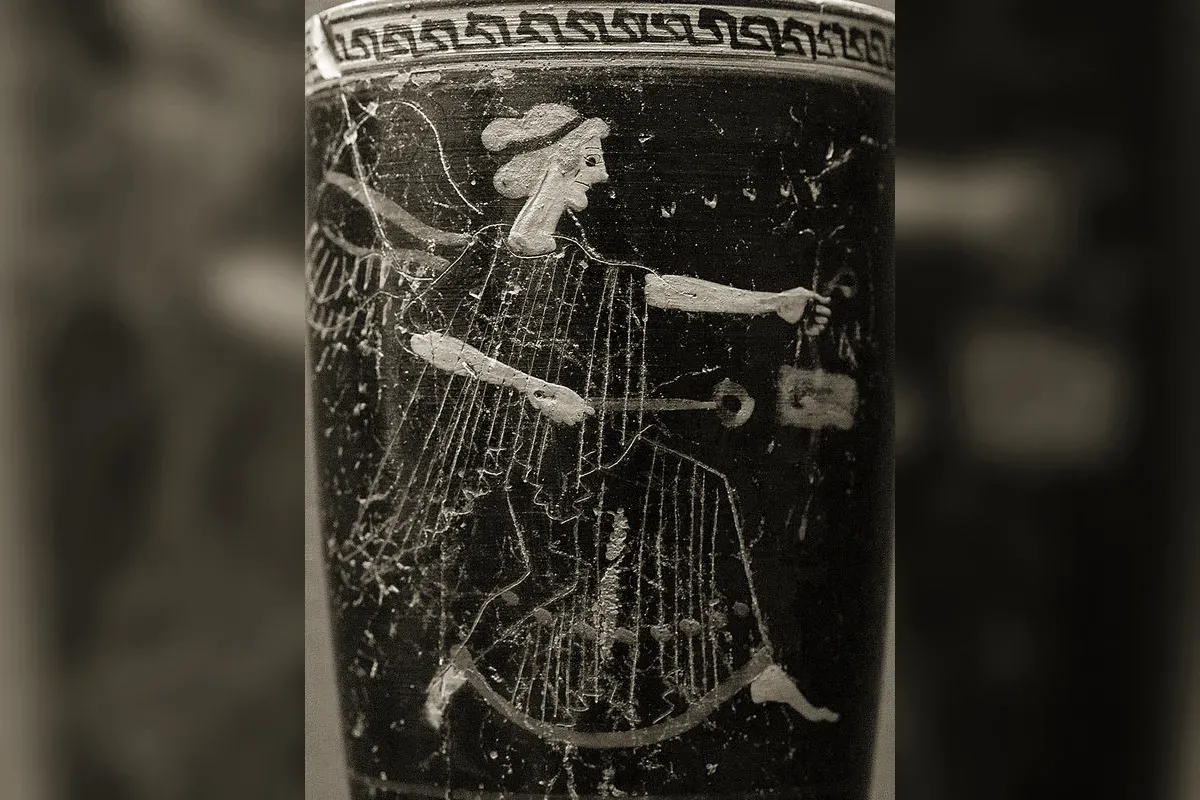
Iris is the messenger of the gods and the rainbow itself. The two roles are one: what visibly joins sky to earth is the same thing that carries divine speech along it. Unlike Hermes, who negotiates, escorts and schemes, Iris only carries — fast, exactly, without comment. She is the messenger of the Iliad, and one of very few Greek deities whose name survives as an ordinary word in several modern languages.
Daughter of Wonder, sister of the Harpies
Hesiod gives her a genealogy that is often overlooked and that explains a great deal.
Iris is the daughter of Thaumas — whose name means “wonder, portent”, and who is himself a son of Pontus the sea and of Gaia — and the Oceanid Electra. From that same union come the Harpies, Aello and Ocypete, “Storm-Wind” and “Swift-Flier.”
The sibling group is perfectly logical. Iris and the Harpies are all winged powers that travel at wind-speed and carry something off: the first a message, the others their prey. One meteorological family produces both the benign portent and the snatching one. Iris’s Homeric epithet podarkes, “swift-footed,” is elsewhere applied to a horse: Podarge, the mare sired by the wind, is a Harpy.
The messenger of the Iliad
This deserves stating plainly, because it is a structural fact about the poem: in the Iliad, messages are almost never carried by Hermes. They are carried by Iris.
She appears at every hinge of the action:
- in Book 2, disguised as Polites, she launches the Trojan army;
- in Book 3, disguised as Laodice, she fetches Helen and places her on the walls for the famous scene where Priam has her name the Greek commanders;
- in Book 15 she brings Poseidon the order to leave the battlefield, and, faced with his furious refusal, reminds him that the Erinyes always attend the elder-born — the argument that ends the god’s revolt;
- in Book 18 she tells Achilles to show himself at the ditch, though he has no armour, so that his shout alone can rout the Trojans;
- in Book 23 she goes to Thrace to fetch Boreas and Zephyrus to light Patroclus’s pyre;
- in Book 24 she descends twice: to Thetis at the bottom of the sea, then to Troy to order Priam to go alone, by night, to ransom his son’s body.
She crosses sky, sea and besieged city without ever stopping in any of them. Her narrative function is that of a channel: she makes it possible for the will of Zeus to reach one precise point of the Trojan War at the exact moment it is needed.
One striking fact: in the Odyssey Iris vanishes entirely and Hermes takes over the job. The change is not a matter of style. The Odyssey needs a messenger who acts — who hands Odysseus the moly, who argues with Calypso — and acting is precisely what Iris does not do.
Styx water and the oath of the gods
Iris’s gravest role is not Homeric but Hesiodic, and it is little known.
When strife breaks out among the immortals, the Theogony says, Zeus sends Iris to fetch, in a golden ewer, the icy water of the Styx, the river that pours from the rocks of the underworld. A god who swears by that water and forswears himself falls breathless for a full great year, tastes neither nectar nor ambrosia, lies without a voice; and when that ordeal is finished he is kept out of the assembly of the gods for nine years more.
The detail matters. Iris is the only figure who moves, between the underworld and Olympus, the substance that makes a divine undertaking binding. In other words: she carries the word of the gods, and also what guarantees that the word holds.
Demeter’s refusal
The Homeric Hymn to Demeter contains the one episode in which a mission of Iris fails, which is what makes it valuable.
After the abduction of Persephone, Demeter has suspended all growth; humanity faces starvation and the gods face the loss of their offerings. Zeus therefore sends Iris first, “swift-footed and saffron-robed.” She crosses the distance in an instant, finds the goddess seated veiled in her temple at Eleusis, and delivers the order to return to the immortals.
Demeter refuses. The poem simply says that “her heart was not persuaded.”
Zeus must then send every other god in turn, with gifts and honours, before conceding the substance of the dispute and recalling Persephone. The scene marks the exact limit of the character: Iris transmits an order flawlessly, but she can do nothing against a will that says no. She has no persuasive power of her own — which is the definition of a messenger.
A goddess with no myth and almost no cult
Iris has no major sanctuary, no civic festival, and no significant offspring. One isolated tradition, credited to the poet Alcaeus, nevertheless makes Eros her son by Zephyrus, the west wind — a rare genealogy that has desire born from the meeting of wind and rainbow.
Her cult amounts to very little: Athenaeus records that on Delos she received particular cakes, which implies a modest but real place in the local calendar.
That cultic thinness fits what she is. You pray to a deity so that it will intervene; you do not pray to a transmission channel.
Aristophanes understood this and built one of the best gags of the Birds on it: Iris, intercepted in mid-flight by Peisetairos as she descends towards humanity, is asked for her papers, her flight plan and her overflight clearance, then sent away under threat of prosecution for illegal flying. The whole scene depends on the audience knowing exactly what Iris is for. She passes through.
A rainbow that belongs to no one
It is worth setting the Greek rainbow beside another tradition, because the contrast is instructive.
For the Greeks the rainbow is an appearance: it signals that something divine is passing, but nobody walks on it. Homer uses it twice as a weather simile — for the gleam of Agamemnon’s baldric, and for the cloud Zeus stretches across the sky as a sign of war or storm.
In Norse mythology, by contrast, the bridge Bifrost is infrastructure: the gods cross it daily to reach their assembly, it is guarded, and it will eventually break. Two cultures look at the same phenomenon and draw opposite conclusions — a sign on one side, a road on the other.
Iris in Virgil: the messenger becomes an agent
At Rome, Iris keeps her name and changes her character, and it is Virgil who performs the shift.
In the Aeneid, Juno uses her as an operative rather than a mouthpiece. Iris takes the shape of old Beroe to push the Trojan women into burning the ships in Sicily; she goes down to tell Turnus the enemy camp is unguarded; and above all, at the death of Dido, Juno sends her to cut the lock of hair that holds the queen’s soul in her body, because Dido dies before her time and Proserpina has not yet claimed her due.
That last scene has no Greek equivalent. The messenger becomes the officiant of a rite of passage, and her coloured descent over the sky of Carthage — “trailing a thousand mingled colours against the sun” — is probably the finest image of a rainbow in ancient literature.
What the ancient sources say
The figure is assembled from roles rather than from a narrative:
- Hesiod supplies the marine genealogy and the judicial function tied to the Styx;
- Homer hands her the whole of the divine post in the Iliad, and removes her completely from the Odyssey;
- the Homeric Hymn to Demeter shows the limits of her mandate;
- Aristophanes proves the role was familiar enough to an Athenian audience to be parodied;
- Virgil turns the messenger into an executive agent and fixes the colourful iconography that Western painting would inherit.
None of these texts gives her a will of her own. That is her definition, and also why she was never displaced: a messenger with no personal stake does not betray.
Ancient sources
- Hesiod, Theogony, 265-269; 780-806
- Homer, Iliad, 2.786-807; 3.121-140; 15.157-219; 18.165-202; 23.198-212; 24.77-99 and 24.144-188
- Homeric Hymn to Demeter, 314-324
- Alcaeus, fr. 327 Lobel-Page
- Aristophanes, Birds, 1199-1261
- Virgil, Aeneid, 4.693-705; 5.606-663; 9.1-24
- Athenaeus, Deipnosophistae, 14.645b
See also
Stories featuring this entity
Frequently asked questions
What is the difference between Iris and Hermes?
They serve in different texts and in different ways. Iris is the messenger of the Iliad: she delivers orders, does not negotiate, and never lingers. Hermes is the messenger of the Odyssey and of later myth, where he acts, escorts, tricks and guides souls. Iris joins sky to earth the way a rainbow joins two points; Hermes crosses boundaries and settles in them.
Why is Iris associated with the rainbow?
Because she is its direct personification. In Greek, iris names the rainbow before it names the goddess, and Homer uses the word for the weather phenomenon itself. The link is functional: a rainbow visibly joins sky to earth, exactly as the messenger brings the speech of the gods down to mortals.
What is Iris's role in the oaths of the gods?
A judicial one. Hesiod tells how, when strife breaks out among the immortals, Zeus sends Iris to fetch the icy water of the Styx from the ends of the world in a golden ewer. A god who swears on that water and forswears himself lies breathless and voiceless for a full year, then is barred from the divine assembly for nine more. Iris does not merely carry the message; she carries the instrument of the penalty.