Greek mythology · Creatures
The Harpies in Greek mythology: the winged snatchers
In brief
In Greek mythology the Harpies are winged daughters of Thaumas and the Oceanid Electra, sisters of Iris. Homer treats them as storm-winds that carry people off; Apollonius makes them the plague of the seer Phineus; Virgil turns them into foul bird-bodied monsters with women's faces.
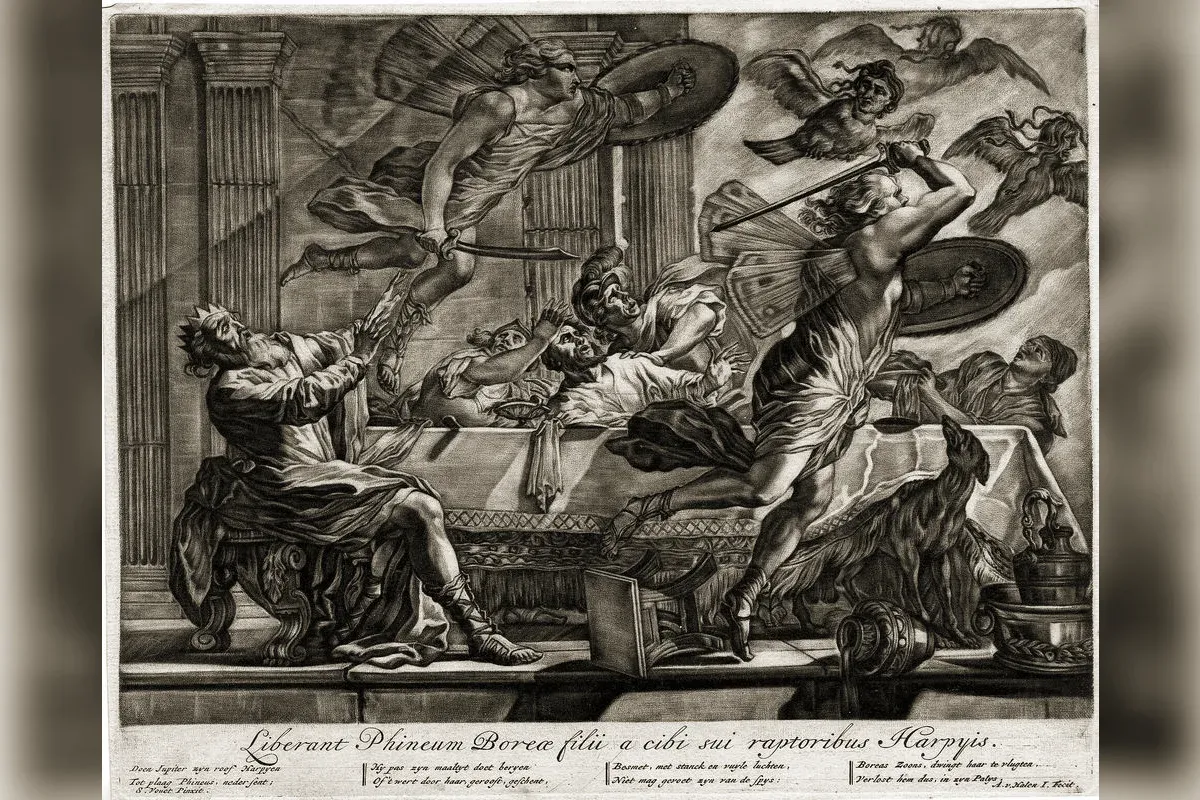
The Harpies are winged powers of Greek mythology whose name means “the snatchers.” Daughters of Thaumas and the Oceanid Electra, and sisters of the messenger goddess Iris, they begin as the gusts that carry people off without a trace. Later poets make them the curse of the blind seer Phineus, driven away by the sons of Boreas during the voyage of the Argonauts, and finally, in Virgil, ravenous monsters with women’s faces and birds’ bodies. Their story is a slow transformation: from the wind that steals to the monster that defiles.
What the name means
Greek Hárpuiai is tied to the verb harpázô, “to seize, snatch, carry off.” The name describes what they do long before anyone describes what they look like. Harpies take: a person, a meal, a life. The individual names point the same way. Hesiod gives Aello, “Storm-Wind,” and Ocypete, “Swift-Flier”; the Iliad knows Podarge, “Swift-Foot”; Virgil stages Celaeno, “the Dark One.” These are names of speed and cloud, not of faces.
Family tree: a household of portents
In the Theogony (265-269), Hesiod places the Harpies among the descendants of the sea. Thaumas, son of Pontus and Gaia, marries Electra, a daughter of Oceanus — an Oceanid, not to be confused with Agamemnon’s daughter. She bears him swift Iris and the “lovely-haired” Harpies, Aello and Ocypete, who on quick wings keep pace with the blasts of the winds and with birds.
The grouping makes sense. Thaumas is “Wonder”; his daughters are wonders of the sky. Iris carries the gods’ messages, the Harpies carry off their prey — the same lightning movement, pointed once toward connection and once toward loss. Apollodorus (Library 1.2.6) keeps the same parentage and names the sisters Aellopus and Ocypete.
Only one Harpy has recorded offspring. In Iliad 16.148-151, the Harpy Podarge, grazing in a meadow by the stream of Ocean, conceives by Zephyrus the two immortal horses Xanthus and Balius that draw the chariot of Achilles. Here the Harpy is a wind-mare: the fastest horses in the epic are born from the meeting of two gusts.
In Homer: the wind that makes people vanish
Homer never describes the Harpies. He only shows them at work, always in the same way. When Telemachus speaks of his missing father, he says the Harpies “have snatched him away without glory” (Odyssey 1.241); the swineherd Eumaeus uses the same line (14.371). The phrase means a disappearance with no body — so no funeral, no tomb, no fame. For a Homeric hero there is no worse end.
The fullest passage is Penelope’s prayer to Artemis (Odyssey 20.61-78). She wishes a storm would carry her off, as one once carried off the daughters of Pandareus: orphans raised by goddesses, they were snatched by the Harpies at the very moment Aphrodite had gone to Zeus to arrange their marriages, and handed over to the Erinyes as servants. The Harpies act as agents of the unseen, pulling the living out of the known world and delivering them to the powers of vengeance.
Phineus and the Argonauts: the core myth
The episode that fixed their image is that of Phineus, the seer-king of Thrace whom Jason’s Argonauts meet on the way to Colchis. Apollonius of Rhodes tells it at length (Argonautica 2.178-300).
Apollo had given Phineus the gift of prophecy, but he revealed Zeus’s intentions too precisely. Zeus punished him with endless old age, blindness and the Harpies: whenever food is set before him they swoop from the clouds, tear it from his hands and mouth, and leave whatever remains reeking with an unbearable stench. Reduced to skin and bone, the old man recognizes in the Argonauts the rescuers he has been promised.
Zetes and Calais, the winged sons of Boreas, stand guard by the meal. The Harpies dive; the Boreads chase them across the sky with drawn swords. They are about to catch them at the Plotae (“Floating”) islands when Iris intervenes: it is not lawful, she says, to strike the “hounds of great Zeus.” She swears by the water of the Styx that the Harpies will never return to Phineus. The brothers turn back, and the islands are renamed the Strophades, the islands “of the turning.” The Harpies withdraw to a cave on Crete. Freed, Phineus tells the heroes the route to the Golden Fleece, including how to pass the Clashing Rocks — a turning point in Jason and the Golden Fleece.
How the versions differ
Apollodorus (Library 1.9.21) departs from Apollonius on three points. First, Phineus’s crime: depending on the source, he foretold the future to mortals, blinded his own sons at their stepmother’s urging, or showed the sons of Phrixus the way from Colchis to Greece. Second, the stakes of the chase: an oracle said the Harpies would die at the hands of the sons of Boreas, and that the Boreads would die if they failed to catch them. Third, what happens to the fugitives: one falls into the river Tigres in the Peloponnese, renamed Harpys after her, and is called Nicothoe or Aellopus; the other, Ocypete or Ocythoe (Hesiod, Apollodorus notes, calls her Ocypode), flees as far as the Echinades, thereafter called the Strophades because she turned back there.
Virgil relocates the episode in the Aeneid (3.209-258). Driven from Phineus’s house, the Harpies have settled on the Strophades in the Ionian Sea. Aeneas and his Trojans land and slaughter cattle; the Harpies swoop on the feast and foul it. Virgil gives them a new, precise body: girls’ faces, an obscene discharge from the belly, hooked hands, faces pale with hunger. Trojan swords cannot wound them. Perched on a rock, Celaeno, who calls herself the greatest of the Furies, delivers a prophecy: the Trojans will reach Italy, but will not wall their city until hunger drives them to eat their tables. The prophecy comes true in Book 7 (107-129), when they devour the wheat cakes they had used as platters — though there Aeneas credits the prophecy to his father Anchises, an inconsistency commentators often point out. In Book 6 (289), Harpies also stand among the monsters at the entrance to the Underworld.
From winged maiden to bird-monster
Art follows the same slope as the texts. Archaic vase-painting, notably the Chalcidian “Phineus cup” in Würzburg, shows the Harpies as winged women fleeing the Boreads, with nothing repulsive about them. Aeschylus remembers that tradition: in the Eumenides (50-51), the Pythia, groping for a way to describe the Erinyes, recalls painted figures carrying off Phineus’s dinner — then adds that the Erinyes, unlike them, have no wings.
The bird’s body with a woman’s head comes to dominate later, to the point that Harpies and Sirens blur together in art. The best-known case is the so-called Harpy Tomb from Xanthos in Lycia, a pillar tomb of the early 5th century BC whose reliefs are now in the British Museum. It takes its name from winged, woman-headed creatures carrying off small figures, usually read as souls. The identification is disputed: many scholars prefer Sirens, or unnamed funerary spirits. The monument’s name is a modern label, not an ancient inscription.
Afterlife of the myth
Dante borrows straight from Virgil. In Inferno 13, the Harpies “who drove the Trojans from the Strophades” nest in the wood of the suicides, feeding on the leaves of the trees in which the souls are imprisoned, so that every bite is a wound. The monster of hunger becomes an instrument of eternal punishment.
English kept the word as an insult — a “harpy” is a grasping, nagging woman — a post-classical shift that only remembers Virgil’s version. And naturalists gave the name harpy eagle (Harpia harpyja) to the great raptor of tropical America: a modern borrowing that, for once, returns to the first meaning of the name, the winged snatcher.
What the ancient sources say
- Hesiod, Theogony 265-269: daughters of Thaumas and Electra, sisters of Iris; Aello and Ocypete, “lovely-haired,” as fast as the winds.
- Homer, Iliad 16.148-151: the Harpy Podarge, mother by Zephyrus of Xanthus and Balius.
- Homer, Odyssey 1.241; 14.371; 20.61-78: the Harpies “snatch away” the missing; the daughters of Pandareus given to the Erinyes.
- Aeschylus, Eumenides 50-51: paintings of the winged thieves of Phineus’s meal.
- Apollonius of Rhodes, Argonautica 2.178-300: Phineus, the pursuit by Zetes and Calais, Iris’s oath, the Plotae renamed Strophades.
- Apollodorus, Library 1.2.6 and 1.9.21: the names Aellopus, Ocypete, Ocythoe, Nicothoe; the oracle and the fate of the two fugitives.
- Virgil, Aeneid 3.209-258; 6.289; 7.107-129: Celaeno and the prophecy of the eaten tables; Harpies at the gates of the Underworld.
Further reading
For the voyage on which the Harpies are driven off, read Jason and the Golden Fleece and the entry on Jason. For their sister, who calls off the chase, see Iris; for the father of the Boreads, Boreas; for the wind that sired Achilles’s horses, Zephyrus. For the other bird-women they are so often confused with, see the Sirens. For Homer’s formula of the vanished, revisit the Odyssey. And for the wider cluster, return to the Greek mythology hub.
Ancient sources
- Hesiod, Theogony, 265-269
- Homer, Iliad, 16.148-151
- Homer, Odyssey, 1.241; 14.371; 20.61-78
- Aeschylus, Eumenides, 50-51
- Apollonius of Rhodes, Argonautica, 2.178-300
- Apollodorus, Library, 1.2.6 and 1.9.21
- Virgil, Aeneid, 3.209-258; 6.289; 7.107-129
See also
Frequently asked questions
What does a harpy look like in Greek myth?
It depends on the century. Hesiod calls them 'lovely-haired' and archaic vases paint them as winged young women. By Virgil they have a girl's pale face, a bird's body, hooked talons and a filthy belly. The bird-woman image that dominates today is the late, Roman-era version.
Are the Harpies the same as the Furies?
No, though they are connected. In the Odyssey the Harpies hand the daughters of Pandareus over to the Erinyes as servants, and in the Aeneid Celaeno calls herself the greatest of the Furies. Aeschylus, by contrast, distinguishes them: his Erinyes resemble the Harpies of paintings but have no wings.
Why is the harpy eagle named after them?
The harpy eagle (Harpia harpyja), a huge raptor of the tropical forests of Central and South America, was named by European naturalists for its massive talons and its habit of snatching prey from the canopy. It is a modern borrowing that goes back to the original sense of the name: the winged snatcher.