Greek mythology · Gods & goddesses
Dione, the goddess whose name is the feminine of Zeus
In brief
Dione, mother of Aphrodite in Homer: a feminine double of Zeus, two irreconcilable genealogies, and a real cult at the oracle of Dodona.
- oracle of Dodona
- divine motherhood
- shared cult with Zeus Naios at Dodona
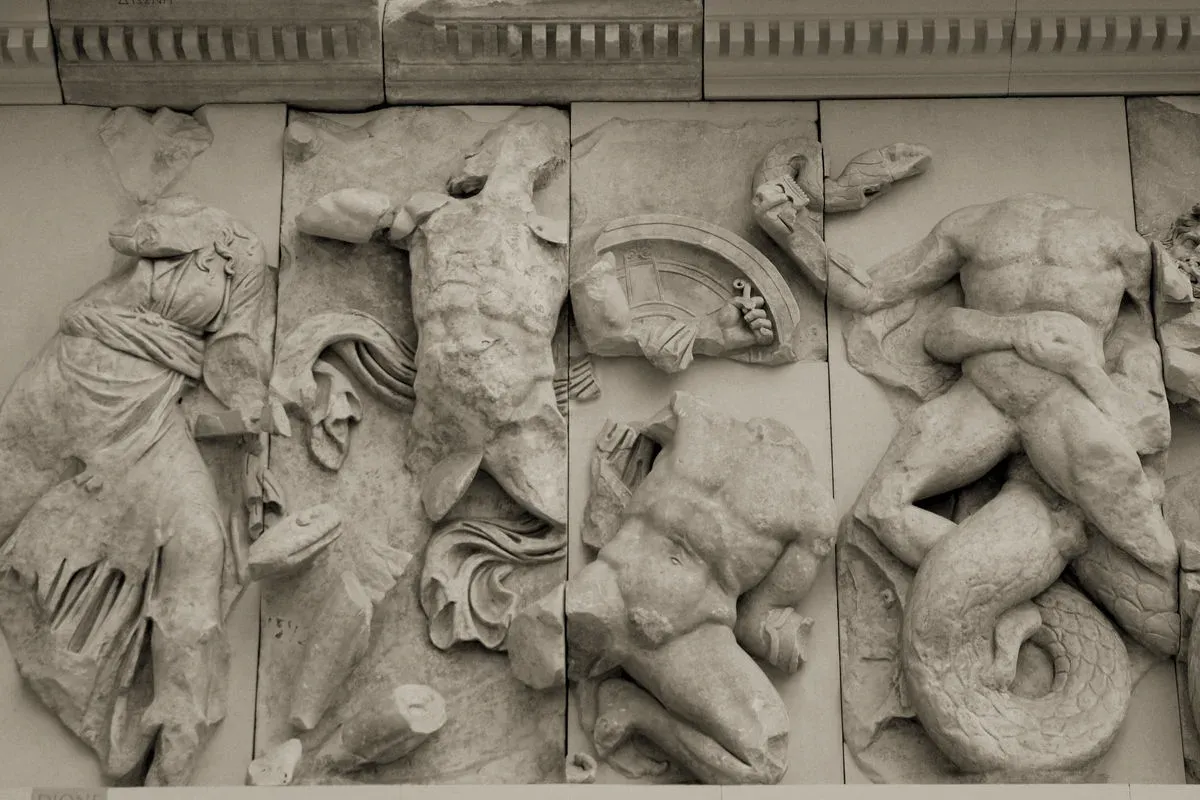
Dione is the mother of Aphrodite in Homer, and almost nothing else. That near-emptiness is what makes her worth a page: her name is the exact feminine of Zeus’s own, she shared his oracle at Dodona, and the mythographers never managed to agree on which generation she belonged to.
The Iliad scene
Start where she actually appears, because it is one moment and it is a good one.
In Iliad 5, Aphrodite has come onto the battlefield at Troy to rescue her son Aeneas, and Diomedes — driven on by Athena — drives his spear through her hand. She flees to Olympus and “flung herself upon the knees of her mother Dione” (5.370). Dione takes her in her arms, strokes her with her hand, and speaks.
What she says is startlingly unsentimental. Instead of pitying her daughter she runs through a list of gods whom mortals have already wounded: Ares, shut up thirteen months in a bronze jar by the sons of Aloeus; Hera, struck in the right breast by a three-barbed arrow of Heracles; Hades himself, shot at Pylos by the same Heracles and forced to have Paeeon dress the wound (5.382-404). Only then does she promise that Diomedes will pay for it.
It is one of the Iliad’s clearest scenes of parental comfort between deities, and Homer gives Dione a catalogue of divine injuries with which to console her daughter — reassurance by comparison, as one might remind a hurt child that others have endured similar pain.
A name that is an equation
Greek inflects Ζεύς (Zeús) as Διός (Diós), Διί (Dií). Διώνη is that stem with a feminine ending: word for word, the female form of the sky-god’s name.
Dione’s name is remarkable among those of Greek goddesses. Unlike Hera, Athena, or Demeter, it is built on the name of the sky-god. Comparative philologists often see in it a possible trace of an ancient Indo-European consort of the daytime sky-god, but the etymology alone cannot reconstruct the history of her cult.
That identity as a consort may help account for the thinness of her mythology: the surviving sources present her chiefly in relation to Zeus or to their daughter Aphrodite.
Dodona, where the pairing survived
Where myth is silent, inscriptions and orators are not. At Dodona in Epirus — the oldest oracle in the Greek world — Zeus was worshipped as Zeus Naios, and Dione stood beside him.
This is documented, not reconstructed. In Against Meidias (21.53) Demosthenes quotes the text of an oracle carried from Dodona to Athens: it prescribes sacrifices to Zeus Naios and then, separately, “to Dione one ox and a bronze table”. A whole city was instructed by the oracle to sacrifice to her, and complied.
Dodona thus preserved an old form of the pairing between Zeus and Dione. Outside that sanctuary Dione’s influence appears limited, while Hera generally occupies the role of Zeus’s wife. The antiquity and continuity of the Dodona cult probably helped preserve Dione as a distinct figure.
Two genealogies that cannot both be true
The mythographers never sorted this out.
Pseudo-Apollodorus (Library 1.1.3) counts her among the seven Titanesses born to Uranus and Gaia, alongside Tethys, Rhea, Themis, Mnemosyne, Phoebe, and Theia. Hesiod instead places her in the long roll-call of Oceanids, daughters of Ocean and Tethys (Theogony 353), between Plexaura and Galaxaura.
The two placements are incompatible: one makes her a contemporary of Cronus, the other of his nieces. Hesiod’s attestation predates the Library of Pseudo-Apollodorus by several centuries, although that does not securely date the traditions collected by the later mythographer. The genealogy on this site follows Pseudo-Apollodorus as an editorial choice, not because his version is older or more authoritative.
The instability is itself evidence. A deity about whom no stories are told, and whose name states only that she is the sky-god’s wife, is exactly the kind of figure a genealogical system files in different drawers depending on who is doing the filing.
Further reading
For the daughter she bears in the Homeric version — and for the rival birth story — read the page on Aphrodite. For the husband whose oracle she shared, see Zeus. For the Titanesses Apollodorus groups her with, read Theia and Rhea. For the castration of Uranus that produces Hesiod’s Aphrodite, read the Greek creation myth.
Ancient sources
- Homer, Iliad, 5.370-417
- Hesiod, Theogony, line 353
- Pseudo-Apollodorus, Library, 1.1.3
- Demosthenes, Against Meidias (21), 53
See also
Related entries
Stories featuring this entity
Frequently asked questions
Is Dione or the sea-foam the mother of Aphrodite?
It depends on the author. Homer makes Aphrodite the daughter of Zeus and Dione (Iliad 5.370-417). Hesiod has her rise from the foam around the severed genitals of Uranus (Theogony 188-206), which gives her no mother and places her birth before Zeus's rule. These are two different genealogies: Homer attaches Aphrodite directly to Zeus's family, while Hesiod traces her birth to the conflict between Uranus and Cronus.
Why does Dione have almost no myths?
The form of her name offers a clue without explaining everything. Diốnê is built on Diós, the genitive of Zeus, and can be understood as the feminine counterpart of the god's name. That identity as a consort probably helps explain her thin narrative record. At Dodona she nevertheless had a well-attested cult beside Zeus Naios; outside that sanctuary her influence appears limited, while Hera generally occupies the role of Zeus's wife.
What was Dione's role at the oracle of Dodona?
She was worshipped there beside Zeus Naios as his consort, and the evidence is documentary rather than mythological. In Against Meidias (21.53) Demosthenes quotes an oracle brought from Dodona to Athens instructing the city to sacrifice to Zeus Naios and, separately, to give 'Dione one ox and a bronze table'. An entire polis was told by the oracle to sacrifice to her, and did.