Greek mythology · Gods & goddesses
Uranus, the primordial Sky in Greek mythology
In brief
Uranus, first ruler of the Greek cosmos: born from Gaia, father of the Titans, unmanned by Cronus, and the source of a curse that outlives him.
- starry sky
- heavenly vault
- first cosmic sovereignty
- firmament covering Earth
- +1
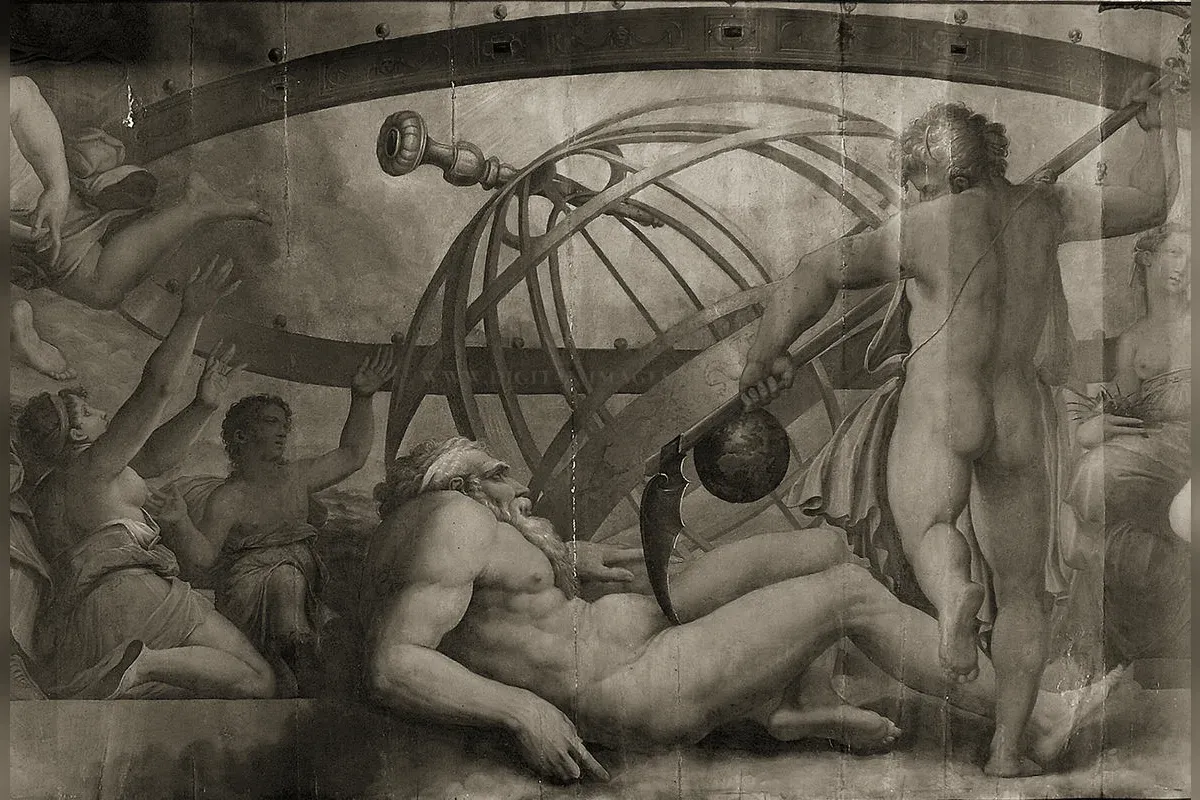
Uranus is the primordial Sky of Greek mythology, born from Gaia and then joined with her to form the world’s first architecture: Earth below and the starry vault above. He rules before the Olympians and even before the Titans. His overthrow by his son Cronus begins the mythic sequence of divine generations replacing one another.
Earth’s son and Earth’s husband
Hesiod’s opening move is deliberately strange: Gaia produces Uranus alone, sizing him to cover her exactly, and then takes him as her partner. He is her child and her husband at once, which is why the tree on this site records him under both relations. Nothing in the Theogony treats this as scandalous — at the beginning of the world there is simply no one else.
Three sets of children follow. Twelve Titans, among them Cronus, Rhea, Iapetus, Hyperion and Theia. Three Cyclopes named Brontes, Steropes and Arges — Thunder, Lightning, Brightness. Three Hundred-Handers, Cottus, Briareus and Gyges. Uranus pushes the last two sets back down inside Gaia rather than let them into the world. The first kingship in Greek myth is defined entirely by what it refuses to allow to be born.
The sickle, and what the blood made
Gaia forges a sickle of adamant and asks for a volunteer. Only Cronus takes it. When the Sky comes down on the Earth at nightfall, the Titan strikes.
The mutilation is generative rather than merely violent, which is the detail that matters. Drops of Uranus’s blood soak into Gaia and produce the Erinyes, the Giants, and the Meliae — the nymphs of the ash trees from whose wood spears are cut. The severed parts fall into the sea, and from the foam around them Hesiod has Aphrodite rise. That sea-birth belongs to the Theogony: Homer instead makes Aphrodite the daughter of Zeus and Dione. The site’s genealogy uses this Homeric parentage for Aphrodite and Pseudo-Apollodorus’s variant for Dione’s own ancestry; this is an editorial combination of two ancient traditions, not a single genealogy transmitted by one author. Uranus’s fall does not end a world. It populates one.
A curse that named a generation
Hesiod gives the maimed Uranus the last word, and turns it into an etymology. He calls his sons Titenes, punning on titainein, “to strain, to overreach”: they strained after a terrible thing, he says, and payment will come for it. In the Theogony, the name Titan is not a title. It is an insult shouted by a defeated father.
The curse then works twice over. Uranus and Gaia later warn Cronus that he too is fated to fall to one of his sons — the warning that drives him to swallow his children, and so to produce the Zeus who unseats him in the Titanomachy. Uranus never acts again after his mutilation. His sentence keeps running anyway.
An older story behind Hesiod
Comparative scholarship since the middle of the twentieth century has read this succession against the Hurrian-Hittite Song of Kumarbi, recovered from Bronze Age tablets at Hattusa. There the sky god Anu is deposed by Kumarbi, who unmans him with his teeth and is impregnated by the act, eventually producing the storm god who overthrows him in turn. The sequence — sky god, castrating usurper, storm god — matches Uranus, Cronus and Zeus closely enough that most scholars now treat Hesiod’s version as a Greek branch of a much older Near Eastern narrative rather than a local invention.
This does not diminish the Theogony. It explains why its first chapters feel less like folklore than like inherited constitutional law.
A god without altars
Uranus scarcely appears as a character after his fall, and — unusually for a deity of such rank — Greece gave him no identifiable temple, priesthood, or festival. What survives is his function: the visible sky, a witness called on in oaths, a permanent layer of the cosmos. Ancient writers slide between speaking of him as a person and as the physical heaven, an ambiguity that is characteristic of the primordial generation.
Orphic theogonies, meanwhile, give him a different ancestry altogether and derive him from Night. The Hesiodic account followed here is the dominant one, not the only one.
Ancient sources
- Hesiod, Theogony, lines 126-210 and 453-506
- Apollodorus, Library, 1.1
See also
Related entries
- Gaia, the primordial Earth and mother of the Greek gods
- Cronus, king of the Titans and father of Zeus in Greek mythology
- Rhea, mother of Zeus and the Olympians in Greek mythology
- Iapetus, Titan father of Prometheus and Atlas in Greek mythology
- Hyperion, Titan of heavenly light in Greek mythology
- Theia, Titaness of brilliance and mother of Helios in Greek mythology
- Dione, the goddess whose name is the feminine of Zeus
- Oceanus, Titan of the river that encircles the world
- Tethys, Titaness of the waters and mother of the Oceanids
- Gaia, the primordial Earth and mother of the Greek gods
Stories featuring this entity
Frequently asked questions
What was born from Uranus's blood?
The mutilation is generative rather than merely violent, which is the detail that matters. Drops of his blood soak into Gaia and produce the Erinyes, the Giants, and the Meliae — the nymphs of the ash trees from whose wood spears are cut. The severed parts fall into the sea, and from the foam around them Hesiod has Aphrodite rise. His fall does not end a world; it populates one.
Is Hesiod's succession myth original to Greece?
Probably not. Comparative scholarship since the mid-twentieth century reads it against the Hurrian-Hittite Song of Kumarbi, recovered from Bronze Age tablets at Hattusa, where the sky god Anu is deposed by Kumarbi, who unmans him with his teeth and eventually produces the storm god who overthrows him. The sequence — sky god, castrating usurper, storm god — matches Uranus, Cronus and Zeus closely enough that most scholars treat Hesiod as a Greek branch of an older Near Eastern narrative.