Greek mythology · Gods & goddesses
Theia, Titaness of brilliance and mother of Helios in Greek mythology
In brief
Theia, Titaness of radiance: the goddess Pindar credits with making gold valuable, mother of Sun, Moon and Dawn, and a Greek theory of sight.
- heavenly radiance
- sight
- value of gold and gemstones
- brilliant light
- +2
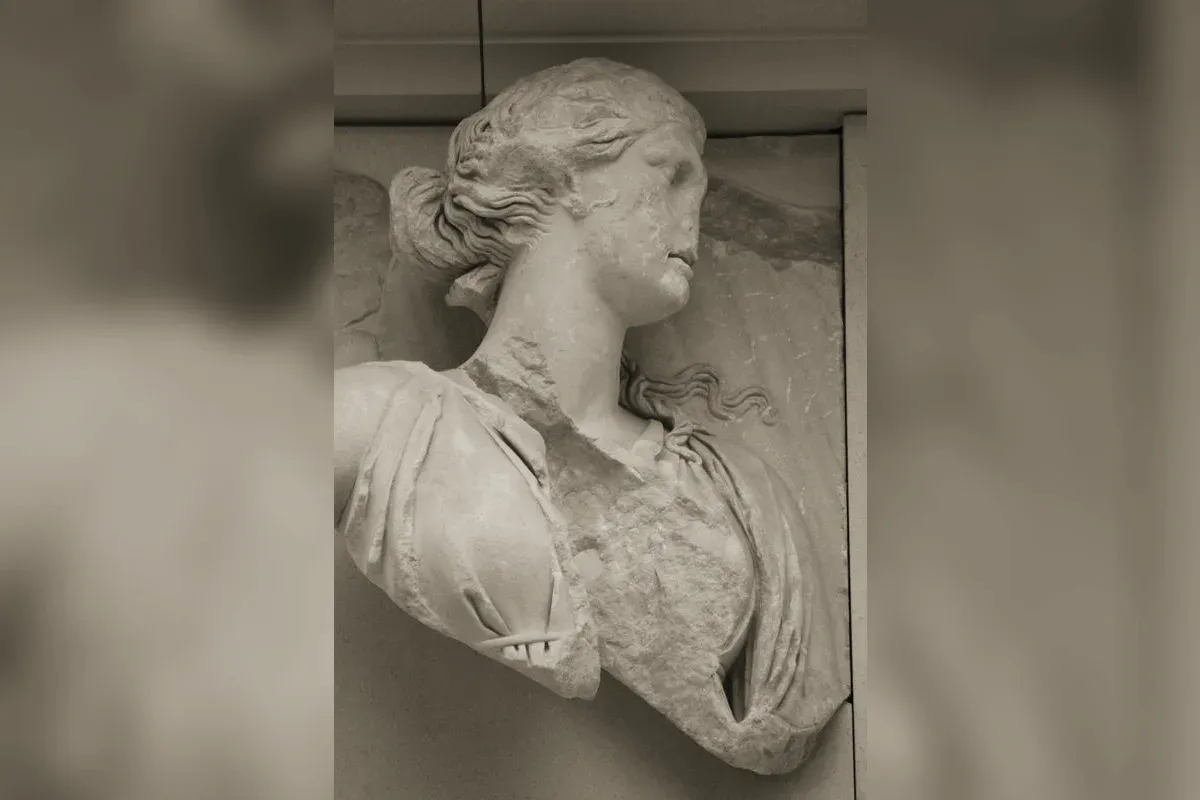
Theia is the Titaness of heavenly radiance, daughter of Uranus and Gaia, and mother — with her brother Hyperion — of Helios, Selene and Eos. She has no myth of her own. She does have one short passage of Pindar, which is enough to make her one of the more thought-provoking figures in the Titan generation.
Why gold is worth what it is worth
Pindar opens his fifth Isthmian Ode with an address to her: Mother of the Sun, Theia of many names, it is because of you that men value gold as mighty above other things.
The logic is not decorative. Gold is precious because it shines, and things shine because of Theia. She is not the goddess of wealth or of metallurgy; she is the goddess of the property that makes certain matter desirable. Pindar goes on to say that ships and horses race for glory through her, so brightness in his hymn covers gold, victory and honour alike.
This is a genuinely unusual piece of Greek thought — an explicit account of value as a function of light — and it survives in three lines by a lyric poet, attached to a goddess who otherwise does nothing.
Sight as something the eyes emit
Her name is simply Theia, “divine one”, and she is also called Euryphaessa, “wide-shining”, the name the Homeric Hymn to Helios gives to the Sun’s mother.
Ancient discussion connected Theia with thea, sight, and the association fits a widespread Greek assumption about vision: that eyes do not passively receive light but send it out, so that seeing is an active beam meeting the world. Empedocles and Plato both work with versions of that model. A goddess who is at once brightness and sight makes sense in a physics where looking is itself a kind of shining.
The connection is a plausible ancient etymology rather than a proven one, and it should be reported as such. But it explains why the same deity governs radiance, vision and the value of shining objects without the list feeling arbitrary.
The mother of the three lights
Her only narrative function is generative, and it is a substantial one: she produces the entire visible timekeeping apparatus of the Greek world.
Helios crosses by day, Selene by night, Eos opens the gate for both. Between them they define the day, the month and the working year, and it is worth noticing that a culture without clocks derived all three from a single divine couple. Theia’s descendants are what everyone in Greece used to know what time it was.
Through Helios she is also the grandmother of a striking set of figures — Circe, Pasiphae, Aeetes and Phaethon — a family in which brilliance repeatedly turns dangerous.
A goddess without stories
Theia takes no part in the Titanomachy, has no cult site of note, and appears in no surviving narrative. She belongs to the same theological layer as Hyperion: a name that gives a cosmic property a parent.
Figures like her are easy to skip, and skipping them misreads the Theogony. Hesiod’s poem is not only a collection of stories; it is an attempt to state how everything relates to everything else, and its dullest sections are frequently its most systematic. Theia is what the system looks like when nothing happens to it.
Ancient sources
- Hesiod, Theogony, 135, 371-374
- Pindar, Isthmian, 5.1-10
- Homeric Hymn 31 (To Helios), 2-7
- Apollodorus, Library, 1.1.3
See also
Related entries
- Uranus, the primordial Sky in Greek mythology
- Gaia, the primordial Earth and mother of the Greek gods
- Helios, the sun god of Greek mythology
- Selene, the Greek moon goddess and the sleep of Endymion
- Eos, the Greek goddess of Dawn, and the curse of Tithonus
- Hyperion, Titan of heavenly light in Greek mythology
Stories featuring this entity
Frequently asked questions
What did Theia actually do?
Nothing, in narrative terms — and that is worth noticing rather than skipping. She takes no part in the Titanomachy, has no cult site, and appears in no surviving story. Her only function is generative: with Hyperion she produces Helios, Selene and Eos, which is to say the entire visible timekeeping apparatus of the Greek world. A culture without clocks derived the day, the month and the working year from one divine couple.
Who are Theia's most famous descendants?
Through Helios she is grandmother to a strikingly dangerous set: Circe, Pasiphae, Aeetes of Colchis and Phaethon. It is a family in which brilliance repeatedly turns lethal — the sorceress, the mother of the Minotaur, the keeper of the Golden Fleece, and the boy who burned the world driving his father's chariot.