Greek mythology · Gods & goddesses
Morpheus, god of dreams: what the myth actually says
In brief
Morpheus is not the god of sleep and not an ancient Greek deity: he is Ovid's creation, a son of Sleep who specialises in wearing human faces inside dreams.
- dreams wearing human shape
- dream apparitions
- imitation of voice and gait
- silent wings
- +2
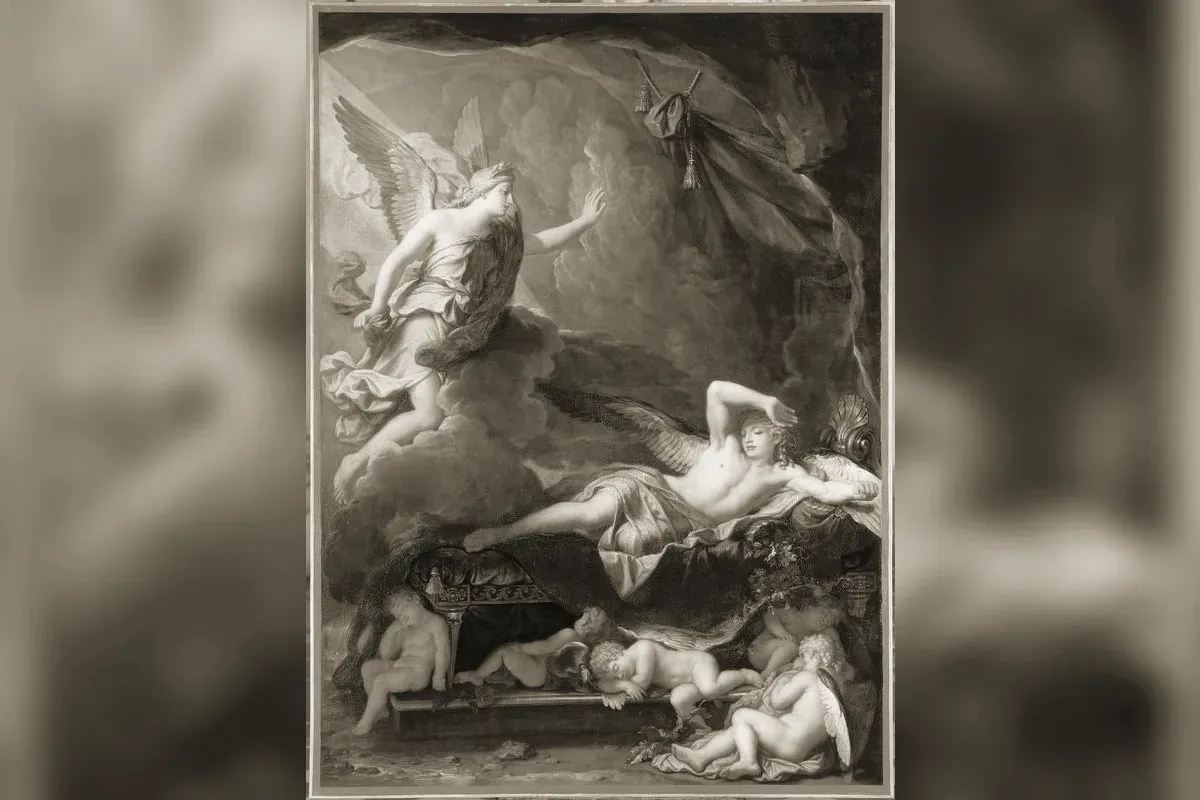
Morpheus is the god of dreams — but almost everything commonly believed about him is wrong. He is not the god of sleep, he does not belong to ancient Greek mythology, and his remit is far narrower than the phrase “in the arms of Morpheus” suggests. He is a literary invention of Ovid’s, remarkably precise, which posterity has broadened until it disappeared.
A Greek name in a Latin poem
The name comes from μορφή (morphḗ), “form, shape.” Morpheus is literally the one who fashions shapes.
That name appears in no surviving Greek text. It surfaces in Book 11 of the Metamorphoses, and nothing suggests Ovid found it in an earlier source: coining a transparent Greek name for a new character is a habit of his. Morpheus is therefore a Greek god in language only, born in Rome under Augustus.
That does not make him shallow. Ovid builds around him a system of dreaming with no equivalent in ancient literature.
Three brothers, or a taxonomy of dreaming
In the Cimmerian cave where Somnus lives — that is, Hypnos — the god sleeps surrounded by a thousand sons, the crowd of Dreams. Ovid names only three, and the selection amounts to a full classification.
- Morpheus is artificem simulatoremque figurae, “craftsman and mimic of shape.” He imitates human beings only, but he imitates them completely: face, gait, bearing, voice, down to clothing and verbal tics.
- Icelos, whom mortals call Phobetor (“the Frightener”), takes the form of beasts: bird, wild animal, serpent.
- Phantasos turns into inanimate things: earth, rock, water, wood.
The division is not ornament. It proposes a theory of dream content in three classes — human, animal, inert — and assigns the first and most disturbing register to the most skilful of the three. Ovid adds that Morpheus is the one Sleep sends to kings and commanders, while his brothers go to ordinary people: dreaming is also a matter of rank.
The one episode in which he acts
Morpheus has a single intervention, but it is superb, and it supplies the context that isolated quotations lose.
Ceyx, king of Trachis, dies at sea. His wife Alcyone does not know it and goes on praying for his return. Juno, tired of receiving the prayers of a widow who does not know she is one, sends Iris to the cave of Sleep so that the sleeping woman may be told the truth.
Barely awake, Somnus picks Morpheus. He takes on the drowned man’s shape — the exact face of Ceyx, the dripping beard, the pallor, the soaked clothes — leans over Alcyone’s bed and speaks. He does not say “your husband is dead”: he says “I am your husband, I am dead, stop waiting for me.” The dream does not inform; it embodies.
Waking, Alcyone runs to the shore and finds the body. The couple are turned into birds — halcyons — and the gods grant each winter the “halcyon days” in which the sea stays calm for their brooding.
The episode defines Morpheus’s function exactly: he invents nothing and has no message of his own. He is a medium, a carrier of appearance.
What the Greeks had instead
The Greeks were not short of dream gods; they conceived them differently, and more collectively.
Hesiod places the tribe of Dreams (Oneiroi) among the children Nyx bears alone, beside Sleep and Death. They are a crowd without individuality: nobody names them one by one.
In Homer the dream is an envoy. In Iliad Book 2, Zeus dispatches a destructive Dream to Agamemnon with orders to take the appearance of Nestor so as to be believed — exactly the device Morpheus will later use, but with no proper name and no speciality. The mechanism is already there; the character is not. That scene is one of the opening springs of the Trojan War as the Iliad tells it: the ruin of the Achaeans begins with a lying dream.
And above all, the Odyssey contains the most famous dream theory of antiquity. In Book 19 Penelope explains to her guest that dreams leave by two gates: those that pass through the gate of ivory deceive and come to nothing, those that pass through the gate of horn come true. The pun is untranslatable but real in Greek — elephas, ivory, echoes elephairomai, “to deceive”; keras, horn, echoes krainō, “to fulfil.” The distinction between true and false dreams is Greek; it is Ovid who gives it faces.
In the arms of Morpheus
The English phrase “in the arms of Morpheus” spreads in the eighteenth century, when Ovidian mythology still supplied ordinary poetic vocabulary. It carries an error that has become invisible: falling asleep is Hypnos’s business, not Morpheus’s. The son inherited the father’s domain, probably because his name scanned better.
That slippage is representative of the whole afterlife. In modern usage Morpheus became “the god of dreams” in the broadest sense, then “the god of sleep,” then a shorthand for anything to do with drifting off.
Morphine
The most concrete witness to that popularity carries a date. In 1817 the German pharmacist Friedrich Sertürner published his work on the active principle of opium, isolated some years earlier, and named it morphium after Morpheus. English morphine followed quickly.
The choice is telling: Sertürner named his substance not after Sleep but after the god who manufactures apparitions. What he observed in his subjects was not only drowsiness but the altered state, the figures, the visions. Ovid’s son turned out, two thousand years later, to have been remarkably well chosen.
Ancient sources
- Ovid, Metamorphoses, 11.592-748
- Hesiod, Theogony, 211-212
- Homer, Iliad, 2.1-40
- Homer, Odyssey, 19.559-569; 4.795-841
- Virgil, Aeneid, 6.893-899
- Statius, Thebaid, 10.84-155
See also
Related entries
Stories featuring this entity
Frequently asked questions
Is Morpheus the god of sleep or the god of dreams?
Dreams, and one kind of dream at that. The god of sleep is his father Hypnos, called Somnus in Latin. In Ovid, Morpheus is the Dream who specialises in impersonating human beings: he takes on the face, the walk, the voice, even the clothes. His brothers handle animals and inanimate things.
Does Morpheus exist in Greek mythology?
Not under that name. No surviving Greek text mentions a god called Morpheus. The Greeks knew the Oneiroi, the anonymous tribe of Dreams that Hesiod makes children of Nyx and that Homer shows being dispatched by Zeus. Morpheus is a literary creation of Ovid's, built on the Greek word morphē, 'shape.'
Why is morphine named after Morpheus?
The German pharmacist Friedrich Sertürner published his work on the active principle of opium in 1817 and named it morphium after Morpheus. The choice is revealing: he named it not after Sleep but after the god who manufactures apparitions, because what he observed was not only drowsiness but visions.