Greek mythology · Gods & goddesses
Hypnos, Greek god of sleep and twin of Death
In brief
Hypnos, Sleep personified: the gentle twin of Thanatos, the only god who can put Zeus under, bought by Hera for a bride — and one of the few to receive real cult.
- sleep
- the lulling of gods and men
- healing rest through incubation
- wings at the temples
- +3
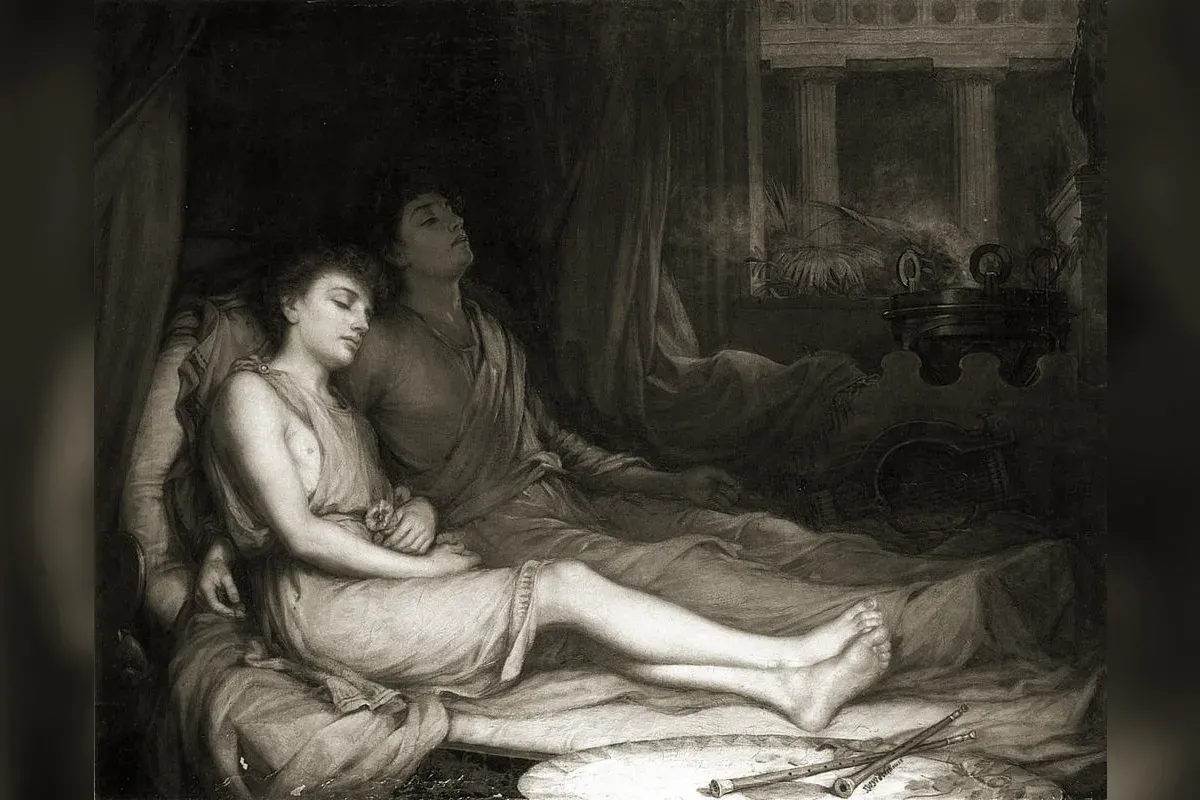
Hypnos is Sleep personified in Greek mythology: son of Night, twin brother of Death, and the only god the tradition ever shows putting Zeus under. He is a paradoxical deity — almost no personal myth of his own, yet indispensable to one of the most decisive episodes in the Iliad, and one of the rare Greek abstractions to receive an actual cult.
The gentle twin
Hesiod places Hypnos in the catalogue of children Nyx bears alone, without joining anyone (Theogony 211-212), beside Moros, the Dreams, the Moirai, Nemesis and Eris.
At lines 756-766 the poet sets the two brothers against each other with a clarity the tradition never abandoned:
Hypnos roams quietly over the earth and the broad back of the sea, gentle and kindly to men. Thanatos has a heart of iron and a spirit of pitiless bronze; he holds whatever man he takes, and even the gods hate him.
Pairing the two is not decoration; it is an argument. Sleep and death produce the same signs — closed eyes, stillness, slowed breath — and the Greeks drew a blood relation from that. But the twinning exists above all to isolate the one difference that matters: one gives back what it takes and the other does not. Homer compresses it into a repeated formula, “the twins Sleep and Death,” which has travelled far beyond Greek.
The big episode: putting Zeus to sleep
Iliad Book 14 is Hypnos’s great moment, and one of the rare passages in which a minor god changes the course of the war.
Hera wants Zeus distracted so that Poseidon can help the Greeks. She goes to Lemnos to find Hypnos and asks him to put the lord of Olympus under.
He refuses at first, and his reason is a precedent. He performed the same service once before, when Heracles was sailing home from Troy: while Zeus slept, Hera raised a storm that drove the hero onto the island of Cos. Waking, Zeus flung the gods about the palace and would have hurled Hypnos from the sky into the sea had he not run to their mother Night — “Night who subdues gods.” Zeus stopped dead, for fear of doing anything displeasing to Nyx. It is one of the very few times Homer shows the king of the gods back down.
So Hera has to pay. She offers a fine golden throne forged by Hephaestus; Hypnos declines. She finally offers what he has always wanted: Pasithea, one of the Graces. He then demands an oath sworn on the water of Styx, before the gods below — the most binding oath in the pantheon.
The next detail is the finest in the passage. Hypnos does not descend on Zeus as a majestic god: he reaches Mount Ida, climbs an enormous fir, and perches there in the shape of a mountain bird, which the gods call chalkis and men call kymindis. From there he works, invisible and roosting, while Hera does the rest.
It ends badly. At line 352 Zeus is finally asleep; on waking, his rage is terrible, and this time Hypnos has already fled to the sea and to mankind.
The one being he cannot put under
One line of the same book deserves isolating, because it defines Hypnos’s power by its limit.
He reminds Hera that he could lull anyone — including “the streams of Oceanus, who is the genesis of all things.” In other words: the river that circles the world, the eldest Titan, the very principle of generation, he could send to sleep without trouble. But not Zeus — not unless Zeus commands it himself.
The hierarchy is explicit, and it is theological: sleep has purchase on the whole cosmos except on the one who governs it.
Carrying Sarpedon home
Hypnos returns in Book 16, in the most solemn funerary scene of the poem. Zeus must let his son Sarpedon die, killed by Patroclus; he cannot save him, but he can spare him disgrace. He orders Apollo to wash the body, anoint it with ambrosia, and hand it to “the swift twins, Sleep and Death,” who carry it to Lycia for burial.
Here the two brothers, normally set in opposition, work together — and it is this scene that the famous krater signed by Euphronios around 515 BC fixed in art: Hypnos and Thanatos, bearded and winged, lifting the body under the eye of Hermes.
The cave of Sleep and its sons
Hypnos’s literary afterlife is mainly Latin, and it finally gives him a setting.
In Ovid (Metamorphoses 11.592-649), Somnus lives among the Cimmerians in a cave the sun never enters. The detail is meticulous: no cock crows there, no dog barks, no goose calls, and the house has no doors, so that no hinge can creak. Lethe seeps from the rock, its murmur inviting sleep, and poppies grow at the entrance. The god lies on an ebony bed, surrounded by his thousand sons, the Dreams.
Ovid names three, and their division of labour amounts to a taxonomy of dreaming: Morpheus, who imitates human figures to perfection; Icelos, whom mortals call Phobetor, who turns into beast, bird or serpent; and Phantasos, who takes the shape of earth, rock, water and wood.
Statius (Thebaid 10) and Virgil (Aeneid 5) put the same god to different use: in Virgil it is Somnus who tips the helmsman Palinurus overboard, a branch soaked in Lethe in his hand. Sleep there becomes a weapon.
A god people actually prayed to
This is the great difference from his twin: Hypnos receives cult, where Thanatos has neither altar nor prayer.
Pausanias describes at Sicyon, inside the precinct of Asclepius, a statue of Hypnos Epidotes — “the generous,” the one who grants — shown lulling a lion. The pairing is not accidental: Greek sanctuary medicine rested on incubation, the rite in which the sick spent the night in the temple to receive the god’s prescription in a dream. No sleep, no cure; Hypnos is therefore a liturgical necessity.
At Troezen, Pausanias records an altar shared by the Muses and Hypnos, “whom they say is dearest of the gods to the Muses” — rest as the condition of inspiration. On the chest of Cypselus at Olympia the same author describes Night carrying two sleeping children, one white and one black, their feet turned opposite ways: Sleep and Death.
The iconography follows that gentleness. Hypnos is a young man with wings set at his temples, holding either poppy stems or a horn from which he pours a sleep-bringing liquid. The bronze head of Hypnos in the British Museum, a Roman copy of a Hellenistic original, is its most widely reproduced version.
Afterlife: hypnosis
The word hypnosis is not ancient. It was coined in the nineteenth century by the Scottish surgeon James Braid, who wanted to strip “animal magnetism” of its occultist vocabulary by tying it to a physiological idea — sleep. Braid later realised that the state he described was precisely not sleep and tried, unsuccessfully, to rename his method: the Greek name had already stuck.
Hesiod’s gentle god thus lent his name to a clinical practice, while his brother supplied psychoanalysis with a label he deserved no better.
Ancient sources
- Hesiod, Theogony, 211-212; 756-766
- Homer, Iliad, 14.224-291; 352-360; 16.671-683
- Pausanias, Description of Greece, 2.10.2; 2.31.3; 5.18.1
- Ovid, Metamorphoses, 11.592-649
- Statius, Thebaid, 10.84-155
- Virgil, Aeneid, 5.838-861
See also
Related entries
Stories featuring this entity
Frequently asked questions
Who is Hypnos in Greek mythology?
Hypnos is Sleep personified, son of Nyx the Night and twin brother of Thanatos, Death. Hesiod calls him gentle and kindly to men, the exact opposite of his iron-hearted brother. He is the only Greek god able to put Zeus to sleep, and he does it twice in the Iliad, at considerable personal risk.
What is the difference between Hypnos and Morpheus?
Hypnos is sleep itself, the state of being asleep. Morpheus is not Greek at all: he is Ovid's invention, one of the thousand sons of Sleep, specialising in the imitation of human figures inside dreams. Sleep is the father's domain; dreaming is the son's trade.
Did Hypnos have a cult in Greece?
Yes, unlike his twin Thanatos, who has none. Pausanias records at Sicyon a statue of Hypnos Epidotes, 'the generous,' lulling a lion, inside the precinct of Asclepius: sleep was tied to incubation, the rite in which a patient slept in the sanctuary to receive a healing dream. At Troezen an altar joined him to the Muses.