Greek mythology · Gods & goddesses
Thanatos, Greek god of death personified
In brief
Thanatos, Death personified: son of Nyx and twin of Hypnos, chained by Sisyphus, wrestled by Heracles, and the one Greek god who accepts no offerings.
- peaceful, inescapable death
- the passage of the last breath
- dark wings
- short sword
- +1
Thanatos is Death personified in Greek mythology: not the realm of the dead, nor the judge of the dead, but the moment of dying given a winged body. Son of Nyx, born without a father, twin brother of Sleep, he holds a peculiar position in the pantheon — a god nobody prays to, nobody placates, and only two mortals ever managed to hold.
Three functions, three gods
The first thing to fix is a distinction that modern translations constantly blur.
- Hades rules the underground kingdom and administers the shades who arrive there. He takes nobody’s life.
- Charon is the ferryman: he handles the crossing, for a fee.
- Thanatos is the agent of dying. He comes to collect, and his job ends there.
Greek myth thus separates dying, crossing and dwelling, and assigns each to a different figure. That division explains why Thanatos barely appears in underworld narratives: his domain ends exactly where everyone else’s begins.
A fourth category belongs here too: the Keres, Thanatos’s sisters, female spirits of violent death, the death of the battlefield. Thanatos covers the death that arrives of itself; the Keres, the death that is torn out of you. The Iliad regularly uses them in the plural, like birds of prey stooping on the wounded.
Son of Night, twin of Sleep
Hesiod places Thanatos in the catalogue of children Nyx bears alone (Theogony 211-212), beside Moros the doom, the Dreams, Momos, the Moirai, Nemesis and Eris. It is an inventory of everything that bounds a human life, and Death is its terminus.
Lines 756-766 describe the brothers’ shared house, at the ends of the earth near the house of Night — and set the twins against each other with striking clarity:
Hypnos roams quietly over earth and the broad sea, gentle and kindly to men. Thanatos has a heart of iron and a spirit of pitiless bronze; he holds whatever man he takes, and even the gods hate him.
The contrast between the twins is the theological core of the figure. Sleep and death look alike — the same closed eyes, the same stillness — and Greeks made them brothers for exactly that reason. But one gives back what it takes and the other does not. The twinning exists to throw the single difference that matters into relief.
The one scene Homer treats with dignity
Homer makes Thanatos and Hypnos a funerary pair in one of the most solemn passages of the Iliad.
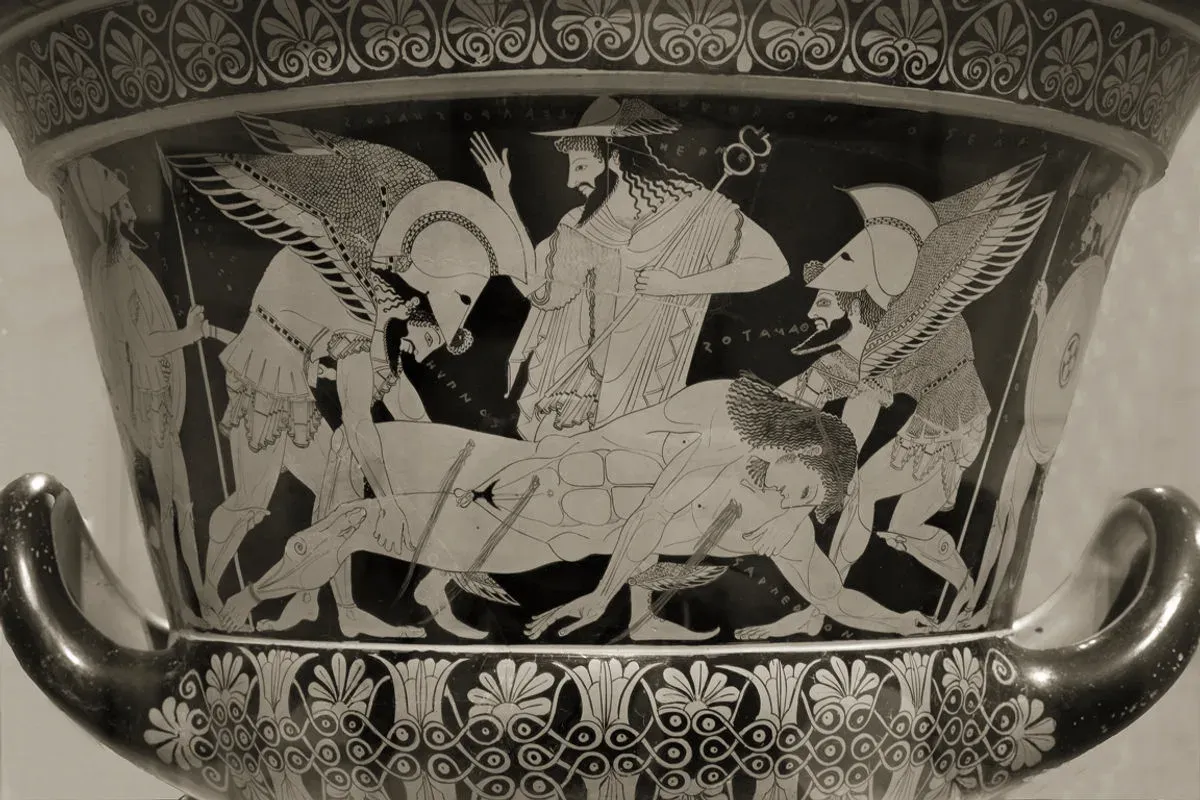
In Book 16, Zeus has to let his son Sarpedon die, killed by Patroclus before Troy. He cannot save him — fate forbids it — but he can spare him disgrace. So he orders Apollo to wash the body, anoint it with ambrosia, and hand it to “the swift twins, Sleep and Death,” who carry it to Lycia for burial.
It is the only occasion on which Thanatos is treated as a god worthy of respect. Everywhere else he takes; here he returns a body to its own soil. The scene produced one of the most famous images in Greek ceramics: the krater signed by Euphronios around 515 BC, in which Hypnos and Thanatos, bearded and winged, lift Sarpedon’s body under the eye of Hermes. The vase, long held in New York, was returned to Italy in 2008.
Book 14 also lights up the family mechanics: Hera wants Zeus asleep and negotiates with Hypnos, who recalls that he escaped the god’s fury once only by taking refuge with their mother Night. Zeus backed off — from Night, not from her sons.
Sisyphus chains Death
The myth that reveals most about the limits of Thanatos’s power belongs to Sisyphus.
The king of Corinth has informed on an abduction committed by Zeus. Sent to fetch him, Thanatos arrives carrying fetters — and Sisyphus, pretending he wants to see how they work, gets them onto Death and chains him.
The consequence is immediate and absurd: nobody dies. The old accumulate, sacrifices to the underworld powers lose their point, and above all the war-wounded survive everything. It is Ares, god of battle, who comes to free Thanatos, because a war without deaths is a war without interest. The detail is excellent: neither Hades nor Zeus fixes the problem, but the god the situation costs the most.
Sisyphus will add a second trick — instructing his wife not to bury him, then obtaining leave to go back up and complain about it, and never returning — before being dragged back by force. His punishment in Tartarus fits the offence exactly: a man who interrupted the course of things is sentenced to a task that never finishes.
Heracles wrestles Death
Thanatos’s other defeat is staged, literally, in Euripides’s Alcestis (438 BC) — the only surviving Greek tragedy in which Death walks on as a character.
King Admetus has been granted a later death if someone will die in his place; only his wife Alcestis agrees. As the play opens, Thanatos arrives to claim what is his. Apollo pleads and offers a postponement; Thanatos flatly refuses, and his answer is the best portrait of him we have: he takes no gifts, grants no delay, and remarks that he gains more honour from the young. Then he goes in to cut a lock of the victim’s hair with his sword — the gesture that consecrates the dead to the underworld powers, exactly as one cuts hair from a sacrificial animal.
Heracles, who has arrived at Admetus’s house without knowing it is in mourning, learns the truth, posts himself by the tomb, seizes Thanatos as he comes to drink the offerings, and pins him in a wrestling hold until he gives Alcestis back. The scene is not shown: Heracles narrates it. It gives the hero his last title — the one who put Death on the ground — and prepares his own deification.
A god with no altar
Thanatos receives almost no cult, and the Greeks were entirely aware of it.
Aeschylus, in a fragment of Niobe antiquity liked to quote, says so outright: alone among the gods, Death loves no gifts. Sacrificing to him gains nothing, libations obtain nothing; he has neither altar nor paean. That is the precise definition of a deity outside the system of ritual exchange — in a religion built entirely on reciprocal giving.
Traces exist all the same. Pausanias describes, on the famous chest of Cypselus at Olympia, a figure of Night carrying two sleeping children, one white and one black, with their feet turned opposite ways: Sleep and Death. A sculpted column drum from the temple of Artemis at Ephesus, now in the British Museum, shows a winged, youthful Thanatos beside Hermes. In the classical and Hellenistic periods funerary iconography softens him: he becomes a winged young man holding an inverted torch, the image of a life put out, which passes unchanged into Roman and then European tomb sculpture.
Afterlife: the Freudian misattribution
One useful correction, because the confusion is widespread. The term “Thanatos” used in psychoanalysis for the death drive is not Sigmund Freud’s: he writes in German of Todestrieb and never uses the Greek word in his published work. The label was introduced by people around him — generally credited to Wilhelm Stekel and then Paul Federn — before establishing itself by symmetry with Eros.
The slippage is worth flagging, because it has given the Greek god a psychological content he never had. The Thanatos of Hesiod and Euripides represents no drive at all. He represents the event — external, non-negotiable — that ends a life.
Ancient sources
- Hesiod, Theogony, 211-212; 756-766
- Homer, Iliad, 14.231-241; 16.671-683
- Euripides, Alcestis, 24-76; 843-860
- Aeschylus, fragment 161 Radt (Niobe)
- Apollodorus, Library, 1.9.15; 3.12.6
- Pausanias, Description of Greece, 5.18.1
See also
Related entries
Stories featuring this entity
Comparisons
Frequently asked questions
Who is Thanatos in Greek mythology?
Thanatos is Death personified, son of Nyx the Night and twin brother of Hypnos, Sleep. He is not the king of the underworld — that is Hades — but the agent of dying itself: the one who comes to take the dying person. Hesiod gives him a heart of iron and a spirit of pitiless bronze, and notes that even the immortals hate him.
What is the difference between Thanatos and Hades?
Hades rules the realm of the dead and administers the shades once they have arrived; he takes nobody's life. Thanatos is the event of dying, the agent who comes to fetch. Charon is the ferryman who handles transport. Greek myth therefore splits three functions — dying, crossing, dwelling — among three distinct figures.
Who ever defeated Thanatos?
Only two figures. Sisyphus, who chains Death when he comes to collect him, so that nobody on earth dies until Ares sets him free. And Heracles, who takes him on bare-handed beside Alcestis's tomb in Euripides's tragedy and wins the dead woman back. In both cases the victory is temporary.