Greek mythology · Gods & goddesses
Oceanus, Titan of the river that encircles the world
In brief
Oceanus, Titan of the encircling river: distinct from Poseidon’s sea, father of three thousand rivers and the Oceanids, he stays out of Zeus’s war.
- circular river at the ends of the earth
- source of all waters
- boundary of the inhabited world
- bull's horns
- +3
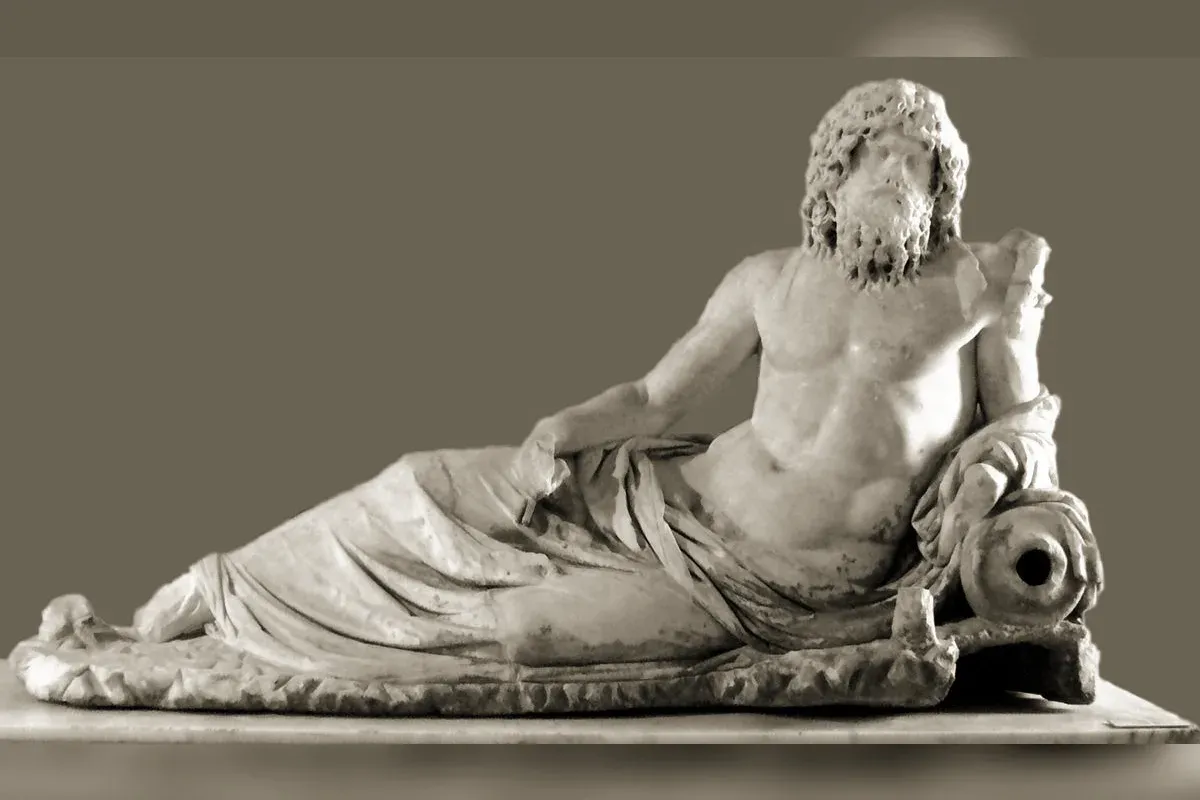
Oceanus is one of the twelve Titans, and one of the most misunderstood figures in the Greek pantheon. He is not a sea god: he is a river — a circular watercourse with no source and no mouth, running round the disc of the earth, from which all other waters flow. That distinction is not scholarly nitpicking; it governs the whole geography of the archaic world.
A river, not a sea
In Homer the earth is a flat disc ringed by a stream that returns into itself. That stream is Oceanus, and it is always called potamos, “river,” never pontos or thalassa, the two words for sea.
That distinction separates him sharply from Poseidon. Poseidon rules the sea people sail on, with its harbours, wrecks and storms; Oceanus bounds the habitable space. You do not cross him, you reach him — and reaching him means leaving the world. The peoples of the far edges live on his banks: the land of the Cimmerians, the entrance to the realm of the dead.
The Iliad says it flatly in Book 21: every river, the whole sea, all springs and deep wells flow from Oceanus. Even Achelous, the greatest river in Greece, cannot match him. In Book 18 the shield of Achilles, which depicts the entire world, is rimmed by the river Ocean along its outer edge: the map closes on him.
A Titan and father of six thousand children
Hesiod puts him at the head of the list of children of Uranus and Gaia (Theogony 133), before Coeus, Crius, Hyperion and Iapetus.
Joined with his sister Tethys, he fathers offspring whose sheer number is itself a cosmological statement: three thousand rivers and three thousand Oceanids. Hesiod names forty-one of the daughters, then explicitly gives up: “it is not easy for a mortal man to tell the names of all.”
Among the named Oceanids are Styx, the eldest; Doris, future mother of the Nereids; Electra, Eurynome, Clymene, Idyia, Perseis; Tyche, whose career as goddess of Fortune would begin centuries later — and Metis, cunning intelligence, first wife of Zeus and mother of Athena. That descent matters: it makes Oceanus the maternal grandfather of the goddess of wisdom, and it explains why crafty intelligence is associated, in Greek thought, with water, detour and current.
Oceanus’s line therefore waters the whole pantheon without ever governing it. That is the mark of this Titan: everywhere in the genealogies, nowhere in the conflicts.
The Titan who sat out the war
The Titanomachy pits Cronus and his brothers against the Olympians for ten years. Oceanus does not appear in it.
Better: his daughter Styx is the very first to join Zeus — on her father’s advice, according to Hesiod — bringing her four children, Zelos (Rivalry), Nike (Victory), Kratos (Power) and Bia (Force). In return Zeus swears his most binding oaths by the water of Styx and installs those four powers permanently at his side.
In other words, the first defection of the war comes out of the house of Ocean. Oceanus does not fight Zeus; he supplies him with Victory herself. That is why he is not thrown into Tartarus with the losers and keeps, in the post-Titanomachy Theogony, both his river and his office.
“Genesis of the gods”: Homer’s variant
Homer offers an entirely different theogony, compressed into two phrases in Iliad 14. Hera announces that she is going to visit, at the ends of the earth, Oceanus, genesis of the gods, and mother Tethys.
The phrase has heavy consequences. It makes the couple of the waters — not Gaia, not Chaos — the origin of everything divine. The passage adds two valuable details: Oceanus and Tethys raised Hera, handed to them by Rhea during the war against the Titans; and the old couple have long been estranged, “no longer sharing a bed, since anger has entered their hearts” — a perfect pretext for Hera’s visit, since she has no intention whatever of reconciling them.
Aristotle, in Metaphysics A, cites the line as the earliest witness to a doctrine making water the principle of all things, and sets it beside Thales of Miletus. The remark stuck: it turned an epic verse into the prehistory of philosophy.
One Hesiodic detail completes the picture. At Theogony 789-792, the Styx is described as a tenth part of Ocean: nine parts wind around earth and the broad sea, while the tenth springs from a rock, and it is that one the gods swear by. The circular river is not only the outline of the world; it is also its legal reserve.
Aeschylus’s cautious elder
The one scene in which Oceanus speaks belongs to Aeschylus. In Prometheus Bound (284-396) he arrives on a winged beast to visit the tortured Titan, while his daughters the Oceanids form the chorus of the tragedy.
His speech is a plea for prudence: he offers to intercede with Zeus, but above all he urges Prometheus to moderate his language, to bend, to acknowledge the new master. “Know yourself and adopt new ways, for there is a new ruler among the gods.”
Prometheus dismisses him with contempt. The contrast is deliberate: against the Titan who refuses and suffers, Aeschylus sets the Titan who adjusts and prospers. Oceanus is the survivor of the regime change — and Greek tragedy, which has no love for the lukewarm, makes him pay for it in dialogue.
Herodotus disputes the Ocean
Not every Greek believed all the world’s waters flowed from Oceanus, and the sharpest objection is Herodotus’s.
Discussing the flooding of the Nile, he examines and rejects the explanation that credits the river Ocean: “they carry the matter back into obscurity and leave nothing to refute, for I myself know of no river Ocean; I think Homer or one of the earlier poets invented the name and brought it into his poetry” (Histories 2.21-23). Elsewhere he mocks the mapmakers who draw the earth perfectly round, ringed by an Ocean traced with a compass, without ever having produced evidence for it.
That scepticism is valuable: it shows that mythical geography was already, in the fifth century BC, a matter of argument rather than dogma.
Images and afterlife
Oceanus’s iconography settles in the Hellenistic and Roman periods: an aged, bearded man with streaming hair, wearing bull’s horns — the usual attribute of river gods — and often crab claws on his forehead. He leans on an urn pouring water, surrounded by fish and sea creatures. The Great Altar of Pergamon shows him fighting in the Gigantomachy, and Roman mosaics from North Africa and Syria turn him into a monumental frontal head, frequently paired with Tethys.
His name has travelled a long way. From the circular river at the edge of things, okeanos became in later Greek the word for the open sea, and then, in every European language, the name of the great salt expanses. The Titan who marked the boundary of the known world now names what separates its parts.
Ancient sources
- Hesiod, Theogony, 133; 337-370; 383-403; 789-792
- Homer, Iliad, 14.200-210; 244-246; 301-306; 18.399; 606-608; 21.194-197
- Aeschylus, Prometheus Bound, 284-396
- Herodotus, Histories, 2.21; 4.8; 4.36
- Aristotle, Metaphysics, A, 983b
- Apollodorus, Library, 1.1.3; 1.2.2
See also
Related entries
Frequently asked questions
Who is Oceanus in Greek mythology?
Oceanus is one of the twelve Titans, son of Uranus and Gaia. He is not a sea god in the manner of Poseidon: he is the vast river that runs around the disc of the earth and from which all the world's waters come. With his sister and wife Tethys he fathers three thousand rivers and three thousand Oceanids.
What is the difference between Oceanus and Poseidon?
Oceanus is cosmological water: a circular river that bounds the world, belonging to the generation of the Titans. Poseidon is an Olympian who rules the navigable sea, the one with harbours, sailors and storms. One draws the edge of the world; the other lives inside it.
Did Oceanus fight Zeus in the Titanomachy?
No, and that sets him apart. No source shows him fighting beside Cronus, and his eldest daughter Styx is the very first to join Zeus, bringing her children Zelos, Nike, Kratos and Bia. In Aeschylus he is the cautious elder who advises Prometheus to submit. He crosses the change of regime without losing his rank.