Greek mythology · Gods & goddesses
Tethys, Titaness of the waters and mother of the Oceanids
In brief
Tethys, nurturing Titaness of the waters: not to be confused with Thetis, mother of six thousand children, and the reason one constellation never sets.
- nurturing fresh waters
- springs and underground streams
- the nursing and feeding of the world
- small wings or crab claws at the brow
- +2
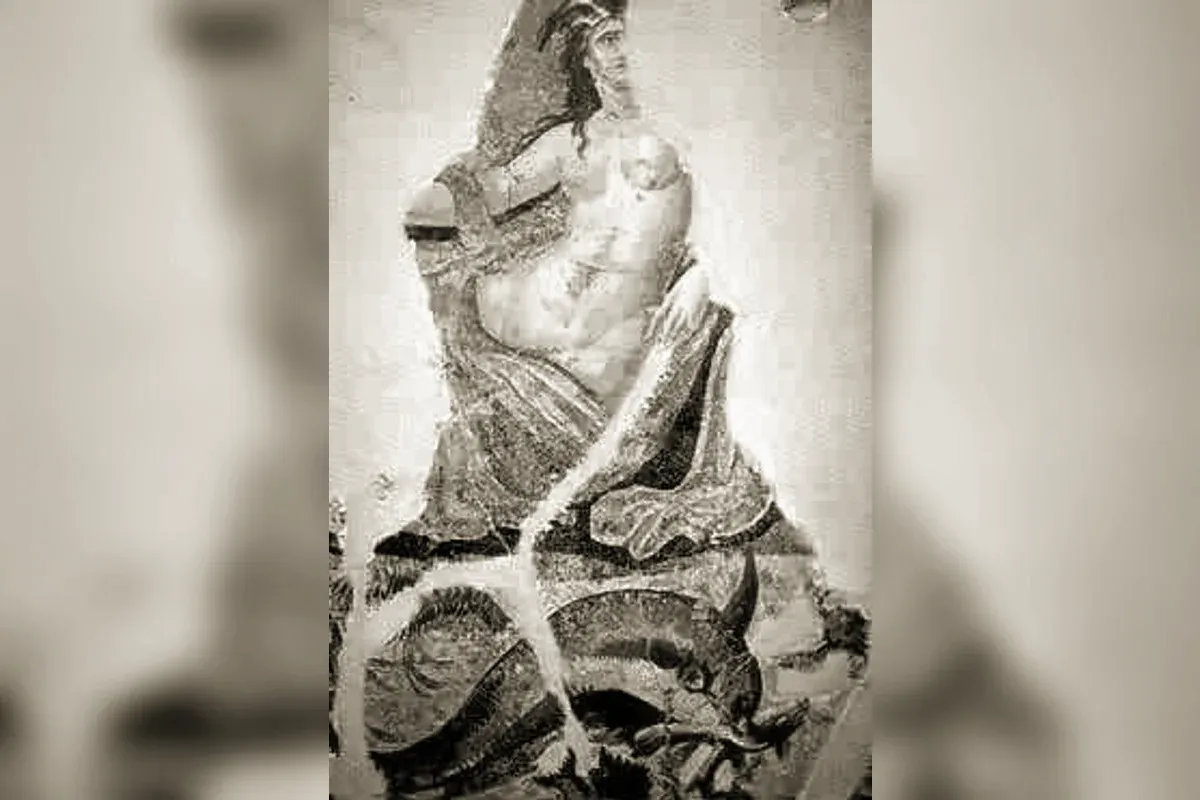
Tethys is the Titaness of the waters, sister and wife of Oceanus, mother of every river and every spring nymph. She is enormous in her descendants and almost silent in the stories: no sanctuary, no adventure, no quarrel. And in English she carries an extra handicap, since her name is routinely mistaken for another goddess’s.
Tethys and Thetis: clearing it up first
This has to be settled at the outset, because it garbles everything else.
- Tethys (Τηθύς) is a first-generation Titaness, daughter of Uranus and Gaia, wife of Oceanus, mother of the Oceanids. She belongs to the world before the Olympians.
- Thetis (Θέτις) is a Nereid, two generations younger: daughter of Nereus, wife of Peleus, mother of Achilles. She is the one who intervenes in the Iliad — not Tethys.
- Themis (Θέμις) is yet another Titaness, of divine justice and customary order, with nothing to do with water.
In Greek the three names are far less alike; the collision is an artefact of transliteration. Ancient authors never confused them: Homer makes Tethys Hera’s nurse and Thetis Zeus’s suppliant, in the same poem, without any ambiguity at all.
A first-generation Titaness
Hesiod names her last among the daughters of Uranus and Gaia (Theogony 135-136), after Theia, Rhea, Themis, Mnemosyne and Phoebe; only Cronus is born after her.
Like her Titan sisters she has no biography. The first storey of the Greek pantheon works less as a cast of characters than as a filing system for cosmic functions: each Titan holds a post, transmits a line, and steps aside. Tethys holds the post of the nurturing waters.
She also passes through the Titanomachy unharmed, like her husband. No source lists her among the losers thrown into Tartarus; on the contrary, the Iliad shows her acting as a place of refuge during the war, which implies an accepted neutrality.
Mother of six thousand children
It is through her offspring that Tethys is genuinely vast. At Theogony 337-370 Hesiod details what she bears to Oceanus:
- three thousand rivers, among them the Nile, the Alpheus, the Scamander of Troy, the Eridanus and the Maeander;
- three thousand Oceanids, daughters of springs, lakes and running water.
The poet names forty-one and then stops short: “it is not easy for a mortal man to tell the names of all, but each of those who live near them knows them.” It is one of the rare moments where Hesiod concedes that his own catalogue is incomplete — an admission that every local spring in Greece had its nymph and its name.
Among the named Oceanids: Styx, the eldest, by whom the gods swear their oaths; Doris, future mother of the fifty Nereids — and therefore, precisely, Thetis’s mother; Clymene, Eurynome, Perseis; and Metis, cunning intelligence, whom Zeus marries and then swallows, and who produces Athena.
That last link matters most for the cluster: through Metis, Tethys is the maternal ancestor of the goddess of wisdom.
Nurse of Hera, and an estranged marriage
The single Homeric passage about her is also the richest. In Iliad 14, Hera claims she is off to the ends of the earth to visit “Ocean, genesis of the gods, and mother Tethys.”
She explains why she owes them a visit: they raised her, Rhea having placed her in their house while Zeus was overthrowing Cronus. Tethys is therefore the nurse of the queen of the gods — a quiet function with real weight, since it puts the upbringing of a major Olympian outside Olympus, in the house of the waters.
The second detail is stranger: Hera adds that the old couple have been estranged for a long time and no longer share a bed, “since anger has entered their hearts.” She offers to reconcile them. The whole thing is a lie — her real aim is to put Zeus to sleep with the help of Hypnos — but the estrangement itself is presented as common knowledge. Homer thereby lets us glimpse a marital history he never tells.
Her one myth: the Great Bear
Tethys acts exactly once, and the result is visible every night in the northern sky.
Ovid tells in Metamorphoses 2 (508-530) the story of Callisto, the companion of Artemis made pregnant by Jupiter, turned into a bear by divine anger, then set among the stars with her son Arcas. Juno finds the honour unbearable: the rival she disfigured now shines in the firmament.
So she goes down to the waters and asks her foster parents, Tethys and Ocean, for one precise favour: never to receive that constellation into their stream. The couple agree.
The consequence is astronomical, and the Greeks could observe it: Ursa Major is circumpolar at Mediterranean latitudes, wheeling round the pole without ever setting, unlike the constellations that plunge into Ocean in the west. The myth explains a real phenomenon — and it makes Tethys, for the space of one scene, the keeper of the threshold where stars go out.
Ovid gives her a second, smaller gesture in Book 11: out of pity she turns the Trojan Aesacus into a diving bird, so that he survives the suicide he keeps attempting.
No cult, but everywhere on mosaics
No temple, festival or priesthood of Tethys is known. Greek cult addressed local nymphs and individual rivers, not the Titaness who bore them all — as though the abstraction were pitched too high to receive an offering.
Her iconography, by contrast, is abundant and late. It is Roman art that gives her a face, mainly on the great floor mosaics of Syria, Asia Minor and North Africa from the second to the fourth century. She appears as a frontal bust rising from the waves, often beside Ocean: streaming hair, small wings or crab claws rising from her brow, sometimes a rudder in hand, surrounded by fish and sea monsters. The mosaics from the region of Antioch supply the most spectacular examples.
Afterlife: a vanished ocean and a moon
The name of Tethys has had two scientific careers.
In 1893 the Austrian geologist Eduard Suess named Tethys the ocean that separated Laurasia from Gondwana before the Alps and the Himalayas were raised. The choice is apt: a vanished sea, mother of today’s mountain ranges, known only from its traces — a fair description of the goddess.
Much earlier, in 1684, Giovanni Domenico Cassini gave her name to one of Saturn’s moons, alongside Dione, Rhea and Iapetus, all borrowed from the generation of the Titans. A Titaness with no myth thus ended up inscribed twice over, in the sky and in the depths of the earth.
Ancient sources
- Hesiod, Theogony, 135-136; 337-370
- Homer, Iliad, 14.200-210; 301-306
- Ovid, Metamorphoses, 2.508-530; 11.784-795
- Apollodorus, Library, 1.1.3; 1.2.2
- Hyginus, Astronomica, 2.1
See also
Related entries
Stories featuring this entity
Frequently asked questions
What is the difference between Tethys and Thetis?
They are two distinct goddesses that English spelling pushes together. Tethys is a first-generation Titaness, daughter of Uranus and Gaia, wife of Oceanus and mother of the Oceanids. Thetis is a Nereid, a much younger marine generation, daughter of Nereus, wife of Peleus and mother of Achilles. In Greek, Τηθύς and Θέτις look far less alike.
Who are the children of Tethys?
With Oceanus she bears three thousand rivers and three thousand Oceanids — that is, all the waters of the world. Hesiod names forty-one of the daughters and then gives up on the full list. Among them are Styx, the eldest, by whom the gods swear; Doris, mother of the Nereids; and Metis, first wife of Zeus and mother of Athena.
Why does the Great Bear never set?
According to Ovid it is a favour granted to Juno. After Callisto, made pregnant by Jupiter, was placed among the stars, Juno went to her foster parents Tethys and Ocean and asked them never to receive that constellation in their waters. Ursa Major therefore wheels around the pole without ever dipping below the horizon.