Egyptian mythology · Gods & goddesses
Nefertem, god of the primeval lotus and of perfume
In brief
Nefertem is the god of the blue lotus that opens on the first morning of the world. Third member of the Memphite triad, son of Ptah and the lioness Sekhmet, he is 'the lotus at the nose of Ra': the flower through which the sun breathes, and therefore the first scent creation ever knew.
- primeval lotus and solar rebirth
- perfume, unguents and scented substances
- protection of the king and the Two Lands
- divine childhood
- +4
Who is Nefertem?
Nefertem is the god of the blue lotus that opens on the surface of the primeval waters at the first morning of the world. Son of Ptah and the lioness Sekhmet, he completes the Memphite triad, the divine family of Egypt’s first capital.
His definition fits into a phrase the Pyramid Texts apply to the dead king: he is “the lotus at the nose of Ra”. That is, the flower through which the sun god breathes — and, since the flower is fragrant, the first scent creation ever knew. Few Egyptian deities are pinned so precisely to a single instant and a single sensation.
A water lily, not a lotus
The plant tradition calls a “lotus” is nothing of the kind: it is the blue water lily of the Nile, Nymphaea caerulea, known to the Egyptians as seshen. Its daily rhythm explains the solar association: the flower opens in daylight and closes again later, ready to repeat the cycle.
For a theology trying to say how light first appeared above the Nun, the inert ocean that preceded the world, no better image exists. In the Heliopolitan version of the Egyptian creation myth, the first sun rises from the emerging mound; in the variant Nefertem carries, it rises from an opening flower, and the divine child inside it is the sun on its first day.
The Bennu bird, heron of the first morning, occupies the same cosmic moment in another body. Egypt never chose between these competing pictures. It stacked them, each major sanctuary offering its own account of the first sunrise.
The child of Memphis
Memphis built its theology around a couple and a son. Ptah conceives the world by heart and tongue; Sekhmet is the power that strikes and heals; Nefertem is the child, the renewal, the flower that opens.
The arrangement is sharper than it looks. This is not a pious family portrait: the three figures form a complete cycle — conceive, destroy, begin again. An Egyptian triad is not domestic sentiment, it is a way of stating that three distinct powers belong to a single system.
A parallel tradition, rooted at Bubastis in the Delta, makes Nefertem the son of Bastet rather than Sekhmet. The swap is unsurprising: cat and lioness are two faces of one feminine solar energy, and changing mother here means changing city, not theology. The same mechanism gives Sekhmet a second son, Maahes, a warlike lion god so close to Nefertem that Nefertem himself is sometimes given a lion’s head.
A headdress that is an argument
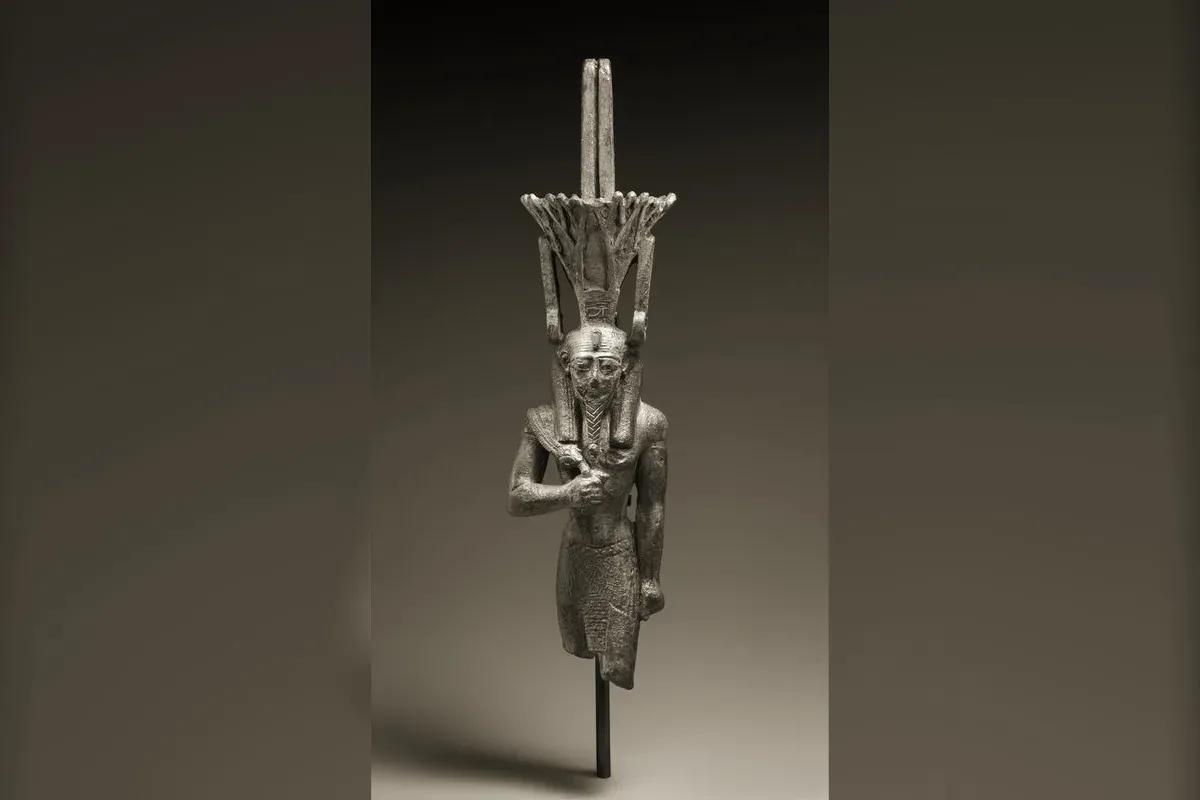
Nefertem’s iconography is remarkably stable: a young man, often naked or in a simple kilt, crowned with an open water-lily flower. Two tall plumes frequently rise from the blossom, and menat counterpoises — the necklace weights associated with Hathor and with ritual music — hang on either side.
Late Period bronzes show him standing, striding forward, the whole headdress carried like a standard. Amulets, of which enormous numbers survive, place him on the chest of the dead: to wear Nefertem is to carry the guarantee of the next morning with you.
When he appears lion-headed, this is not a different deity but the other side of the same one. Sekhmet’s son inherits his mother’s capacity for violence, and the flower that opens and the jaws that open eventually come to resemble one another.
The god of scent
Nothing is harder to fit into a pantheon than a sensation. Egypt managed it with Nefertem.
The blue water lily is fragrant, and its scent entered early into the oils and unguents used to anoint statues, kings and the dead. Because the god is that flower, and because he is placed “at the nose of Ra”, he becomes the natural patron of everything that is breathed in: resins, balms, the seven sacred oils of the funerary ritual.
That competence gives him an unexpected foothold in daily life. Unguent makers, priests responsible for censing, the perfume workshops of Memphis all fall under him. Where Thoth patronises writing and Ptah the working of matter, Nefertem patronises an industry of the senses.
What the ancient sources say
Nefertem has no narrative myth: no story shows him acting. What we know of him comes from ritual formulae and from objects.
The Pyramid Texts, in Utterance 249, identify the dead king with the lotus that rises at the nose of Ra — the oldest definition of the god, and already a complete one. The Coffin Texts take the image up and extend it to any privileged dead person.
The Book of the Dead draws the practical conclusion. Its chapter 81 is a spell “for being transformed into a lotus”: the deceased asks to become the flower that opens every morning, that is, to hold the same right of renewal as the sun. Nefertem is no longer only a figure of the pantheon; he is a model of survival offered to the dead, in the same way that the whole stake of the judgment of the dead is the right to go on existing.
Greek authors, by contrast, all but ignore him. Ptah becomes Hephaestus and Sekhmet finds warlike counterparts, but the child with the lotus has no obvious Olympian equivalent: Greece has no god of the first morning.
The afterlife of a flower
The image outlived the religion that produced it. Its most famous reuse is a carved head from the treasure of Tutankhamun: the child king emerging from an open blue water lily, neck elongated, as though the flower had just parted. Commentators routinely read it as the pharaoh assimilated to Nefertem; the tomb’s own inscriptions speak rather of the solar child. The overlap matters: by then, the difference between the newborn sun and the god of the lotus was no longer felt to be essential.
It also explains the motif’s endurance. The open water lily runs across capitals, collars, drinking cups and banquet paintings throughout Egyptian history. Every time a blue flower appears on an object, the promise is the same: this closes, and it will open again.
Further reading
For the Memphite creator whose son he is, read the page on Ptah, and for the lioness from whom he inherits his dangerous half, Sekhmet. The Bubastite variant makes more sense alongside Bastet. For the Heliopolitan version of the same first morning, see Atum and Ra, together with the Egyptian creation myth. For the other creature of the first sunrise, see the Bennu.
Ancient sources
- Pyramid Texts, Utterance 249
- Coffin Texts
- Book of the Dead, chapter 81 (transformation into a lotus)
- Reliefs and statuary from the temple of Ptah at Memphis
- Late Period bronzes and amulets
See also
Related entries
Stories featuring this entity
Frequently asked questions
What is Nefertem the god of?
Nefertem is the god of the blue lotus that opens on the primeval waters at the first morning of the world, and by extension the god of solar renewal and of scented substances. With Ptah and Sekhmet he forms the triad of Memphis. His domain is not vegetation in general: it is one precise instant of the cosmogony, the moment the flower opens and the sun appears.
Is the Egyptian lotus really a lotus?
No. The plant behind Nefertem is the blue water lily of the Nile, *Nymphaea caerulea*, which the Egyptians called *seshen*. Its flowers open in daylight and close again later. That daily rhythm, not the botany, helped make it an emblem of solar rebirth — and the name 'lotus' is a Greek and later European habit that has stuck.
Is the famous Tutankhamun lotus head a statue of Nefertem?
It is usually presented that way, and the image fits: a child's head rising out of an open blue water lily. The funerary inscriptions of the tomb, however, speak of the king as the solar child rather than naming Nefertem outright. The ambiguity is itself informative — by the New Kingdom the newborn sun and the god of the opening flower had become almost interchangeable.