Greek mythology · Gods & goddesses
Asclepius, Greek god of medicine and healing
In brief
Asclepius, the Greek healer god: snatched from his mother's pyre, taught by Chiron, struck down for raising the dead, and the true single-snake rod.
- medicine and healing
- healing dreams
- therapeutic sanctuaries
- rod with a single snake
- +3
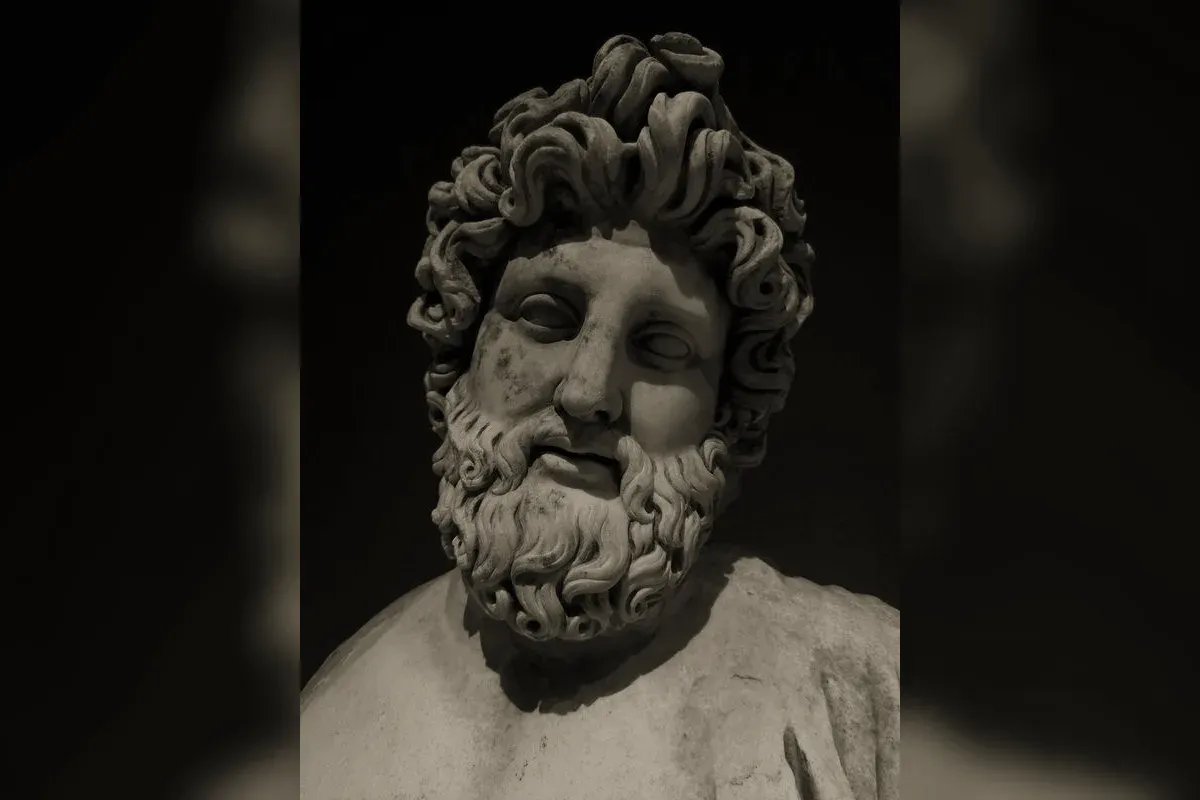
Asclepius is the Greek god of medicine. Son of Apollo and a mortal woman, he begins as a healing hero, reaches such mastery that he calls the dead back to life, is struck down for it by Zeus — and ends up a god. His cult centred on sanctuaries where the sick slept to receive a healing dream; the inscriptions from Epidaurus preserve an exceptional collection of cure narratives.
A birth pulled from the pyre
The standard account is Pindar’s third Pythian, and it is brutally efficient.
Apollo loves Coronis, daughter of Phlegyas, a Thessalian princess. She is pregnant by him when she agrees to marry a mortal, Ischys. The god finds out — through his prophetic knowledge in Pindar, through a raven messenger in other versions, which is how the bird, white until then, gets blackened as payment for its news. Artemis shoots Coronis down.
Then comes the decisive scene. Coronis’s body is already burning on the pyre when Apollo changes his mind: he steps into the flames and tears the child from his dead mother’s womb. Pindar compresses it into a chilling line — the fire ran through in a single sweep, and the god said he would not endure losing his son in his mother’s death. Greek medicine therefore begins with a post-mortem extraction: a surgical act before it is a myth.
Epidaurus told a different story, and Pausanias records the local version: Coronis, who had come to the Argolid with her father, gives birth in secret on Mount Titthion and exposes the newborn. A goat suckles him and a sheepdog guards him; the shepherd Aresthanas finds him when he sees lightning flashing from the child, and does not dare touch him. The two traditions competed over the birthplace because the sanctuary that held it also held the legitimacy — the stakes were economic as much as religious.
The centaur’s pupil
The child is entrusted to Chiron, wisest of the centaurs and tutor to Achilles and Jason, who teaches him herbs, surgery and incantation. The detail fits archaic Greek medicine exactly: it is first a knowledge of plants coupled with ritual practice, and it passes from master to pupil.
Pindar itemises the adult Asclepius’s four modes of treatment: gentle incantations, potions to drink, salves applied to the wound, and the knife. The list matches precisely what physicians of his own day did. Asclepius is not a wonder-worker; he is an exemplary practitioner.
His excellence has a family consequence. The Iliad places his two sons, Machaon and Podalirius, in the Greek camp at Troy, commanding the Thessalian contingents; Machaon treats Menelaus’s wound by drawing out the arrow and applying the remedies “which the centaur had given to his father.” In Homer, Asclepius is not yet a god — he is simply “the blameless physician,” and the knowledge runs from Chiron to him and from him to his sons.
The crime: raising the dead
The knowledge eventually crosses a line.
Apollodorus lists those Asclepius is said to have brought back: Capaneus, Lycurgus, Tyndareus, Hymenaeus, Glaucus — and above all Hippolytus, son of Theseus, killed by a bull from the sea. Pindar adds an aggravating circumstance: he gave way to “gold gleaming in the hand” and restored life for a fee.
The reaction is immediate. An old tradition has Hades himself complain to his brother that his realm is being depopulated. Zeus strikes Asclepius down with the thunderbolt.
The offence is not healing. It is abolishing the difference between mortals and gods. Mortality is the very definition of the human in Greek thought; a physician who removes it does not extend a life, he destroys a cosmic boundary.
What follows is a chain reaction. Apollo, unable to strike at Zeus, kills the Cyclopes who forged the thunderbolt. Zeus sentences him to a year as a herdsman for King Admetus of Pherae. And Asclepius, after death, is set among the stars as Ophiuchus, the serpent-bearer — then granted divine honours. It is one of very few cases, alongside Heracles, where a mortal killed by fire ends up a god.
Epidaurus and the sleep that heals
Asclepius’s cult is the best-documented part of his file, and the most surprising.
The great sanctuary of Epidaurus in the Argolid grows from the sixth century BC and becomes, in the fourth, a substantial complex: temple, a theatre seating fourteen thousand, guest quarters, baths, a stadium. The heart of it is the abaton, a portico where the sick spent the night after purification and sacrifice. The rite is incubation: you sleep in the sanctuary and the god appears in a dream, either to operate directly or to prescribe a treatment to follow on waking. Since sleep was the precondition of the cure, Hypnos shared Asclepius’s precinct at Sicyon under the epithet Epidotes, “the generous.”
What makes Epidaurus exceptional is the iamata: stone stelae inscribed in the fourth century BC and found on site, recording healing narratives under the patients’ names. They cover blindness, paralysis, kidney stones, impossibly long pregnancies, a spearhead lodged in a jaw. The tone is that of an official record, occasionally with a sardonic note aimed at sceptics. The collection documents the practices and cure narratives promoted by the sanctuary, though it should not be read as a set of medical case records in the modern sense.
Snakes had a concrete role: non-venomous colubrids — the species is still called the Aesculapian snake — moved freely in the precinct and were said to lick the diseased parts of sleepers. Sacred dogs did the same work. The snake’s sloughing of its skin offered, besides, an exact image of recovery.
The cult spreads: Athens imports it in 420-419 BC and installs an Asclepieion on the south slope of the Acropolis; Cos ties its own to the Hippocratic school; Pergamon develops its sanctuary well into the imperial period. The Hippocratic Oath in fact opens with an invocation: “I swear by Apollo the Physician, by Asclepius, by Hygieia and Panacea.”
A family of health
Asclepius’s descendants are a small medical vocabulary made flesh. His wife Epione soothes pain; his daughters are Hygieia (health, whence hygiene), Panacea (the universal remedy, whence panacea), Iaso (cure), Aceso (convalescence) and Aglaea (healthy glow); his sons Machaon and Podalirius are the two surgeons of the Iliad.
This is not an ordinary genealogy. It is a nomenclature: each name marks a stage of the process of care, from diagnosis to full recovery.
The rod, the caduceus, and Rome
Asclepius’s attribute is a knotted staff with a single snake coiled around it, no wings. That is the authentic medical symbol, kept today by the World Health Organization and by most European medical bodies.
The caduceus — two snakes facing each other around a winged wand — belongs to Hermes, god of exchange, messengers and travellers. The confusion between them is recent and largely North American; it took hold when US military medical services adopted the caduceus in the late nineteenth century. A hospital flying a caduceus is therefore claiming, unawares, the patronage of commerce.
Rome adopts the god as Aesculapius in 293 BC, during an epidemic. An embassy is sent to Epidaurus; according to Ovid and Livy, the god takes the form of a snake, comes aboard the ship, and on reaching the Tiber swims ashore at the Tiber Island, where his temple is built. The island, remodelled in antiquity to evoke a ship, still houses a hospital today: Fatebenefratelli, founded in the sixteenth century.
Ancient sources
- Homer, Iliad, 2.729-733; 4.193-219
- Hesiod, Catalogue of Women, fr. 51-54 Merkelbach-West
- Pindar, Pythian 3.1-58
- Apollodorus, Library, 3.10.3-4
- Pausanias, Description of Greece, 2.26-27
- The iamata inscriptions of Epidaurus (4th century BC)
- Ovid, Metamorphoses, 15.622-744
See also
Related entries
Frequently asked questions
Who is Asclepius in Greek mythology?
Asclepius is the god of medicine, son of Apollo and the mortal Coronis. Snatched from his mother's funeral pyre and raised by the centaur Chiron, he grows so skilled that he brings the dead back to life. Zeus strikes him down for crossing the line between mortals and immortals, then raises him to divine rank. His sanctuaries were among the busiest in the Greek world.
Why did Zeus kill Asclepius?
Because he was resurrecting the dead, which emptied Hades's realm and blurred the boundary between humanity and divinity. Several sources add that he did it for payment. Apollo took revenge by killing the Cyclopes who forged the thunderbolt, and was sentenced to a year's servitude with King Admetus. Asclepius was afterwards set in the sky as the constellation Ophiuchus, the serpent-bearer.
What is the difference between the Rod of Asclepius and the caduceus?
The Rod of Asclepius carries a single snake and no wings: that is the authentic medical symbol. The caduceus has two snakes facing each other around a winged staff, and belongs to Hermes, god of trade, exchange and messengers. The confusion is largely North American and dates from the nineteenth and twentieth centuries, notably after US military medical services adopted the caduceus.