Greek mythology · Heroes & mortals
Menelaus: King of Sparta, Helen's husband and the Trojan War
In brief
Menelaus is the king of Sparta, son of Atreus and younger brother of Agamemnon, whose wife Helen is carried off to Troy by Paris. The Greeks go to war to win her back; he brings her home to Sparta and is the only Homeric hero promised a place in Elysium.
- kingship of Sparta
- the rights of host and husband
- the Trojan War
- fair hair (xanthos)
- +2
Menelaus is the king of Sparta, son of Atreus, younger brother of Agamemnon and husband of Helen. When Paris carries Helen off, it is Menelaus’s marriage that has been broken, and the whole Trojan War is, strictly speaking, fought on his behalf. Yet the tradition never gave him the leading part. Homer makes him brave but second-rank, more humane than frightening; Athenian tragedy tends to belittle him; and it is Menelaus, of all people, who is granted the kindest ending in the Trojan cycle.
An heir of Atreus, raised in exile
Menelaus belongs to the doomed house of Atreus. His father Atreus and his uncle Thyestes fight over the throne of Mycenae through a chain of crimes that culminates in the banquet at which Atreus serves Thyestes his own children. When Aegisthus, son of Thyestes, kills Atreus, the two young princes have to flee. In Pseudo-Apollodorus, a nurse takes them to Sicyon, from where they are passed on to Oeneus in Aetolia, until Tyndareus, king of Sparta, brings them back to the Peloponnese (Epitome 2.15-16).
His mother Aerope is Cretan, a daughter of Catreus and granddaughter of Minos, which will matter when Helen is taken. One Hesiodic tradition, preserved in the Catalogue of Women, even makes the two brothers sons of Pleisthenes, with Atreus as their grandfather. Homer has no doubts: they are “the sons of Atreus”.
The chosen husband, and the oath behind him
Tyndareus marries Agamemnon to Clytemnestra, then has to pick a husband for Helen from a crowd of suitors drawn from every corner of Greece. To stop a rejected suitor from taking revenge, he makes them all swear, on Odysseus’s advice, to defend the winner against anyone who tries to take his wife. Menelaus is chosen and, when Tyndareus dies, inherits the throne of Sparta (Apollodorus 3.10.8-9).
That oath turns Menelaus into a man with a legal army at his back. He does not need to persuade the Greek kings, only to remind them of their word. Command of the expedition, though, goes to his elder brother, king of Mycenae. Menelaus spends the whole war in an odd position: the reason for the coalition, but never its leader.
The betrayed host
Everything starts with a crime against hospitality. According to the Cypria, as summarised by Proclus, Paris comes to Sparta and Menelaus receives him as a guest. The king then has to sail to Crete for the funeral of his grandfather Catreus, leaving Helen to look after the visitors. While he is away, Paris and Helen become lovers and sail off with the palace treasure; it is Iris who brings Menelaus the news.
That context matters. Paris’s offence is a double betrayal, of a husband and of a host, under the eye of Zeus Xenios, protector of strangers. Menelaus is first of all a king whose house has been violated, and only then a wounded lover.
Before the fighting starts, he tries diplomacy. With Odysseus he goes to Troy to demand Helen back. In Iliad 3 the Trojan elder Antenor, who hosted them, remembers the contrast between the two envoys: Menelaus spoke quickly, in few words but very clearly; Odysseus began with his eyes on the ground, stock-still, and then the words came “like snowflakes in winter” (3.205-224).
In the Iliad: a cancelled duel and a broken truce
In Book 3 Menelaus catches sight of Paris in front of the Trojan lines and rejoices “like a lion that comes upon a great carcass”. Paris backs away, Hector shames him, and a duel is arranged: the winner takes Helen and the treasure, and the war ends there.
Menelaus has the better of it. His sword shatters on Paris’s helmet, so he grabs the Trojan by the crest and hauls him towards the Greek lines — until Aphrodite snaps the chin strap, wraps Paris in mist and sets him down in his bedroom next to Helen (3.340-382). The one duel in the Iliad that could have ended the war is voided by a goddess.
In Book 4, Athena talks the Trojan archer Pandarus into breaking the truce with a shot at Menelaus, then deflects the arrow herself so that it only grazes him. Agamemnon, thinking his brother is done for, launches into a long lament, and it is Machaon, son of Asclepius, who draws the arrowhead and treats the wound (4.104-219).
Elsewhere the poem shows a Menelaus kinder than most of the commanders. He is about to spare the Trojan Adrestus, who clasps his knees and begs, when Agamemnon arrives and kills the suppliant himself (6.37-65). He volunteers to face Hector, and his brother holds him back, knowing he is outmatched (7.94-122). In Book 17 he finally has his moment: he kills Euphorbus, who had wounded Patroclus, stands over the body, then runs to fetch Ajax to help carry it away from the Trojans (17.1-123).
The fall of Troy, and the sword that drops
Menelaus is one of the warriors hidden inside the Wooden Horse. In the Odyssey he tells the story himself: Helen circled the horse imitating the voices of the hidden men’s wives, and Odysseus had to keep them from answering (4.271-289). On the night of the sack, he and Odysseus head for the house of Deiphobus, the brother of Paris whom Helen had married after Paris died (8.517-520).
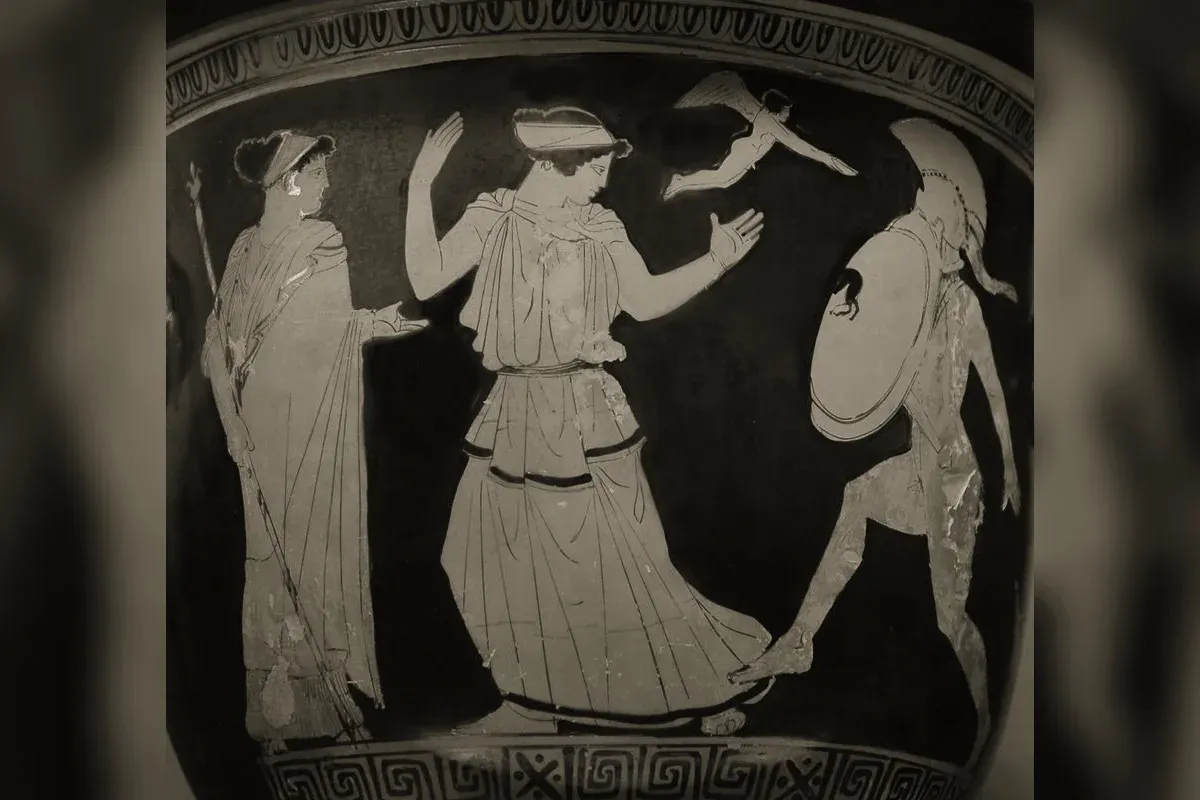
The most famous Menelaus scene is not in Homer at all. He goes for Helen to kill her, sword raised, and lets it fall at the sight of her bared breasts. The story goes back to the Little Iliad and the poet Ibycus; Aristophanes can allude to it as something everyone knows (Lysistrata 155-156), and Euripides reuses it in Andromache (628-631).
Eight years to get home
As the Greeks leave Troy, the sons of Atreus quarrel: Menelaus wants to sail at once, Agamemnon wants to stay and appease Athena with sacrifices (Odyssey 3.130-150). Menelaus leaves, but a storm off Cape Malea drives him and five ships to the coast of Egypt. He then wanders for eight years, from Cyprus and Phoenicia to Egypt, Ethiopia and Libya, piling up treasure along the way (4.81-85).
Becalmed for twenty days on the island of Pharos, he is rescued by Eidothea, daughter of Proteus. On her advice he hides with three companions under sealskins, seizes the old sea god as he sleeps and hangs on through every shape he takes — lion, snake, leopard, boar, water, tree — until Proteus gives in and talks (4.351-570). The god tells him what happened to the others: Ajax son of Oileus drowned, Agamemnon murdered, Odysseus held captive by Calypso. Menelaus reaches Sparta on the very day Orestes is holding the funeral feast for Aegisthus and Clytemnestra (3.309-312).
The king of the Odyssey, and the promise of Elysium
In Odyssey 4, Telemachus finds the palace at Sparta in the middle of a double wedding: Menelaus is marrying his daughter Hermione to Neoptolemus, son of Achilles, and his son Megapenthes, born to a slave woman. Helen comes in, recognises Telemachus at once as Odysseus’s son, and slips into the wine an Egyptian drug that takes away grief (4.219-232).
The couple then talk about Troy with an unsettling calm. Helen tells how she helped Odysseus when he slipped into the city disguised as a beggar; Menelaus answers with the story of the horse, where she nearly got the Greeks killed. The two stories pull against each other, and Homer leaves the tension unresolved.
This is also where Proteus reveals Menelaus’s fate. He will not die in Argos: the gods will send him to the Elysian plain at the ends of the earth, where life is easy, with no snow or rain, only the cool breezes of Zephyrus — “because you have Helen as your wife, and in their eyes you are the son-in-law of Zeus” (4.561-569). The only hero Homer promises Elysium owes it not to his deeds or his virtue, but to his marriage.
Cut down to size by the tragedians
Athenian tragedy, much of it written during the Peloponnesian War against Sparta, has little patience with the Spartan king:
- in Sophocles’ Ajax, he forbids the hero’s burial with an arrogance the play makes hateful (1047-1162);
- in Euripides’ Andromache, he threatens to kill Andromache’s child and plays the brutal tyrant;
- in Orestes (408 BC), he coldly abandons his nephew to the judgement of the Argives;
- in Trojan Women (415 BC), he vows to have Helen put to death, and the audience knows he will do nothing of the kind.
Helen (412 BC) is the counterweight. Euripides follows the version in which the real Helen never went to Troy: Menelaus, shipwrecked in Egypt and dressed in rags, discovers that the woman he fought ten years for was only a phantom. The play gives him back the part of a faithful husband, while getting some comedy out of his dignity.
Worship: Menelaus and Helen at Therapne
Menelaus was more than a character in a poem. On the hill of Therapne near Sparta stood the Menelaion, where Pausanias places the tomb of Menelaus and Helen (3.19.9). Isocrates says they received sacrifice there not as heroes but as gods (Helen 63). Excavation has uncovered an archaic sanctuary built over the ruins of a large Mycenaean building, along with offerings inscribed to Helen.
Further reading
For the wife whose abduction starts the war, see Helen of Troy; for the Trojan prince who abuses his hospitality, Paris. For the brother who commands the army in his place, see Agamemnon. The divine contest behind it all is told in the Judgement of Paris, and the war itself in the Trojan War. For his homecoming and Telemachus’s visit, see the Odyssey; for the sea god he forces to speak, Proteus; and for the blessed land he is promised, Elysium.
Ancient sources
- Homer, Iliad, 3.21-120 and 3.340-382; 4.104-219; 6.37-65; 17.1-113
- Homer, Odyssey, 3.130-150 and 3.276-312; 4.1-624
- Proclus, Chrestomathy (summaries of the Cypria, Little Iliad and Nostoi)
- Euripides, Trojan Women (860-1059), Helen, Andromache, Orestes
- Sophocles, Ajax, 1047-1162
- Aristophanes, Lysistrata, 155-156
- Apollodorus, Library, 3.10.8-9; Epitome 2.15-16, 3.3, 6.29
- Pausanias, Description of Greece, 3.19.9; Isocrates, Helen, 62-63
See also
Frequently asked questions
Did Menelaus kill Paris?
No, though he came close. In Iliad 3 he wins their duel outright and is dragging Paris off by the helmet when Aphrodite snaps the chin strap and whisks him away. Paris dies later, shot by Philoctetes with the bow of Heracles, according to the Little Iliad as summarised by Proclus. Menelaus's only recorded act against him afterwards is to mutilate the corpse, which the Trojans recover and bury.
Why does Menelaus go to Elysium instead of Hades?
Because he married into the family of Zeus. In Odyssey 4, Proteus tells him he will not die in Argos: the gods will send him to the Elysian plain at the ends of the earth, 'because you have Helen as your wife, and in their eyes you are the son-in-law of Zeus' (4.561-569). It is a privilege of kinship, not a reward for valour, which is why the least fearsome hero of the Iliad gets the gentlest ending in the whole Trojan cycle.
Did Menelaus take Helen back after the war?
He did, despite every intention not to. On the night Troy fell he went for her with his sword drawn and, in a story that goes back to the Little Iliad, dropped it at the sight of her. Euripides' Trojan Women has him swear to have her killed once home, while Hecuba warns him not to sail on the same ship. The Odyssey settles it: in Book 4 the couple rule Sparta together, and Helen serves their guests wine laced with an Egyptian drug that banishes grief.