Greek mythology · Gods & goddesses
Hebe, Greek goddess of youth and cupbearer of the gods
In brief
Hebe, Greek goddess of youth: daughter of Zeus and Hera, cupbearer on Olympus before Ganymede, and the bride Heracles wins on becoming immortal.
- youth and bodily prime
- service at the divine table
- coming of age
- cup and nectar jug
- +2
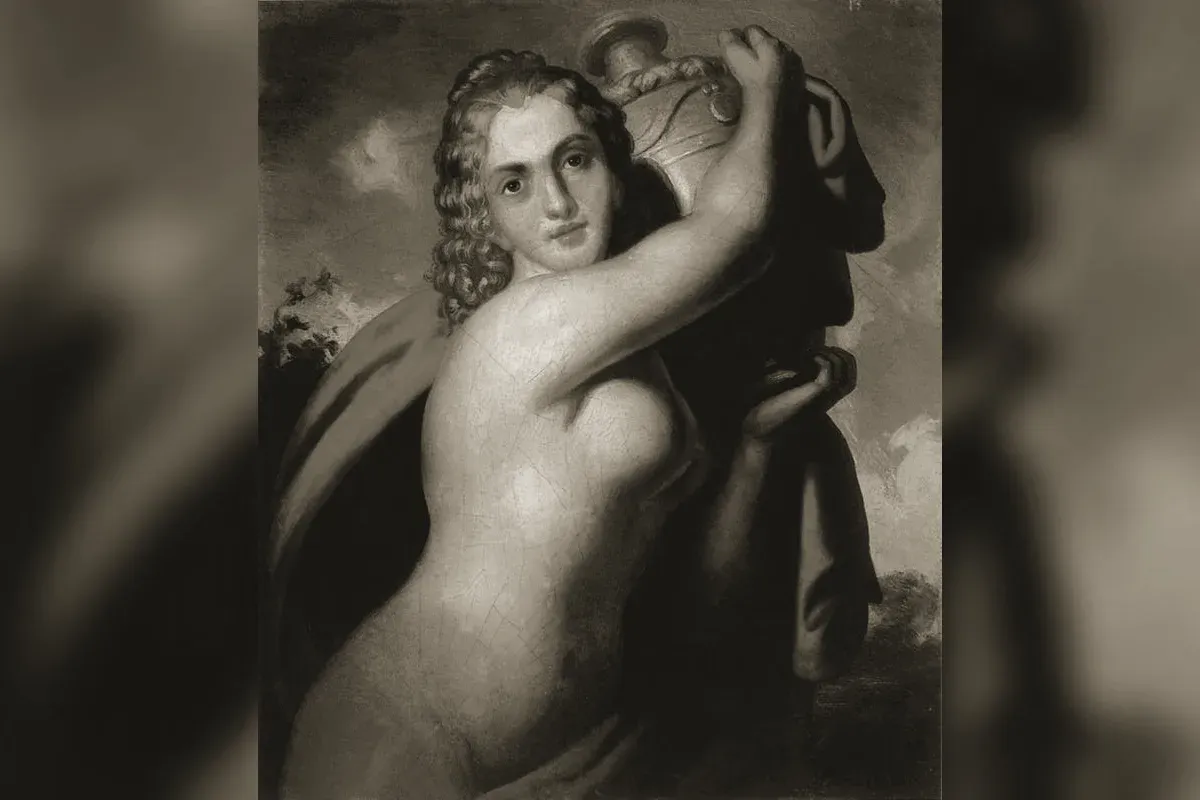
Hebe is the Greek goddess of youth, and of one narrowly defined kind of it: hebe is the bloom of adolescence, the moment a body reaches its physical prime. The legitimate daughter of Zeus and Hera, she pours nectar at the Olympian table and is later given in marriage to Heracles at the moment he becomes immortal. The two roles are really one: she is what the gods keep and mortals lose.
A name for an age, not a mood
Greek hêbê is not a poetic synonym for youthfulness. It is a technical word for completed puberty — the age at which a boy can bear arms and father children, around sixteen in Athenian practice. Attic law speaks of a boy “come to his hebe” to mean that he leaves guardianship and enters the citizen body.
The goddess inherits all of that precision. She presides over neither childhood nor beauty nor long life, but over the top of a curve, which makes her the exact counterpart of Geras, Old Age, whom Hesiod lists among the children of Nyx. Vase painters occasionally stage the opposition directly: Heracles drives off a shrivelled little old man, and the painter labels the figure Geras.
Hera’s daughter, and no one else’s
The Theogony is unambiguous. Hera, as Zeus’s wife, bears him three children: Hebe, Ares and Eileithyia (921-923). In a pantheon where nearly every divine birth comes of an irregular union, Hebe belongs to the very small group of fully legitimate offspring of the ruling couple. She is the full sister of Ares.
That status does real work. It explains her place in the divine household, her role as her mother’s attendant, and the political weight of her hand in marriage.
A Roman variant is worth keeping. In Ovid’s Fasti (6.21-24), Juno herself relates that she conceived her daughter without Jupiter’s involvement, after touching a lettuce that Flora held out to her. The story is late and Italian, but it chimes with a well-attested Greek datum: Hera bears Hephaestus alone, out of spite. The queen of the gods claims a fertility that owes her husband nothing.
Cupbearer on Olympus
Hebe’s first role in Homer is domestic, and that is exactly where her dignity lies. In Iliad 4 the gods sit on the golden floor and “Hebe poured them nectar” (4.2-3). In a Greek house, serving the cup falls to the young members of the family; doing it for the Olympians is an honour, not a chore.
She is not confined to the table. In book 5, when Hera has her chariot readied to go down to the plain of Troy, it is Hebe who fits the eight-spoked bronze wheels to the iron axle and sets the golden rims and silver naves in place (5.722-732). A few hundred lines later, when Ares comes back to Olympus wounded by Diomedes, it is Hebe again who bathes and clothes him (5.905). She is the image of faultless service: never a word of her own, never a will of her own.
Yet the Iliad also knows Ganymede, the Trojan prince snatched away for his beauty and made Zeus’s cupbearer (20.232-235). Homer makes no attempt to square the two. It was later tradition that turned the overlap into a succession, and later still that some mythographers supplied a scabrous reason — a slip while serving, an exposure before the assembled gods. No archaic source knows anything of the kind: the episode is a late patch over a contradiction the poets never felt as one.
Marriage to Heracles: the end of a persecution
Hebe’s most consequential myth is not an action but an ending.
Heracles is hounded all his life by Hera’s hatred — from the delayed birth, through the madness in which he kills his own children, to the twelve labours that follow from it. When the pyre on Mount Oeta burns away his mortal part, he ascends to Olympus, and Hebe is the bride he is given. Hesiod ends his catalogue of divine marriages with it: Heracles, “having finished his grievous labours”, now lives among the immortals “free from pain and free from age for all his days”, husband of fair-ankled Hebe (Theogony 950-955).
The choice of bride is an argument, not a decoration. For a deified mortal, the prize is not a palace but exemption from time: to marry Youth is to receive an immortality that does not decay. Pindar makes it the summit of the heroic reward — at the close of Nemean 1, the seer Tiresias foretells to Amphitryon that his son, once he has broken the Giants, will be given “flowering Hebe as his wife” and an unending feast beside Zeus (69-72).
The Odyssey preserves a dissonant version worth flagging. In book 11 Odysseus meets the eidôlon of Heracles among the dead, his phantom only, while the hero himself “takes his joy at the feast among the immortal gods and has fair-ankled Hebe” (11.601-604). The lines are probably an early adjustment meant to reconcile the underworld scene with the apotheosis tradition — and they show that by that date, marriage to Hebe was already the recognised badge of Heracles’ divinity.
Apollodorus supplies the children: two sons, Alexiares (“he who wards off war”) and Anicetus (“the unconquered”), function-names rather than characters (2.7.7).
Cult at Phlius: a grove with the right of asylum
Hebe is not merely a literary figure. Pausanias describes a sanctuary of hers that is one of the more striking in his account of the Peloponnese.
On the citadel of Phlius, in the Argolid, stands a cypress grove enclosing a very old sanctuary where the goddess was worshipped first as Ganymeda, later as Hebe. Pausanias records two remarkable features: the sanctuary holds no cult statue, the goddess being honoured with no image at all, and it possesses the right of asylum. Suppliants there obtain pardon, and released prisoners hang their fetters on the trees of the sacred grove, where they could still be seen in his day (2.13.3-4).
The detail matters, because it shows a Hebe who is not an ornamental personification but a protective power with a legal function. At Athens she has an altar in the Cynosarges gymnasium alongside Heracles, Alcmene and Iolaus (Pausanias 1.19.3) — a training ground for young men, which is precisely where she belongs.
Juventas, the goddess who would not move
The Romans identified Hebe with Juventas, goddess of civic youth. Her Roman office is markedly more institutional: young men assuming the toga of manhood paid a coin into her treasury, and she watched over the iuniores, the age class liable for military service.
One tradition reported by Livy deserves keeping. When the great temple of Jupiter was to be raised on the Capitol, the cults already installed on the hill had to be deconsecrated and moved. The auspices allowed every removal but two: Terminus and Juventas refused to give ground, and the temple had to be built around them. Romans read the prodigy as a promise — the boundary stone and the youth of Rome would never yield.
A goddess of what does not spoil
Hebe has no intrigue, no wrath, no metamorphosis. The narrative poverty is only apparent; it is the definition of what she stands for.
Greek gods differ from mortals less in power than in two privileges: they do not die and they do not age. The second is named in Homer’s commonest formula, athanatos kai agêrôs, “deathless and unageing”. Hebe is that second clause given a body. She pours the nectar, which is to say the substance that sustains agêrasia — the gods do not feed on it, they are renewed by it.
Post-classical art grasped this and used her constantly. Hebe with the cup became, from the seventeenth to the nineteenth century, a favourite allegorical guise for portraits of young women of rank, from Vigée Le Brun to Canova. The word itself survives in clinical vocabulary, where hebephrenia names a disorder of adolescent onset.
Further reading
For her mother, and the quarrel this marriage settles, see Hera. For the hero she marries once his ordeals are over, see Heracles and the account of the twelve labours. For her full brother, the other legitimate child of the ruling couple, see Ares. For Hera’s other attendant in the Iliad, see Iris. For the house where she pours the nectar, see Olympus, and for the mortal woman honoured beside her at Cynosarges, Alcmene.
Ancient sources
- Homer, Iliad, 4.2-3; 5.722-732; 5.905
- Homer, Odyssey, 11.601-604
- Hesiod, Theogony, 921-923 and 950-955
- Pindar, Nemean 1.69-72; Isthmian 4.55-60
- Apollodorus, Library, 2.7.7
- Pausanias, Description of Greece, 1.19.3; 2.13.3-4
- Ovid, Fasti, 6.21-24
See also
Frequently asked questions
What is Hebe the goddess of?
Hebe personifies hebe, the bloom of adolescence — the point at which a body reaches its full strength, just before adult life proper begins. She is not a goddess of childhood or of beauty at large, which is why her standing job is to pour at the divine table: in a Greek household, serving the cup was the work of the young.
Did Ganymede replace Hebe as cupbearer?
Homer names both without reconciling them. Hebe pours the nectar in Iliad 4, while Ganymede, carried off for his beauty, is already Zeus's cupbearer in Iliad 20. Later tradition tidied the overlap into a succession, and late mythographers invented an embarrassing fall to explain why she was replaced — an episode unknown to any archaic source.
Why is Hebe given to Heracles?
The marriage closes the central conflict of his life. Hera persecuted Heracles from birth; by handing him her own daughter after his apotheosis she seals the peace. Hesiod is explicit: having finished his grievous labours, Heracles lives among the immortals 'free from pain and free from age', married to Hebe. To marry Youth is precisely to stop growing old.