Greek mythology · Gods & goddesses
Hyperion, Titan of heavenly light in Greek mythology
In brief
Hyperion, Titan of heavenly light: father of Sun, Moon and Dawn, the god Homer keeps confusing with his own son, and a name with a long afterlife.
- heavenly light
- observation of the stars
- cycle of day
- radiance of heaven
- +1
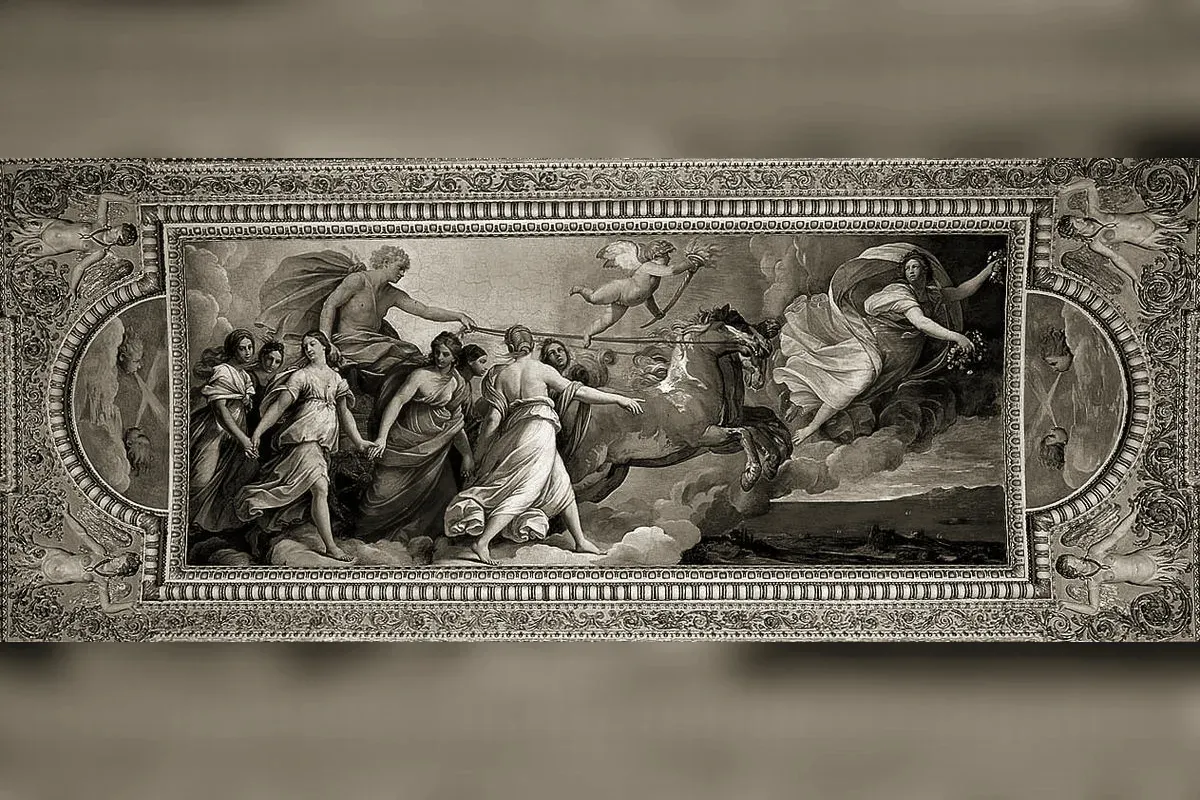
Hyperion is one of the twelve Titans born to Uranus and Gaia, and the father, with his sister Theia, of the three lights that move across the sky: Helios the Sun, Selene the Moon, and Eos the Dawn. He does almost nothing, and that turns out to be the interesting thing about him.
A god who is a job description
His name means “he who goes above” — from hyper and a root of motion — and it describes the arc of a body crossing overhead. Hesiod gives him no narrative at all: he is listed among the Titans, he fathers the luminaries, and that is the whole of his biography in the Theogony.
This is normal for the first Titan generation. Coeus, Crius and Theia are similar: names attached to a cosmic office, without adventures. The Greeks needed the sun, moon and dawn to descend from something, and Hyperion is the something. He belongs to the layer of Greek theology that is closer to a filing system than to storytelling.
Where Homer confuses him with his son
Homer regularly calls the Sun himself Hyperion. The opening lines of the Odyssey blame the crew’s destruction on the cattle of Hyperion; the god who complains to Zeus about that slaughter is elsewhere plainly Helios.
Two explanations compete, and both may be right. Hyperionides means “son of Hyperion” and is used as a patronymic, so some occurrences are simple shorthand. But the plain use of Hyperion for the Sun suggests that the two were once one god, and that the Titan is a back-formation — a father invented to give an epithet somewhere to live once it stopped being understood as a description.
If so, Hyperion is a fossil: the older name of the sun, promoted to a separate deity by a genealogy that needed one more generation.
The war, and after
In the Titanomachy Hyperion fights on Cronus’ side and loses with the rest. Hesiod’s Titans are chained in Tartarus behind bronze gates; some later traditions release them or relocate them to the Isles of the Blessed.
Hyperion is not named in the fighting, and his children are conspicuously unaffected by the defeat. Helios keeps driving the sun for Zeus’s cosmos exactly as he did for Cronus’, and is influential enough to threaten to shine among the dead if his cattle go unavenged. The functions survive the regime change, which is a fair summary of how Greek myth handles the Titans generally.
The name after antiquity
The word has had a long second life on its own. Keats left two unfinished poems, Hyperion and The Fall of Hyperion, in which the defeated Titans debate their own obsolescence and Hyperion is the last of them still burning; Hölderlin used the name for a novel. A moon of Saturn carries it, as does a redwood in northern California that is the tallest known living tree.
For a god with no myths, that is a durable afterlife — and it is arguably the right one. Hyperion was always a name for something very large that passes overhead without explaining itself.
Ancient sources
- Hesiod, Theogony, 133-138, 371-374
- Homer, Odyssey, 1.8-9; 12.127-141, 12.374-388
- Homeric Hymn 31, To Helios
- Apollodorus, Library, 1.1.3-1.2.1
See also
Related entries
- Uranus, the primordial Sky in Greek mythology
- Gaia, the primordial Earth and mother of the Greek gods
- Helios, the sun god of Greek mythology
- Selene, the Greek moon goddess and the sleep of Endymion
- Eos, the Greek goddess of Dawn, and the curse of Tithonus
- Theia, Titaness of brilliance and mother of Helios in Greek mythology
Stories featuring this entity
Frequently asked questions
What does the name Hyperion mean?
He who goes above, from hyper and a root of motion — a description of the arc a body traces overhead. Hesiod gives him no narrative at all: he is listed among the Titans, he fathers the luminaries, and that is his whole biography in the Theogony. He belongs to the layer of Greek theology that is closer to a filing system than to storytelling.
Why is Hyperion so famous outside mythology?
The name has had a long second life on its own. Keats left two unfinished poems, Hyperion and The Fall of Hyperion, in which the defeated Titans debate their own obsolescence; Hölderlin used it for a novel. A moon of Saturn carries it, as does a redwood in northern California that is the tallest known living tree. For a god with no myths, that is a durable afterlife.