Greek mythology · Heroes & mortals
Cassandra: the Trojan prophetess cursed never to be believed
In brief
Cassandra is a Trojan princess, daughter of Priam and Hecuba, to whom Apollo gave the gift of prophecy. Because she refused herself to the god, he cursed her never to be believed. She foretells the fall of Troy in vain, then dies at Mycenae as Agamemnon's captive.
- prophecy
- truth that goes unheard
- service of Apollo
- a seer's ribbons and staff
- +2
Cassandra is a Trojan princess, daughter of Priam and Hecuba, to whom Apollo gave the gift of prophecy before cursing her never to be believed. She sees the destruction of Troy coming, says so, and no one listens. Her name has come to stand for the warning that is right and useless. Yet that defining trait is missing from Homer: the prophetess Cassandra was built up gradually, and it was fifth-century Athens that brought her to full strength.
A princess in Homer
The Iliad knows only a very beautiful princess. In Book 13 we learn that Othryoneus came to Troy to ask for her hand without bringing gifts, offering instead to drive the Greeks out; Idomeneus kills him (13.361-382). Homer calls her “the finest in looks of Priam’s daughters”. In Book 24, “like golden Aphrodite”, she is the first to see from the citadel her father bringing back Hector’s body, and it is she who calls the city out to mourn (24.697-706).
In the Odyssey she appears only in death. In the Underworld, the ghost of Agamemnon tells Odysseus that as he died he heard Cassandra scream as Clytemnestra cut her down beside him (11.421-423). Nowhere does Homer give her any vision of the future.
How a prophetess was made
The gift appears in the Epic Cycle. According to Proclus’s summary of the Cypria, when Paris has his ships built for the voyage to Sparta, Cassandra already foretells what will follow. In the fifth century, Pindar calls her “the prophetic maiden” (Pythian 11.33). Some versions even make her the one who interprets Hecuba’s dream before Paris is born, the dream warning that the child would set Troy ablaze.
Aeschylus fixes the legend. In the Agamemnon (458 BC), Cassandra, brought home by the king as a captive, stands silent before the palace for a long time, then falls into a trance. When the chorus presses her, she explains her fate: Apollo desired her, she agreed, then backed out, and the god, unable to take back his gift, doomed her never to be believed (1202-1212). Pseudo-Apollodorus gives the same account in prose: Apollo promised to teach her prophecy in exchange for her favours; she learned, then refused, and he stripped her prophecies of the power to persuade (3.12.5).
Another tradition, preserved by ancient commentators, places the gift in childhood. Left overnight in the sanctuary of Thymbraean Apollo, Cassandra and her twin brother Helenus had their ears cleansed by snakes, which let them hear the voices of the gods. There is no curse in this version, and the contrast with Helenus is striking: in the Iliad, her brother is a respected seer whose advice Hector follows (6.73-101).
The warning about the horse
Cassandra’s best-known scene is not Homeric either. When the Trojans debate what to do with the Wooden Horse, she declares that it is full of armed men, and the priest Laocoon says the same (Apollodorus, Epitome 5.17). No one believes her, and the horse is dragged into the city. Virgil puts her condition in two lines: Cassandra opens her mouth on what is to come, “never believed by the Trojans, by a god’s command” (Aeneid 2.246-247). For how the episode fits into the fall of the city, see the Trojan War.
The night of the sack: the crime of Ajax
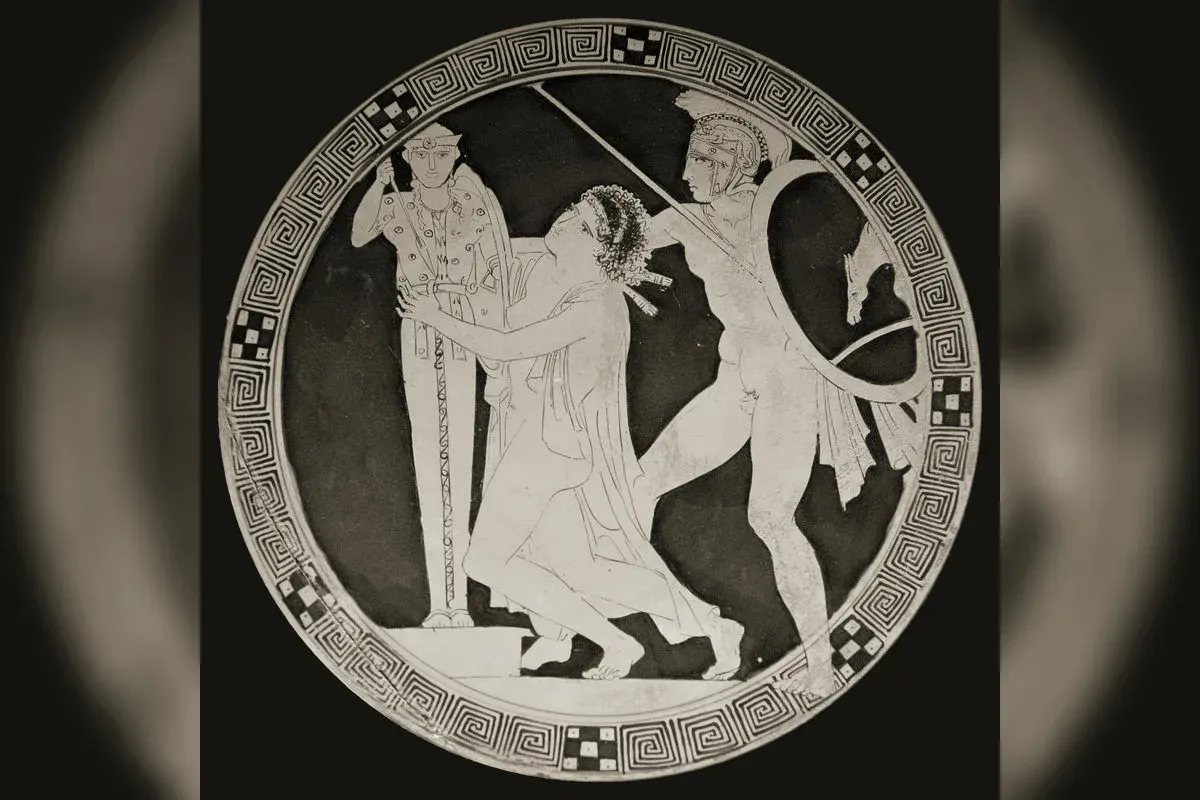
As Troy is sacked, Cassandra takes refuge in Athena’s temple and clings to the goddess’s statue. Ajax son of Oileus tears her away by force, pulling the statue over with her, according to Proclus’s summary of the Sack of Ilion; in Pseudo-Apollodorus, the statue then turns its eyes to the sky (Epitome 5.22). The earliest sources speak of a sacrilegious seizure; later tradition makes it a rape. Vase painters returned to the scene again and again: Cassandra half-naked, clinging to the image, while a helmeted warrior grabs her by the hair.
The sacrilege costs the Greeks dearly. Athena, outraged, wrecks their homecoming with storms, and the Locrians, Ajax’s people, spent centuries atoning for his crime.
Agamemnon’s captive
When the captive women are shared out, Cassandra goes to Agamemnon (Apollodorus, Epitome 5.23). In Euripides’ Trojan Women (415 BC), she enters with a torch, singing a wild wedding hymn for her own marriage to the Greek king. Then she tells her mother to rejoice: this marriage will destroy Agamemnon and his house, and the Trojans who died for their homeland are luckier than the victorious Greeks, killed far from home. She goes on to foretell Odysseus’s ten years of wandering. The herald Talthybius calls her mad, and nobody listens.
In Aeschylus, she walks into Agamemnon’s palace knowing she will die there. She tears off her ribbons and her seer’s staff, the insignia of Apollo, and tramples them (Agamemnon 1264-1272), then goes to the door like a beast “driven by a god to the altar”. Clytemnestra kills her with the king and boasts of it afterwards. Pindar, a little earlier, already has “the daughter of Priam” fall to Clytemnestra’s bronze (Pythian 11.19-22).
Pausanias saw Cassandra’s tomb at Mycenae, a claim disputed by the people of Amyclae in Laconia. He adds that she had borne Agamemnon twin sons, Teledamus and Pelops, whom Aegisthus slaughtered (2.16.6).
Alexandra: a cult in Laconia
Cassandra was also worshipped as a divine power. At Amyclae near Sparta, Pausanias describes a sanctuary and statue of Alexandra, whom the locals identified with Cassandra (3.19.6). Excavations at the site have turned up a deposit of archaic offerings in which Agamemnon and Alexandra were honoured together: captive and master, united in a cult that Athenian tragedy never mentions.
Under that name she gives her title to Lycophron’s Alexandra, a Hellenistic poem of nearly fifteen hundred lines in which a guard reports to Priam his daughter’s cryptic prophecies, from the fall of Troy to the rise of Rome.
Legacy
The West turned Cassandra into the figure of clear sight that changes nothing. A “Cassandra” today is anyone who warns of a real danger and is ignored, and the term turns up in psychology as readily as in debates about financial or climate crises. Berlioz gives her the whole first part of his opera Les Troyens, and the German novelist Christa Wolf makes her the narrator of Cassandra (1983), a retelling of the war from the side of the defeated.
Further reading
For her parents, the king and queen of Troy, see Priam and Hecuba. For the god who gives her the gift and then spoils it, see Apollo. For the warrior who drags her from Athena’s shrine, see Ajax, and for the king who takes her to Mycenae and dies with her, Agamemnon. For another Trojan captive of the Trojan Women, see Andromache, and for the city she cannot save, Troy.
Ancient sources
- Homer, Iliad, 13.361-382; 24.697-706
- Homer, Odyssey, 11.405-434
- Proclus, Chrestomathy (summaries of the Cypria and the Sack of Ilion)
- Pindar, Pythian 11.17-37
- Aeschylus, Agamemnon, 1035-1330
- Euripides, Trojan Women, 294-461
- Lycophron, Alexandra
- Apollodorus, Library, 3.12.5; Epitome 5.17-23
- Virgil, Aeneid, 2.246-247 and 2.402-406
- Pausanias, Description of Greece, 2.16.6; 3.19.6
See also
Frequently asked questions
Why did no one believe Cassandra?
Because Apollo cursed her. In Aeschylus' Agamemnon, Cassandra explains that the god wanted her and that she promised herself to him; she received the gift of prophecy, then refused him. Since a god cannot take back a gift, Apollo made sure no one would ever be persuaded by it. Pseudo-Apollodorus tells the same story: she always sees truly, and she is never believed.
What happened to Cassandra after the fall of Troy?
She was dragged from Athena's statue by Ajax son of Oileus, then allotted to Agamemnon as his captive and taken back to Mycenae. There Clytemnestra killed her along with the king, a death Homer already mentions in the Odyssey and Aeschylus puts at the heart of his Agamemnon. Pausanias adds that she had borne Agamemnon twin sons, Teledamus and Pelops, whom Aegisthus murdered.
Is Cassandra a prophet in Homer?
No, and this surprises most readers. In the Iliad she is simply the most beautiful of Priam's daughters, the first to spot her father bringing back Hector's body; in the Odyssey she appears only as a murdered captive. Her gift of prophecy first shows up in the lost Cypria, Pindar calls her a seer, and it is Aeschylus who adds the curse of never being believed.