Greek mythology · Heroes & mortals
Agamemnon, king of Mycenae and commander of the Greeks at Troy
In brief
Agamemnon, leader of the Achaean host: the quarrel with Achilles, Iphigenia at Aulis, the curse of the Atreidae and the murder that met his homecoming.
- kingship and command
- the inherited sceptre
- a commander's honour (timê)
- the sceptre made by Hephaestus and handed down from Pelops
- +2
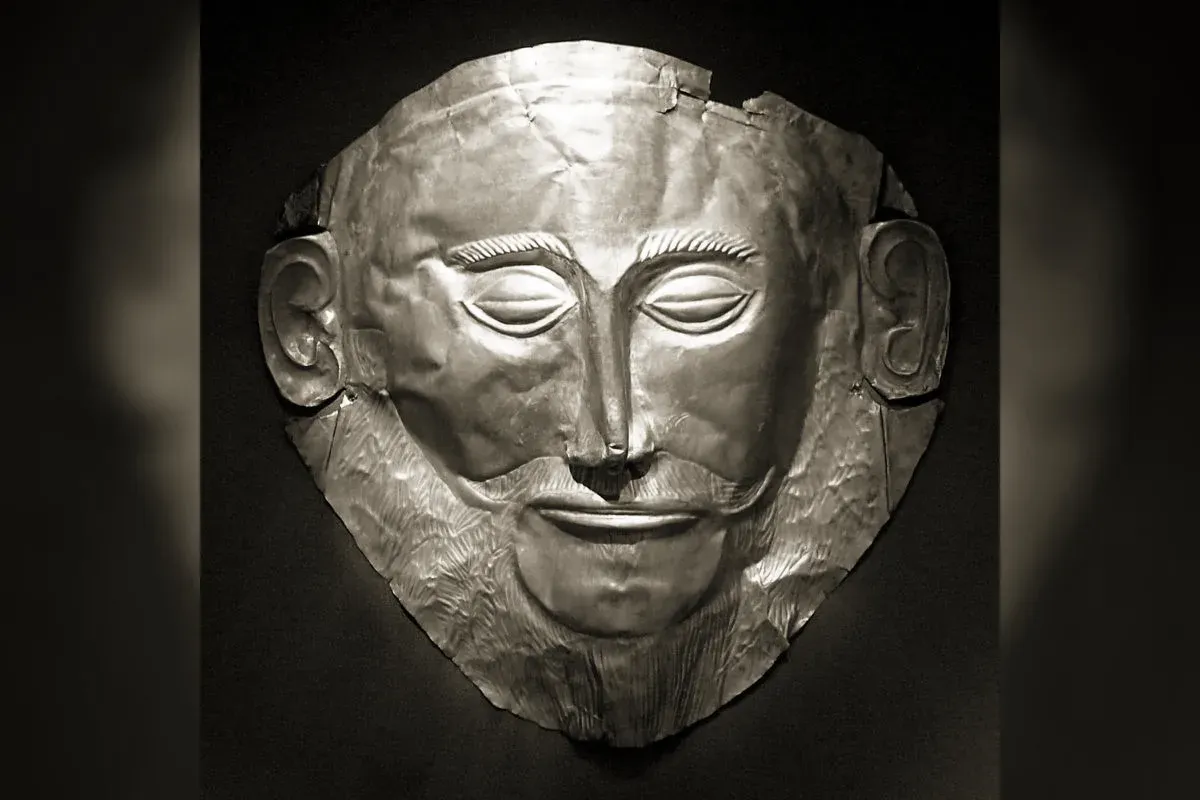
Agamemnon is king of Mycenae and commander of the coalition besieging Troy — the most powerful figure in the Iliad and one of the least admirable. Son of Atreus and brother of Menelaus, he leads eleven hundred and eighty-six ships, and the poem opens on the blunder by which he disables his own army. His arc runs from the sacrifice of his daughter at Aulis to his death in a bath on the day he comes home. No Greek hero combines so much authority with so little glory.
The sceptre and the blood of the Atreidae
Agamemnon is not a self-made adventurer; he inherits. The Iliad takes unusual care over the object that underwrites his authority — the sceptre made by Hephaestus, given by Zeus to Pelops, passed from Atreus to Thyestes and on to Agamemnon, “to be lord of many islands and of all Argos” (2.100-108). It is the only object in the poem whose full pedigree is recited: his kingship descends from the top, and it descends through a cursed house.
That house is the Atreidae. Tantalus serves up his son Pelops to the gods; Pelops betrays his charioteer Myrtilus, who curses him as he dies; Atreus feeds his brother Thyestes the flesh of Thyestes’ own children. Out of that banquet comes Aegisthus, the one surviving son, who will wait a full generation to collect. Agamemnon’s murder is therefore not a domestic accident. It is a debt falling due two generations late.
Aulis: the first decision
The fleet gathered at Aulis cannot sail. Contrary winds — or no wind at all — pin the Achaeans in harbour, and the seer Calchas names the cause: Artemis has been offended, and will grant the crossing only for the king’s eldest daughter.
What Agamemnon does next depends entirely on which source you follow, and the gap between them is wide.
The Cypria, as summarised by Proclus, and Euripides in Iphigenia among the Taurians both know a substitution: at the moment of sacrifice Artemis snatches the girl away, leaves a deer on the altar, and carries Iphigenia off to the Tauric land to serve as her priestess. On that telling the myth runs close to the binding of Isaac — the goddess tests and then stays her hand.
Aeschylus refuses the escape. In the great opening ode of the Agamemnon (184-249) the chorus shows the king stepping under “the yoke of necessity”: he weighs it, and he chooses. They gag the girl so she cannot curse the house, lift her over the altar “like a young goat”, and the poet stops on her eyes searching the face of each man who is about to kill her. No deer. That refusal is what makes the whole trilogy possible: without a real death at Aulis, Clytemnestra has no case.
The quarrel with Achilles
The first line of the Iliad announces the wrath of Achilles; the first episode shows why Agamemnon provokes it.
The priest Chryses comes to ransom his daughter, the king’s captive. The whole army approves. Agamemnon refuses and sends the old man away with threats. Apollo answers with nine days of plague, and when Calchas at last names the cause, the king has to yield — but immediately demands compensation out of another man’s share. He takes Briseis, the prize of Achilles.
The stake is not the woman. It is timê, the publicly acknowledged worth of a warrior, made visible in the spoils the assembly awards him. In taking Achilles’ portion Agamemnon does not steal a captive; he removes a rank, and he does it in front of the army. Achilles withdraws, and the Greeks begin to lose.
The poem tracks his obstinacy with some precision. In book 9 he sends an embassy — Odysseus, Phoenix and Ajax — carrying an overwhelming offer: seven tripods, ten talents of gold, seven women of Lesbos, one of his own daughters in marriage, seven cities. Then he adds the clause that ruins it: “let him submit to me, since I am the kinglier and the elder.” Odysseus, relaying the offer, has the sense to leave that sentence out. Achilles refuses anyway.
“I am not the cause”: Agamemnon and Atê
The reconciliation in book 19 contains the most argued-over speech in the poem (19.86-144).
Agamemnon admits the damage and declines the blame: “I am not the cause, but Zeus and Fate and the Erinys who walks in darkness; they cast a savage Atê into my mind on the day I took away Achilles’ prize.” A long mythological digression follows about how Atê, Delusion, the eldest daughter of Zeus, once deceived Zeus himself over the birth of Heracles.
The argument is not evasion in the modern sense. In archaic thought Atê is a force that enters a man and darkens his judgement; he is its victim, and he still pays for it — Agamemnon ends by offering full material restitution. The passage has fed centuries of debate about Homeric responsibility precisely because it shows a commander who concedes the harm while refusing the guilt, and sees no contradiction in doing both.
The homecoming: two versions of one murder
Greek literature tells Agamemnon’s end twice, and the two accounts do not overlap.
In the Odyssey the weight falls on Aegisthus. The story is told three times over: Menelaus hears it from Proteus (4.512-537), Agamemnon’s own ghost tells it to Odysseus among the dead (11.404-434), and he returns to it in the final book. Aegisthus, who stayed home through the war, seduced Clytemnestra, watched for the ships, welcomed the king with a feast and butchered him “as a man kills an ox at the manger”, with twenty men in ambush. Clytemnestra kills Cassandra and lends a hand, but the murderer is the lover. The ghost draws the moral Odysseus is meant to keep: never come to your own shore in the open.
In Aeschylus’ Agamemnon, Aegisthus appears only at the end, and cuts a poor figure. The killing belongs entirely to Clytemnestra. She spreads crimson cloths under the victor’s feet to trap him into an act of arrogance, then in the bath throws over him a garment with no armhole — “a net for fish” — and strikes twice, with a third blow for Zeus of the dead. She then comes out and claims the deed before the elders of the city: she has avenged Iphigenia.
The shift is a shift of genre. Epic reports a political ambush; tragedy manufactures a private justice, and above all a murderess who speaks for herself. It is Aeschylus’ version that prevailed.
Cassandra’s part likewise belongs to tragedy. Brought home as a prize of honour, she sees the entire scene in advance, describes it to a chorus that cannot follow her, then walks into the palace knowing exactly what waits inside. The daughter of Priam and Hecuba dies beside the man who destroyed her city.
The counter-example to Odysseus
Agamemnon’s homecoming and Odysseus’s are meant to be read together; the Odyssey compares them explicitly, and the comparison is one of its engines.
Two kings sail, two kings return after twenty years, two houses have been occupied in their absence. Agamemnon walks in as a conqueror, takes no precautions, and dies at his own table. Odysseus comes home disguised as a beggar, tests everyone, and kills the suitors. Clytemnestra betrays; Penelope holds out for twenty years. Orestes avenges his father; Telemachus is repeatedly urged to do the same.
The poem states the moral itself, through Agamemnon’s ghost: caution saves, confidence kills. The commander of the Achaeans serves the second epic as the negative example for the man he outranked in the first.
Cult — and a mask that is not his
Agamemnon received real worship. At Mycenae a hero shrine, the Agamemnoneion, was in use from the Geometric period on, beside the road up to the citadel; much later Pausanias was still shown the tombs of Agamemnon, his charioteer and his companions there, while Clytemnestra and Aegisthus lay outside the walls, “judged unworthy to lie within” (2.16.6). At Amyclae near Sparta he was honoured alongside Cassandra-Alexandra under a striking title: Zeus Agamemnon (3.19.6).
That leaves the most famous object attached to his name, and here precision matters. The gold funeral mask Heinrich Schliemann lifted from Grave Circle A at Mycenae in 1876, and instantly christened the “Mask of Agamemnon”, dates to roughly 1550-1500 BC — some three centuries before the date antiquity assigned to the Trojan War. It belongs to a Mycenaean ruler whose name we do not know. It documents the real wealth of the citadel, not the existence of Homer’s king.
Further reading
For the war he commands and profits nothing by, read the Trojan War. For the hero whose wrath he provokes, and without whom his army cannot win, see Achilles. For the homecoming that mirrors his own in reverse, see the Odyssey, Odysseus, and Penelope, the exact opposite of Clytemnestra. For the goddess who pins his fleet at Aulis, see Artemis; for the god whose priest he insults, Apollo. For the city he destroys and the royal family he carries off, see Troy, Priam and Hecuba.
Ancient sources
- Homer, Iliad, 1.101-187; 2.100-108; 9.114-161; 19.76-144
- Homer, Odyssey, 4.512-537; 11.404-434; 24.191-202
- Aeschylus, Agamemnon, 184-249 and 1372-1398
- Euripides, Iphigenia at Aulis; Iphigenia among the Taurians 1-41
- Proclus, Chrestomathy (summaries of the Cypria and the Nostoi)
- Pausanias, Description of Greece, 2.16.6; 3.19.6
See also
Related entries
Stories featuring this entity
Frequently asked questions
What starts the quarrel between Agamemnon and Achilles?
Apollo sends plague on the Greek camp because Agamemnon has refused to ransom Chryseis back to her father, the god's priest. Forced to give her up, the king seizes Briseis, Achilles' allotted prize, in compensation. The issue is not the woman but timê — the publicly acknowledged worth of a warrior, made visible in what the army awards him. By taking Achilles' portion in front of everyone, Agamemnon strips him of rank, and the wrath that shapes the whole Iliad follows.
Was Iphigenia really sacrificed at Aulis?
The sources split, and this is one of the sharpest divisions in Greek myth. The Cypria and Euripides' Iphigenia among the Taurians have Artemis substitute a deer at the last moment and carry the girl off to the Tauric land as her priestess. Aeschylus allows no substitution at all: the father cuts his daughter's throat, and that killing is the ground on which Clytemnestra will kill him.
Who murders Agamemnon when he gets home?
It depends where you read. In the Odyssey it is Aegisthus, Clytemnestra's lover, who cuts him down at a banquet 'as a man kills an ox at the manger', with his wife as accomplice. In Aeschylus' Agamemnon, Clytemnestra acts alone: she wraps him in a garment with no opening while he bathes, strikes twice, then walks out and claims the killing publicly as justice for Iphigenia.