Greek mythology · Heroes & mortals
Ajax the Great: the bulwark of the Achaeans at Troy
In brief
Ajax, son of Telamon and king of Salamis, is the strongest Greek at Troy after his cousin Achilles. When the armour of Achilles is awarded to Odysseus instead of him, he goes mad and kills himself. He is not to be confused with Ajax the Lesser, son of Oileus.
- defence and endurance in battle
- physical strength
- a warrior's honour (timê)
- a shield 'like a tower' of seven ox-hides
- +2
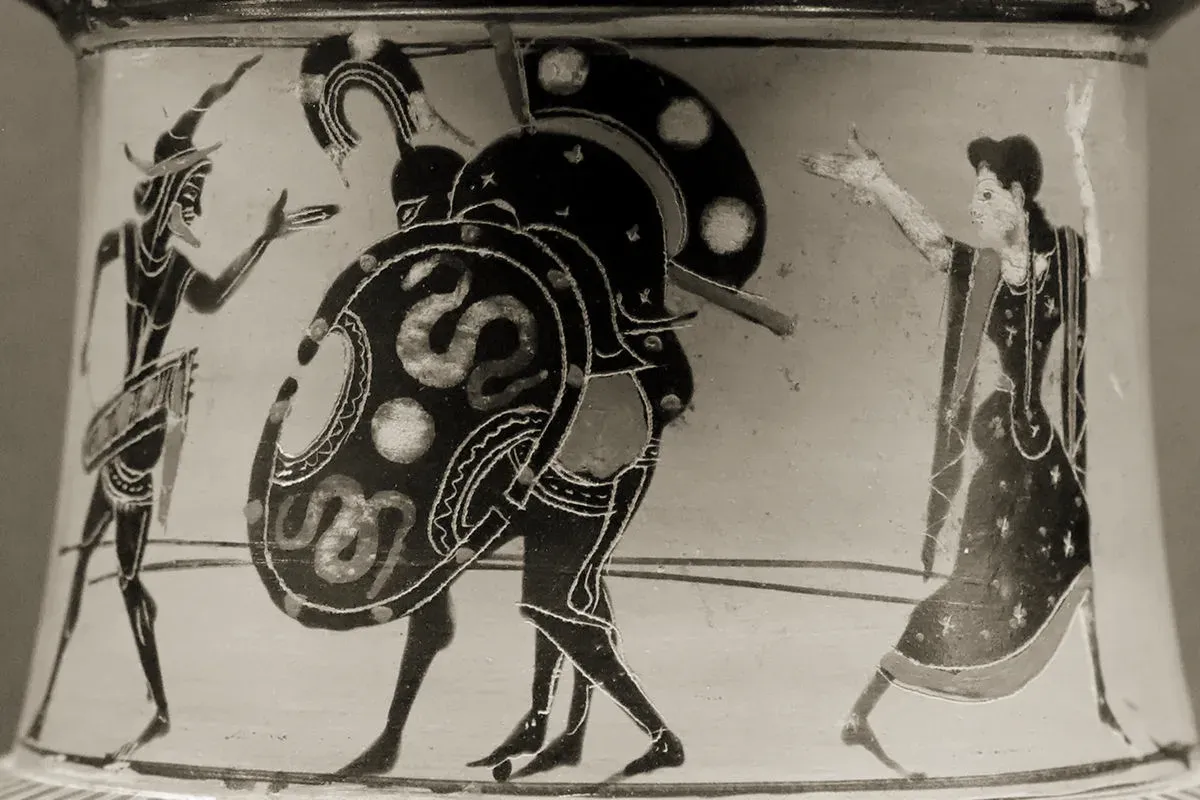
Ajax, son of Telamon, is the strongest Greek fighter at Troy after Achilles, and the biggest. Homer has him standing out among the Achaeans “by head and broad shoulders” (Iliad 3.227) and calls him “the bulwark of the Achaeans”. He is not clever and not a talker; what he does is hold the line when everyone else gives way. His fate, even so, turns on a vote. When the armour of Achilles is awarded to Odysseus rather than to him, Ajax goes mad and kills himself, and that ending, which Sophocles brought to the stage, made him the classic figure of wounded honour.
He should not be confused with his namesake Ajax son of Oileus, known as Ajax the Lesser, who is covered further down.
Son of Telamon, cousin of Achilles
Ajax is the son of Telamon, king of Salamis, and of Periboea, called Eriboea by some. Telamon is the brother of Peleus, which makes Ajax and Achilles first cousins, both grandsons of Aeacus, himself a son of Zeus. Through Hesione, a Trojan princess Telamon received from Heracles after an earlier sack of Troy, Ajax also has a half-brother, the archer Teucer, who shoots from behind his shield (8.266-272).
Pindar tells the story of his birth as an omen. Arriving to fetch Telamon for an expedition, Heracles prays that Zeus give his host a son “unbreakable in body, like this hide” — the skin of the Nemean Lion on his shoulders. Zeus answers with an eagle, aietos, and Heracles tells them to name the boy Aias (Isthmian 6.35-54).
The bulwark of the Achaeans
Salamis sends twelve ships, stationed, says the Catalogue of Ships, next to the Athenians (2.557-558). Ancient critics already suspected that line of being slipped in by Solon or Peisistratus to support Athens’ claim to the island.
Ajax’s weapon is a defensive one. His shield “like a tower”, seven ox-hides faced with bronze by the craftsman Tychius (7.219-223), is almost an antique inside the epic: a great body shield of the kind used in the Mycenaean age. Homer compares Ajax giving ground to a lion driven reluctantly from a cattle yard, and then to a stubborn donkey that will not leave a field until it has eaten its fill, however many sticks the boys break on its back (11.548-565).
The duel with Hector
In Book 7 Hector challenges the best of the Greeks to single combat. Nine commanders step forward, lots are drawn, and to the army’s delight the lot falls to Ajax (7.161-192). The fight goes his way: his spear punches through Hector’s shield and nicks his neck, and a huge boulder knocks him flat (7.244-272). The heralds call a halt at nightfall, and the two men part by exchanging gifts: Hector gives his silver-studded sword, Ajax his purple belt (7.303-305).
That courteous exchange turns tragic. It is on Hector’s sword that Ajax falls in Sophocles, and it was with Ajax’s belt, Teucer reminds us, that Achilles tied Hector to his chariot (Ajax 1028-1035). Ajax sums it up himself before he dies: “the gifts of enemies are no gifts” (Ajax 665).
Holding the ships, carrying the dead
Ajax is the man for the moments when everything gives. Sent with Odysseus and Phoenix on the embassy to Achilles in Book 9, he closes the scene with the shortest and bluntest speech: Achilles is pitiless, refusing seven women for the sake of one. Achilles concedes all the same that Ajax has spoken “after my own heart” (9.622-655).
In Book 15, with the Trojans at the fleet, Ajax strides from deck to deck with a long boarding pike and all but single-handedly drives off the men bringing fire (15.674-746). In Book 16, worn out, he watches Hector lop the head off his spear, understands that the gods are against him and falls back, and the first ship goes up in flames (16.101-123). That fire is what makes Achilles send Patroclus into battle.
In Book 17 he stands over Patroclus’s body with Menelaus. At the funeral games his wrestling match with Odysseus ends in a draw declared by Achilles (23.700-739), so the Iliad is already setting strength against cunning. After Achilles is killed, in the lost Aethiopis, it is Ajax again who carries the body out of the fighting while Odysseus holds off the Trojans.
The contest for the armour
When Achilles dies, Thetis offers her son’s armour, made by Hephaestus, to the bravest of the Greeks. Ajax and Odysseus both claim it. The sources disagree about how the choice was made:
- the Odyssey says the judges were “the sons of the Trojans and Pallas Athena” (11.547);
- the Little Iliad, according to an ancient commentator, had Greek scouts overhear Trojan girls arguing over which hero had done more, with one of them, prompted by Athena, deciding for Odysseus;
- Pindar speaks of a secret ballot among the Greeks, swayed by deceitful words (Nemean 8.23-34);
- Ovid stages the two men’s speeches before the assembled army (Metamorphoses 13.1-398).
All agree on the result: the armour goes to Odysseus. Pindar is the harshest. Odysseus’s fame, he writes, outstrips what he actually did, thanks to Homer’s “sweet words”, while Ajax, the strongest after Achilles, ended on his own sword (Nemean 7.20-30).
Madness and death: Sophocles’ Ajax
In Sophocles’ tragedy, Ajax means to take revenge that same night on the sons of Atreus and Odysseus. Athena sends him astray: he slaughters the camp’s livestock, taking them for his enemies, and drags a ram into his hut to flog it, thinking it is Odysseus. When his mind clears, he sees the full disgrace. His partner Tecmessa, a Phrygian captive, begs him to live for her and their son Eurysaces. He pretends to accept his lot, then goes alone to the shore, fixes Hector’s sword point-up in the sand and throws himself on it. It is one of the very few suicides shown on the Greek tragic stage.
The second half of the play is a fight over his body. Menelaus and then Agamemnon forbid its burial; Teucer defies them. In the end it is Odysseus, the enemy, who talks Agamemnon into letting Ajax be buried, on a simple principle: hatred should not follow a man past death.
The ghost who says nothing
Ajax’s most famous scene has no words in it. In Odyssey 11, Odysseus, come to consult the dead, sees the ghost of Ajax standing apart, still angry. He speaks to it kindly and says he wishes he had never won the armour that cost such a man his life. Ajax does not answer; he turns and goes off into Erebus with the other dead (11.543-564). The treatise On the Sublime cites that silence as greater than any speech (9.2).
Ajax the Lesser, son of Oileus
Homer knows two Ajaxes, paired so often in battle that he refers to them together in the grammatical dual, “the two Aiantes”. The second, son of Oileus, leads the Locrians. Short and wearing a linen corselet, he still outdoes every Greek with the spear and is beaten in a race only by Achilles (2.527-535). At Patroclus’s funeral games, Athena makes him slip in the dung of the sacrificed cattle in the middle of the footrace (23.773-784).
His crime seals his fate. On the night Troy falls, he tears Cassandra away from the statue of Athena where she has taken refuge, and the statue, it was said, turned its eyes away (Apollodorus, Epitome 5.22). On the voyage home Athena wrecks his fleet; Poseidon lets him reach a rock, then splits it with his trident when Ajax boasts that he has escaped the sea in spite of the gods. Proteus tells the story to Menelaus (Odyssey 4.499-511). For centuries the Locrians atoned for his sacrilege by sending young women to serve Athena’s sanctuary at Ilion (Apollodorus, Epitome 6.20-22).
Worship and legacy
Ajax was honoured as the protecting hero of Salamis, where a festival, the Aianteia, was held for him. Cleisthenes made him the namesake of one of Athens’ ten tribes, the Aiantis; according to Herodotus he was the only hero chosen from outside Attica, “as a neighbour and ally” (5.66). Before the battle of Salamis in 480 BC, the Greeks called on Ajax and Telamon for help (8.64).
Pausanias reports that when Ajax died, a white flower tinged with red sprang up on Salamis, bearing the letters of his name (1.35.4). Ovid makes it a hyacinth marked AI, letters that are both the hero’s initials and the cry of mourning (Metamorphoses 13.394-398).
Further reading
For the cousin whose armour he claims, see Achilles; for the rival who wins it, Odysseus. For the opponent of Book 7 and the fatal sword, see Hector. For the companion whose body he defends, see Patroclus, and for the wider conflict, the Trojan War. For the princess attacked by Ajax the Lesser, see Cassandra, and for the silent meeting among the dead, the Odyssey.
Ancient sources
- Homer, Iliad, 2.557-558; 3.225-229; 7.161-312; 9.622-655; 15.674-746; 16.101-123; 23.700-739
- Homer, Odyssey, 11.541-567
- Proclus, Chrestomathy (summaries of the Aethiopis, Little Iliad and Sack of Ilion)
- Pindar, Isthmian 6.35-54; Nemean 7.20-30 and 8.23-34
- Sophocles, Ajax
- Ovid, Metamorphoses, 13.1-398
- Apollodorus, Library, 3.12.7; Epitome 5.6-7 and 5.22; 6.6 and 6.20-22
- Herodotus, Histories, 5.66 and 8.64; Pausanias, Description of Greece, 1.35.2-5
See also
Stories featuring this entity
Frequently asked questions
Why did Ajax kill himself?
Because he had been dishonoured twice over. The armour of Achilles, meant for the bravest of the Greeks, went to Odysseus. In Sophocles' play Ajax sets out that night to kill the sons of Atreus and Odysseus, but Athena clouds his mind and he butchers the army's livestock, believing he is slaughtering his enemies. When he comes to his senses, the humiliation is unbearable: he fixes in the ground the sword Hector gave him and falls on it.
Who were the two Ajaxes?
Two different heroes who often fight side by side at Troy, so often that Homer refers to them as a pair. Ajax the Great, son of Telamon of Salamis, is a towering defensive fighter, cousin of Achilles, who kills himself after losing the contest for the armour. Ajax the Lesser, son of Oileus, leads the Locrians: short, fast and deadly with a spear, he drags Cassandra from Athena's statue during the sack of Troy and is drowned by Poseidon on the way home.
Why is Ajax silent in the Underworld?
Because he has not forgiven Odysseus. In Odyssey 11, the ghost of Ajax keeps apart from the other dead, still angry over the armour. Odysseus speaks to him gently and says he wishes he had never won the prize. Ajax says nothing and walks off into Erebus. The ancient treatise On the Sublime singles out that silence as more eloquent than any speech Homer could have written for him.