Greek mythology · Heroes & mortals
Patroclus, the companion of Achilles whose death turns the Iliad
In brief
Patroclus in the Iliad: the exile raised at Phthia, the borrowed armour, his death below the walls of Troy, and the long-argued bond with Achilles.
- heroic friendship
- counsel and restraint
- devotion in battle
- the borrowed armour of Achilles
- +2
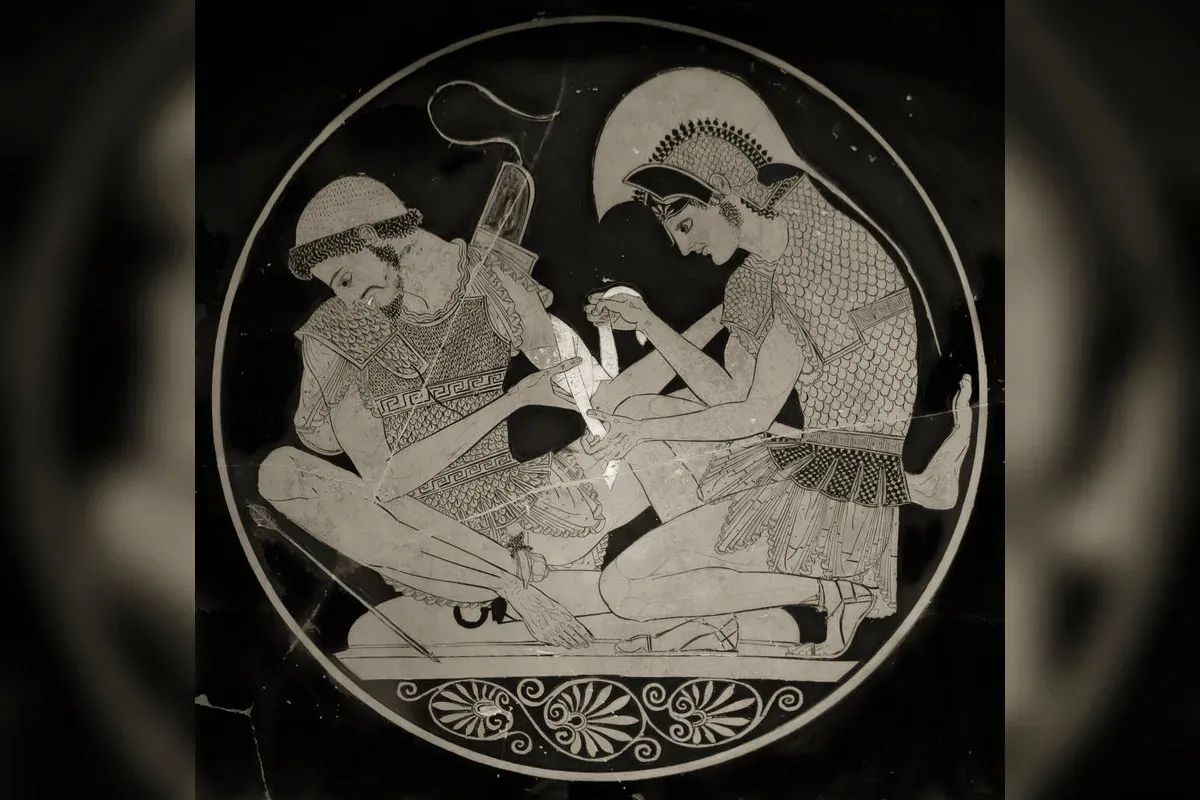
Patroclus is the companion of Achilles, and the character whose death turns the Iliad around. He has no kingdom, no prophecy and no divine parent: he is an exile taken in by the house of Peleus. Yet the poem pivots on him — while he lives, Achilles stays in his hut and the Greeks lose; the moment he dies, Achilles goes back to the field and Troy is doomed. Book 16, traditionally called the Patrocleia, follows his brief return to battle and his death.
A child who killed, and was taken in at Phthia
Patroclus’s origin is a criminal matter, and Homer saves it for late in the poem.
In book 23 his ghost comes to demand burial and reminds Achilles of what he already knows: as a boy at Opous in Locris, he killed the son of Amphidamas “foolishly, not meaning it, in anger over a game of knucklebones”. His father Menoetius brought him to Phthia, where Peleus received him, raised him and made him therapon to Achilles — a squire of honour, lower in rank but undiminished in dignity (23.83-90).
That status defines the man. Patroclus belongs to the household without being its heir; he shares Achilles’ hut, his horses and his table, but owns nothing of his own. His loyalty is not one option among several — it is the shape of his life.
A second detail, dropped by Nestor in book 11, upends the usual picture. Patroclus is the elder of the two. When they left for Troy, Menoetius gave him his instructions: Achilles is the stronger and the better born, but “you are the older man” — so speak wisely to him and guide him, and he will listen for his own good (11.786-789). The companion is not an admiring junior; he holds a mandate to restrain.
Nestor’s idea, and a shared mistake
By book 11 the Greek position is desperate. Achilles, still withdrawn since the quarrel with Agamemnon, sends Patroclus over to Nestor for news. The old king of Pylos detains him, lists the wounded, then floats the idea that decides everything: if Achilles will not fight, let him lend you his armour — the Trojans will take you for him and fall back.
Patroclus leaves with that idea in his head. On the way he stops to treat the wounded Eurypylus, a detail the poem lingers on: he is the only front-rank hero we watch dress a wound.
In book 16 he comes before Achilles in tears, and Homer gives him one of the gentlest similes in the epic: his tears run “like a dark spring that pours its black water down a sheer rock face” (16.2-4). Achilles opens with a jibe — are you crying like a little girl? — then gives way. He hands over the armour, the horses and the Myrmidons, with a hard condition: push the Trojans off the ships, then come back. Do not march on Troy; it would diminish Achilles’ own honour and expose Patroclus to Apollo.
The fault here is shared, and the poem does not excuse it. Achilles sends out a man who lacks his strength, in armour that marks him as a target, while keeping back the ash spear from Pelion — the one weapon Patroclus cannot lift.
The Patrocleia: a brief glory
Book 16 is among the longest and most violent in the Iliad, and its shape is a steep rise followed by a sheer drop.
Patroclus and the Myrmidons sweep the Trojans off the ships and put out the fire. Then he kills, and keeps killing; the poem lists the names. The summit is his duel with Sarpedon, son of Zeus and king of the Lycians. Before the blow lands, Zeus openly considers rescuing his son, and Hera talks him out of it with a formidable argument: lift your son out of his fated death, and every god will want the same for theirs. Zeus consents and rains drops of blood on the earth (16.431-461). No scene states the limits of Homeric divine power more sharply.
After Sarpedon, Patroclus forgets his orders. He drives on to the walls of Troy and three times scales the angle of the rampart. Three times Apollo shoves him back. At the fourth the god shouts at him to give way: it is not fated that this city fall to your spear — nor even to Achilles’.
Three blows and a death
Homer breaks the killing into stages with a precision that amounts to a verdict.
First Apollo, wrapped in mist, strikes him flat-handed between the shoulders. The helmet of Achilles rolls in the dust — something that had never happened before — the long spear shatters, the shield drops, the corselet falls open. The god does not kill him: he disarms him, literally and symbolically.
Then the Dardanian Euphorbus spears him in the back and runs off without daring to finish the job.
Only then does Hector, seeing a man already stripped and stunned giving ground, close in and drive his spear through his belly.
Homer therefore denies Hector a whole victory, and the dying Patroclus tells him so: it was Zeus and Apollo who killed me; of men, Euphorbus struck first, and you are only the third. Then he prophesies in turn — you will not live long, death stands beside you already, at the hand of Achilles. That ranking governs the rest of the poem: Hector dies paying a debt, not losing a fair fight.
The grief of Achilles
What follows is the central event of the Iliad. Antilochus brings the news; Achilles pours ash over his head, stretches out in the dust, and lets out a cry that Thetis hears at the bottom of the sea.
The consequence is immediate and paradoxical. Achilles knows from his mother that killing Hector condemns him to die soon after, and he does not hesitate. The wrath against Agamemnon that has filled fifteen books is dismissed in a sentence: let strife perish. He returns to battle not out of loyalty to the army or hunger for honour, but because he cannot bear having outlived Patroclus.
Hephaestus forges new armour, the old set having been stripped from the body. Then come the funeral rites of book 23: the pyre, the twelve Trojan captives with their throats cut — the single worst atrocity in the poem — and the funeral games, nearly seven hundred lines of them, which finally give the army back some form of civil peace.
Patroclus’s last request is a line antiquity quoted often: that their bones should not lie apart, but be gathered into the same golden urn. The Odyssey confirms that it was done (24.76-86).
Lovers or comrades: an ancient argument
This is the question most often asked about Patroclus, and it deserves an accurate answer rather than a slogan.
Homer never describes the relationship as erotic. His vocabulary is that of the hetairos, the companion, and the therapon, the squire of honour. The intensity is extreme — Achilles says he could not have grieved more at news of his own father’s death — but the language remains that of heroic friendship, and book 9 shows the two men sleeping with a woman each in the same shelter.
The erotic reading is Athenian, and it surfaces in the fifth century. Aeschylus, in the lost Myrmidons, staged an Achilles who mourns Patroclus in frankly physical terms (frr. 135-136 Radt).
Plato disputes the casting rather than the relationship. In the Symposium (179e-180b) Phaedrus objects that Aeschylus “talks nonsense”: since Achilles is the younger and more beautiful, he must be the beloved and Patroclus the lover — which, he adds, makes Achilles’ sacrifice the more admirable, a beloved dying for his lover being rarer than the reverse. The debate is about the social grammar of Athenian paiderasteia, a category that does not exist in the Homeric world at all.
Xenophon, in his own Symposium (8.31), rules the other way: Homer shows them joined by a friendship with nothing carnal in it.
The honest position is this. The question was asked in antiquity, and the answer already depended on when the asker lived. Assigning either reading to Homer himself is an anachronism, in whichever direction it runs.
Alexander, Hephaestion and after
The pairing outlived the poems as a model. Passing through the Troad in 334 BC, Alexander the Great laid a wreath on the tomb of Achilles while Hephaestion laid one on the tomb of Patroclus — a piece of political staging his contemporaries read without difficulty (Arrian 1.12.1; Plutarch, Alexander 15).
In modern fiction the figure has come back strongly through retellings of the Iliad from a secondary character’s point of view, most prominently Madeline Miller’s The Song of Achilles (2011), which adopts the Aeschylean reading. Such books prove nothing about Homer, but they do show what structural place Patroclus holds: he is the only character through whom Achilles can be seen close up.
Further reading
For the hero he shadows, and whose death follows from his own, see Achilles. For the enemy who finishes him and pays for it, see Hector, and for the wider conflict, the Trojan War. For the king whose insult keeps Achilles out of the fighting and makes the whole expedition necessary, see Agamemnon. For the foster father who took him in at Phthia, see Peleus; for the goddess who has the lost armour remade, Thetis. For the god who disarms him before letting him die, see Apollo.
Ancient sources
- Homer, Iliad, 11.596-848; 16 (the Patrocleia); 17; 18.22-147; 23.1-257
- Homer, Odyssey, 24.76-86
- Aeschylus, Myrmidons (fragments 135-137 Radt)
- Plato, Symposium, 179e-180b
- Xenophon, Symposium, 8.31
- Apollodorus, Library, 3.13.8; Epitome 4.6
- Arrian, Anabasis, 1.12.1; Plutarch, Life of Alexander, 15
See also
Stories featuring this entity
Frequently asked questions
Why does Patroclus wear the armour of Achilles?
Because the Trojans have reached the ships and the Greeks are about to lose the war. Achilles still refuses to fight, but lets Patroclus put on his armour so the Trojans will think he has returned — with one strict condition: drive them back from the ships, then come away. Patroclus disobeys and pursues to the walls of Troy, and the disobedience kills him.
Who actually kills Patroclus?
Three blows in sequence, and the sequence is the point. Apollo, unseen, strikes him between the shoulders: the helmet rolls away, the spear splinters, the corselet comes loose. The Trojan Euphorbus then spears him in the back and runs. Hector merely finishes a man already disarmed and dazed, with a thrust to the belly. Homer denies Hector a clean victory — which is what makes Hector's own death read as a debt falling due.
Were Achilles and Patroclus lovers?
Homer never says so: he calls them hetairoi, companions, and makes Patroclus the therapon or squire of Achilles. The erotic reading is Athenian and later. Aeschylus, in the lost Myrmidons, staged them as lovers with Achilles in the senior role; Plato's Symposium corrects Aeschylus by making the older Patroclus the lover and Achilles the beloved; Xenophon denies any such relation. The argument is ancient, and it was never settled.