Greek mythology · Creatures
Orthrus, the two-headed dog of Geryon in Greek mythology
In brief
Orthrus, called Orthos by Hesiod, is the two-headed watchdog of the giant Geryon in Greek mythology. A son of Typhon and Echidna and the elder brother of Cerberus, he guarded Geryon's red cattle on the far-western island of Erytheia with the herdsman Eurytion until Heracles killed him during his tenth labor.
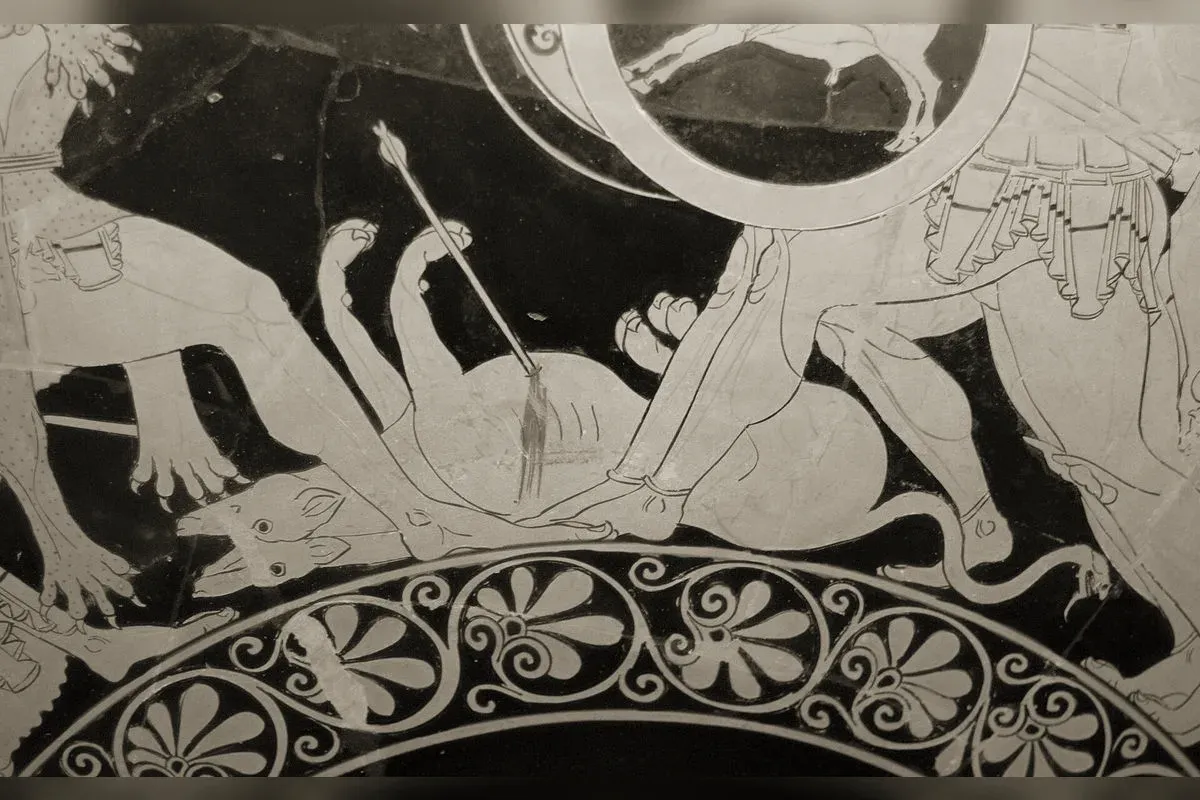
Orthrus (also spelled Orthros, and Orthos in Hesiod) is the two-headed watchdog of the giant Geryon in Greek mythology. A son of Typhon and Echidna, he guarded Geryon’s red cattle on the island of Erytheia, at the western edge of the world, alongside the herdsman Eurytion, until Heracles came to steal the herd and killed him. Orthrus appears in only a few lines of ancient text, but those lines put him at the center of the monster family: he is the firstborn brother of Cerberus and, in Hesiod, the father of the Sphinx.
A herd dog at the end of the world
Orthrus exists only in relation to his master. Geryon, son of Chrysaor and the Oceanid Callirrhoe, is a giant with three bodies who owns a herd of red cattle. The herd grazes on Erytheia, “the red island”, beyond the river Ocean where the sun goes down. Two guards watch it: a man, the herdsman Eurytion, and a dog, Orthrus.
That pairing matters. Orthrus is not a wild monster like the Hydra in her swamp or the Chimera roaming Lycia. He is a working dog, a sheepdog scaled up to fit a divine herd. His monstrous nature serves the rules of property: he protects wealth that the hero is meant to take.
Ancient writers argued over where Erytheia lay. Stesichorus, as quoted by Strabo (Geography, 3.2.11), puts it almost opposite Tartessos, near the springs of the Tartessos river in southern Spain. Herodotus (4.8) and Apollodorus place it near Gadeira, modern Cádiz, beyond the Pillars of Heracles. Geryon’s dog guards the last inhabited land before Ocean.
Family tree: the eldest of the monsters
Hesiod introduces Orthos in the great catalogue of monsters in the Theogony. Typhaon (another name for Typhon) mates with Echidna, and she “first bore Orthos, the hound for Geryon” (306-309). Next comes Cerberus, “the hound of Hades”, whom Hesiod gives fifty heads (310-312), and then the Lernaean Hydra.
The order is telling. The couple’s first two children are both guard dogs: one keeps a herd at the western edge of the world, the other keeps the door of the dead. Hesiod draws no comparison, but his list sets the two side by side.
Who is “she”? Theogony 326-327
A few lines later, Orthrus becomes a father: “she, overpowered by Orthos, bore the deadly Phix, ruin of the Cadmeans, and the Nemean lion”. Phix is the Boeotian name of the Sphinx of Thebes.
The problem is the pronoun. “She” can be Echidna, the subject of the whole passage, which would make Orthrus his own mother’s mate. It can also be the Chimera, named just before. Ancient and modern readers have never settled the question. The text makes Orthrus the father but leaves the mother unclear, which is why no mate is listed for him here.
Later mythographers often take the simpler route and make the Sphinx and the Nemean lion direct children of Typhon and Echidna, writing Orthrus out of the family. The Sphinx page on this site gives both versions.
Death on Erytheia: the tenth labor
Orthrus does only one thing in the myths, and that is die. Eurystheus sends Heracles to fetch Geryon’s cattle, the tenth of the Labors of Heracles in Apollodorus’ sequence.
Hesiod: two lines and a dark stable
The Theogony compresses the story into a single sentence. Heracles killed Geryon beside his cattle on Erytheia, after crossing Ocean and slaying Orthos and the herdsman Eurytion “in the misty stable beyond glorious Ocean” (293-294). The adjective ēeroeis, “misty, murky”, is the word Hesiod also uses for Tartarus. Geryon’s farm already lies in twilight.
Apollodorus: one blow of the club
The Library (2.5.10) gives the fullest account. Heracles crosses Europe and Libya and sets up two pillars on either side of the strait. Scorched by the Sun on the way, he aims his bow at the god. Helios admires his nerve and lends him the golden cup in which he sails across Ocean.
On Erytheia, Heracles camps on Mount Abas. The dog scents him and charges, and Heracles kills it with his club. Eurytion comes to help the dog and dies the same way. Menoetes, who is grazing the cattle of Hades nearby, runs to warn Geryon, who catches the thief by the river Anthemus and is shot down with an arrow.
Apollodorus is also the one who calls Orthrus two-headed and names Typhon and Echidna as his parents. The victims fall in the same order as the guards: first the dog, then the herdsman, then the owner.
Stesichorus and the Geryoneis
In the sixth century BCE, the lyric poet Stesichorus wrote a long poem on the monster, the Geryoneis. Only fragments survive, most of them recovered from an Oxyrhynchus papyrus (P.Oxy. 2617). They focus on Geryon, whom the poet treats with surprising sympathy. What role the dog played in the lost sections cannot be reconstructed with any confidence.
The dog on painted vases
The Geryon episode is a favorite subject on Attic black-figure vases of the sixth century BCE. Painters often show the dog already down, sprawled between the fighters’ feet, sometimes pierced by arrows and frequently with two heads. On some pieces the tail appears to end in a snake’s head, a nod to Echidna, but this depends on the individual vase and should not be taken as the rule.
The gap with Apollodorus is worth noticing. The mythographer gives Heracles a club, while several painters prefer arrows, the weapon that kills Geryon. Texts and images each tell the story in their own way, and there is no need to force them into agreement.
Orthrus and Cerberus: two dogs at two edges of the world
Comparing the brothers shows what Orthrus is for:
| Orthrus | Cerberus | |
|---|---|---|
| Heads | unspecified in Hesiod, two in Apollodorus | fifty in Hesiod, three later |
| Guards | a herd on an island beyond Ocean | the gates of the Underworld |
| Master | Geryon | Hades |
| Meets Heracles | killed in the tenth labor | captured alive in the twelfth |
One detail in Apollodorus links the two episodes. Menoetes, the herdsman of Hades, appears on Erytheia and then again in the Underworld, where he challenges Heracles to a wrestling match during the capture of Cerberus (2.5.12). Hades keeps cattle right next to Geryon’s.
Many modern scholars read this as a clue. The far west, where the sun sets and where Hesiod also places the Gorgons and the Hesperides “toward Night” (Theogony 274-275), would be another version of the land of the dead. Seen this way, the raid on Geryon’s cattle becomes an earlier journey to the Underworld, and Orthrus an earlier Cerberus. The reading is attractive, but it is modern: no ancient text calls Erytheia the realm of the dead. It does, however, help explain why two brother dogs stand guard at both ends of Heracles’ labors.
What the ancient sources say
- Hesiod (Theogony 287-294, 306-310, 326-327) names Orthos, makes him the eldest child of Typhon and Echidna, has him killed with Eurytion “in the misty stable”, and gives him the Phix and the Nemean lion as offspring by an uncertain mother.
- Stesichorus (Geryoneis, fragments) tells the Geryon story at length; Strabo (3.2.11) quotes him on the location of Erytheia opposite Tartessos.
- Herodotus (4.8) places Erytheia near Gadeira, outside the Pillars of Heracles.
- Apollodorus (Library 2.5.10) gives the dog two heads, has Heracles club it before killing Eurytion and Geryon, and introduces Menoetes, herdsman of Hades.
- Attic black-figure pottery often shows a two-headed dog lying dead at Geryon’s feet.
Further reading
For the full expedition to Erytheia, read the Twelve Labors of Heracles and the profile of Heracles himself. For Orthrus’ family, see his parents Typhon and Echidna, and his siblings Cerberus, the Lernaean Hydra and the Chimera. For his possible offspring, read about the Sphinx of Thebes. For the wider picture, start from the Greek mythology hub.
Ancient sources
- Hesiod, Theogony, 287-294 (death of Orthos and Eurytion)
- Hesiod, Theogony, 306-310 and 326-327 (birth and offspring)
- Apollodorus, Library, 2.5.10
- Stesichorus, Geryoneis (papyrus fragments, P.Oxy. 2617)
- Strabo, Geography, 3.2.11 (quoting Stesichorus on Erytheia)
- Herodotus, Histories, 4.8
See also
Frequently asked questions
Is Orthrus the same as Cerberus?
No. They are brothers, both born of Typhon and Echidna, and Hesiod names Orthrus first. Orthrus guards Geryon's cattle in the far west and is killed by Heracles; Cerberus guards the gates of the Underworld and is captured alive. Popular culture often blends them because both are many-headed guard dogs.
Why is the name spelled Orthrus, Orthros and Orthos?
All three go back to antiquity. Hesiod's Theogony has Orthos; Apollodorus' Library has Orthros; Orthrus is the Latinized form found in most English translations. They all refer to the same dog.
Did Orthrus father the Sphinx?
Hesiod says so, with a catch. In the Theogony, 'she', mated with Orthos, bore the Phix (the Theban Sphinx) and the Nemean lion. The pronoun may mean Echidna or the Chimera, so the mother is uncertain, but the father is Orthrus. Later mythographers often skip him and make the Sphinx a direct child of Typhon and Echidna.