Greek mythology · Gods & goddesses
Themis, Greek goddess of divine law and order
In brief
Themis, the Titaness of divine law: mother of the Horae and the Fates, keeper of Delphi before Apollo, and the prophecy that saved Zeus's throne.
- divine law and custom
- order of assemblies
- oracles and prophecy
- oaths and social good order
- +3
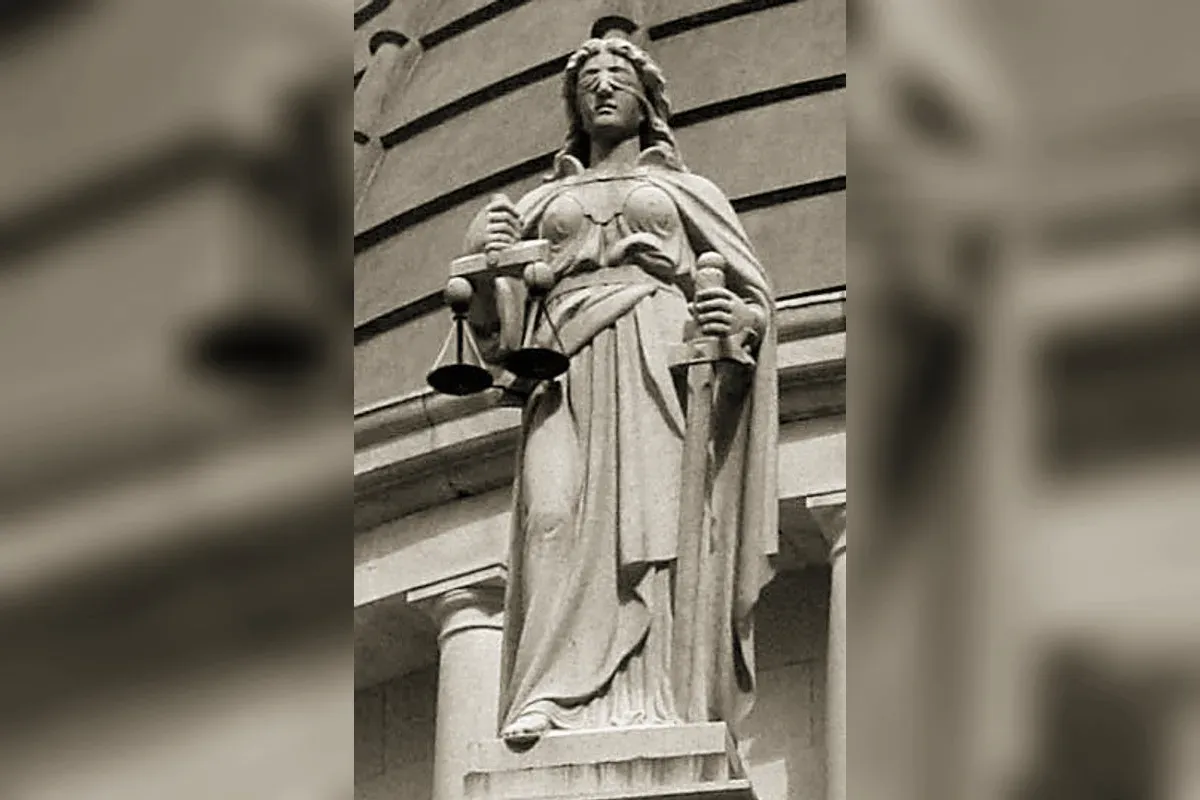
Themis is the Titaness of divine law: not justice as it gets delivered, but the rule that exists before anyone delivers it. Daughter of Uranus and Gaia, she belongs to the generation the Olympians defeated — and yet she comes through the revolution undeposed, because Zeus’s power needs her in order to be something other than force. She is the one Titaness who sits on Olympus as an adviser, holds the Delphic oracle before Apollo, and saves the king of the gods his throne by handing him a prophecy.
A legal word that became a goddess
Start with the vocabulary, because the whole figure follows from it.
Themis is not primarily a proper name. It is an ordinary Greek noun, built on tithēmi, “to set down.” A themis is what has been set down, established, instituted — the usage that binds without ever having been voted on. In the plural, Homer’s themistes are the rulings a king issues on that basis: the sceptre in his hand comes from Zeus, and the themistes come with the sceptre.
Three distinctions follow, and English flattens all of them into “law”:
- Themis is the unwritten norm of divine origin, older than any city;
- Dike, her daughter, is justice in action, the verdict in a specific case;
- Nomos is positive law, voted by an assembly of men and therefore amendable.
Break the nomos and you are an outlaw. Break Themis and you have done something ou themis — “not done,” literally unthinkable. The phrase recurs throughout Homer around hospitality, oaths, and the treatment of suppliants. Themis covers precisely the territory a modern reader would call unwritten public order.
Ancestry and place in the succession
Hesiod lists Themis among the children of Uranus and Gaia, alongside Rhea, Theia, Hyperion, Iapetus and Cronus (Theogony 132-136). She is therefore sister to the Titans who fight Zeus in the Titanomachy.
She takes no visible side in that war, and her fate afterwards proves the point: instead of being flung into Tartarus, she marries the winner. Hesiod puts the union second in the catalogue of Zeus’s wives, directly after Metis and before Mnemosyne. The order is not casual: Zeus absorbs cunning first, then law, then memory. It is a programme of government disguised as a marriage list.
The key passage is Theogony 901-906. Themis bears Zeus two triads:
- the Horae — Eunomia, lawful good order, Dike, justice, and Eirene, peace — “who watch over the works of mortal men”;
- the Moirai — Clotho, Lachesis and Atropos — “who give mortals their share of good and ill.”
The first triad states what a well-run state is for; the second, that even a well-run state does not decide everything. Hesiod has already given the Moirai to Nyx at line 217 and never reconciles the two claims: the doublet marks two rival theologies of fate, one primordial and out of reach, one folded into the reign of Zeus. Themis is exactly the hinge on which the second wins.
Marshal of the gods
Homer almost never makes Themis an agent, and that is the revealing part: he makes her a function.
In Iliad 20, when Zeus decides to release the gods to fight in the battle again, it is Themis he sends to summon the assembly from the peaks of Olympus. In Iliad 15, when Hera returns furious from an interview with Zeus, Themis is the first to meet her, offer the cup, and ask what has happened. In the Odyssey, Telemachus invokes “Themis, who dissolves and convenes the assemblies of men.”
Three appearances, one role: she is the one who opens proceedings. Where Nemesis — with whom Attic cult pairs her closely — punishes after the fact, Themis acts upstream, at the moment public speech is brought into order. She is a goddess of procedure, not of retribution. In no surviving myth does she punish anybody.
Delphi before Apollo
The richest tradition about Themis is oracular rather than genealogical.
Aeschylus opens the Eumenides with the Pythia reciting the succession of owners of the sanctuary: first Gaia, Earth; then Themis, her daughter, who receives the oracle without violence; then Phoebe, another Titaness, who passes it to Apollo as a birthday gift. Four holders, no war: Aeschylus stresses that every transfer was willing.
The version has an agenda. The rival legend — Apollo killing the serpent Python — makes the founding of Delphi a conquest. Aeschylus proposes the opposite: an orderly handover in which the Olympian inherits an ancient right rather than seizing it. Themis is exactly where she belongs in that account. She is what makes a succession legitimate.
The iconography suggests Greeks took it seriously. On a famous Attic cup by the Codrus Painter (c. 440-430 BC, now in Berlin), Themis sits on the Delphic tripod, libation bowl in one hand and branch in the other, delivering an oracle to King Aegeus of Athens. That is a portrait of a prophetess, not a magistrate.
The prophecy that saved Zeus’s throne
The most consequential myth Themis takes part in does not carry her name.
Zeus and Poseidon both want the Nereid Thetis. In Isthmian 8, Pindar has Themis speak up in full divine assembly: Thetis is fated to bear a son stronger than his father. Whichever brother takes her fathers his own deposer — precisely the pattern that finished Uranus and then Cronus. Themis therefore advises marrying her to a mortal, Peleus, “most pious of men.” From that marriage comes Achilles: greater than his father, but mortal, and therefore no threat to Olympus.
This is the keystone of the whole Greek mythology of sovereignty. The chain of overthrows stops there — and it stops because a goddess of law spoke in time.
Aeschylus gives the same idea another shape in Prometheus Bound: Prometheus declares that his mother is “Themis, or Gaia, one form with many names,” and that it is from her that he holds the secret capable of unseating Zeus. The two versions converge. Dangerous knowledge about the future of power always belongs to Themis, and Zeus’s reign depends on her discretion.
After the flood
One last scene, this time Latin, shows how long her oracle kept its prestige. In Ovid (Metamorphoses 1.377-394), Deucalion and Pyrrha, the only survivors of the flood, climb to the shrine of Themis, then moss-grown with no fire on its altars. The goddess orders them to throw “their great mother’s bones” behind them. Pyrrha refuses at first, appalled at the thought of profaning her mother’s shade; Deucalion works out that the bones are the stones of the Earth. The stones they throw become men and women.
The oracle is deliberately obscure, and that is the point: Themis states a true rule in a form that has to be decoded. The repopulation of the world rests on a correct interpretation.
Cult and the afterlife of an image
Themis never had Olympian-scale worship, but she is not an abstraction without an altar. Pausanias records a sanctuary of Themis at Athens on the south slope of the Acropolis, next to the tomb of Hippolytus; the Attic site of Rhamnous pairs her closely with Nemesis in a small archaic temple. Rhamnous produced her best-known statue, carved by Chairestratos around 300 BC and now in the National Archaeological Museum in Athens: a standing draped woman, with no scales and no blindfold.
The slide into the modern allegory of Justice is Roman and then medieval. Roman Justitia inherits the imagery of weighing. The blindfold appears only in the late Middle Ages, first as satire against judges who could not see, later flipped into praise of impartiality. Attaching that blindfold to Themis projects fifteen centuries of European legal history onto a Titaness whose other speciality, in Greece, was seeing what had not happened yet.
Ancient sources
- Hesiod, Theogony, 132-136; 901-906
- Homer, Iliad, 15.87-95; 20.4-6
- Homer, Odyssey, 2.68-69
- Aeschylus, Eumenides, 1-8
- Aeschylus, Prometheus Bound, 209-218
- Pindar, Isthmian 8.26-47
- Ovid, Metamorphoses, 1.377-394
- Pausanias, Description of Greece, 1.22.1; 10.5.6
See also
Frequently asked questions
Who is Themis in Greek mythology?
Themis is a Titaness, daughter of Uranus and Gaia, who personifies divine law — not the written statutes of a city but the settled rule that exists before any human legislation. In Hesiod she becomes Zeus's second wife and bears him the Horae and the Moirai. In Homer she is the one who opens and closes the assemblies of gods and men alike.
What is the difference between Themis and Dike?
Themis is law as the divine order lays it down; Dike, her daughter, is justice as delivered in a particular verdict. A city can have laws that conform to Themis and still hand down judgements that offend Dike. Greeks kept both terms distinct from nomos, the statute voted by human beings, which is later and repealable.
Is Themis the blindfolded goddess of justice?
No — the blindfold is a late medieval European addition, first a satire on judges who could not see and only later a compliment about impartiality. Roman Justitia supplied the scales and sword. In Greek art Themis usually appears seated on the Delphic tripod as a prophetess, holding a libation bowl and a branch, with nothing over her eyes.