Greek mythology · Gods & goddesses
Metis, Greek goddess of cunning and first wife of Zeus
In brief
Metis, Oceanid of cunning intelligence: the drug that freed the Olympians, why Zeus swallowed her, and how Athena was born from his split skull.
- cunning intelligence
- counsel and stratagem
- political prudence
- shape-shifting
- +2
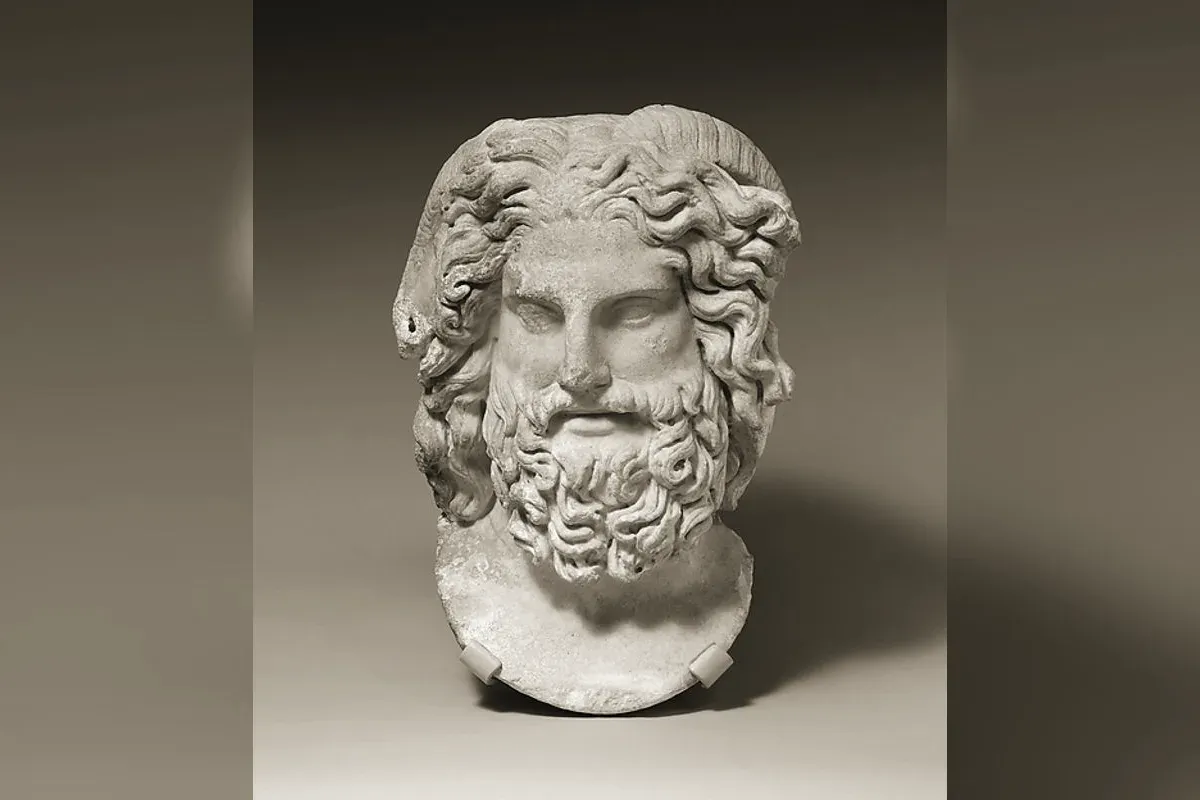
Metis is the goddess of cunning intelligence and the first wife of Zeus. Her myth fits into one blunt sentence — Zeus swallowed her while she was pregnant — but that sentence closes the entire cycle of divine overthrows and explains why Athena is born from a skull. Metis is the one Greek deity whose fate is to be absorbed rather than defeated, and that is what makes her central to the Greek theology of power.
The word before the goddess
Like Themis and Mnemosyne, Metis begins as a noun.
Mētis is intelligence applied to shifting situations: the helmsman reading the sea, the wrestler reversing a hold, the physician facing an unfamiliar case, the craftsman improvising. It stands opposed term by term to biē, force, and is distinct from sophia, stable knowledge. It is an oblique intelligence that wins by deflection rather than by crushing.
Epic vocabulary is saturated with it. Zeus is mētieta, “the deviser”; Odysseus is polymētis, “of many devices”; Prometheus is ankylomētēs, “of crooked counsel.” The myth of Metis is, in a single image, the story of how that quality changes owner.
An Oceanid, not a first-generation Titaness
Hesiod lists Metis among the daughters of Oceanus and Tethys (Theogony 358), one of the three thousand Oceanids. The genealogy matters: Metis does not belong to Cronus’s sibling group but to the next generation, the children of the Titans. She is therefore Zeus’s contemporary rather than his elder, and she first appears as his ally.
The drug that emptied Cronus
Metis’s first act is an act of pharmacy.
Cronus has swallowed his children one by one as Rhea bore them. Zeus, saved by the swaddled stone, returns as an adult to free them. In Apollodorus (Library 1.2.1) it is Metis who supplies the means: she prepares a pharmakon, a drug, which Zeus gets his father to drink and which forces him to vomit up the stone first, then Hestia, Demeter, Hera, Hades and Poseidon, alive and intact.
In other words: without Metis there is no Olympian army, and therefore no Titanomachy to win. Zeus’s victory begins with a pharmacist’s trick, not a thunderbolt. Some versions add that she disguised herself to get near Cronus — shape-shifting is the standard mode of sea deities, and Metis, daughter of Ocean, belongs to that family where changing form and changing tactic are the same move.
The prophecy and the swallowing
The decisive passage is Theogony 886-900, and it is built as a startling compression.
Zeus takes Metis as his first wife. She becomes pregnant. At that moment Gaia and Uranus disclose the future: Metis will bear first a daughter “equal to her father in strength and in counsel”; and then, in a second pregnancy, a son of overbearing spirit, destined to rule gods and men. That is word for word the succession formula — the one that already finished Uranus and then Cronus.
Zeus acts before the second child exists. Hesiod says he “deceived her with cunning words” and lodged her in his belly. The scholiast tradition supplies the trick: Zeus challenges her to shape-shift, she takes the form of a drop of water or a fly, and he swallows her. Cunning is defeated by cunning, which is the only correct way to defeat it.
The distance from Cronus is where the whole meaning sits. Cronus swallowed his children: he deferred the prophecy by one generation without cancelling it, and the children came back out. Zeus swallows the mother: he removes the source, not the symptoms. And he loses nothing, because, the poem says, Metis “remains within him and tells him what is good and what is harmful.” The king of the gods has not destroyed cunning intelligence — he has internalised it. After this episode the chain of overthrows stops for good.
It is also why Zeus carries the title of counsellor from then on: he consults nobody because the counsellor is inside.
The birth of Athena
The pregnancy continues inside the god, and its conclusion gives Greek art one of its most-copied images.
Zeus’s skull is opened — with an axe, by Hephaestus in the commonest version, by Prometheus in others — and Athena leaps out, adult and armed, with a war cry that shakes Olympus. The Homeric Hymn to Athena describes sky and sea halted, Helios reining in his horses until she lays down her weapons.
The scene is a theological manifesto in three points:
- Athena inherits exactly her mother’s domain — applied intelligence, strategy, skilled craft — but exercises it in the service of the Olympian order;
- she is born from the head, the seat of deliberation, and not from the belly: the myth substitutes an intellectual fatherhood for the motherhood it has just swallowed;
- she is the motherless daughter par excellence, which Aeschylus turns into an explicit legal argument in the Eumenides, when Athena votes for Orestes on the grounds that she “had no mother.”
That last point is best read for what it is: an operation. Metis is not absent from Hesiod’s account — she is where it starts. Later tradition is what erases her in order to make Athena a purely paternal product.
What the myth says about power
Metis never had a temple, a festival, or an identified cult statue. She belongs to that class of deities who are concepts before they are persons, and whose ritual existence is nil.
Her interest lies elsewhere: she supplies Greek myth with its theory of stable power. Power resting on force alone is reversible, and it was reversed twice. Power becomes irreversible when it absorbs cunning instead of fighting it. The historians of religion Marcel Detienne and Jean-Pierre Vernant made this the core of their study Cunning Intelligence in Greek Culture and Society (1974), which put the concept back at the centre of how archaic texts are read.
The rest of the pantheon can be read in that light: Athena the strategist, Hermes the skilled thief, Hephaestus trapping gods in an invisible net, Odysseus surviving by wit everything force cannot solve. All of them are, one way or another, heirs of Metis.
Ancient sources
- Hesiod, Theogony, 358; 886-900; 924-929
- Apollodorus, Library, 1.2.1; 1.3.6
- Homeric Hymn 28 (to Athena)
- Pindar, Olympian 7.35-38
- Scholia on Hesiod and Pindar for the swallowing of Metis
See also
Related entries
Stories featuring this entity
Frequently asked questions
Who is Metis in Greek mythology?
Metis is an Oceanid, daughter of Oceanus and Tethys, whom Hesiod calls 'wisest of gods and men.' She is the first wife of Zeus. Pregnant with Athena, she is swallowed by her husband after he learns she would go on to bear a son destined to overthrow him. She continues to live inside him and to tell him what is good and what is harmful.
Why did Zeus swallow Metis?
Because Gaia and Uranus warn him of a prophecy: Metis will bear first a daughter equal to her father in strength and judgement, and then a son who will rule gods and men. Cronus had swallowed his children to postpone the same prophecy; Zeus swallows the mother before the son exists. He does not repeat his father's mistake — he corrects it.
Is Metis the mother of Athena?
Yes, in Hesiod's version. Athena is conceived by Metis and then carried to term inside Zeus's body, from which she springs fully armed through his split skull. That is why the goddess is said to be born 'from Zeus alone' without her mother vanishing from the story: Athena inherits precisely her mother's domain, intelligence in action.